Argentina Glacier Painting Vanishes From Casa Rosada
A glacier painting vanished from Casa Rosada as Argentina loosened protections for glacial regions, turning a maintenance claim into a cultural flashpoint.
The painting’s disappearance matters because the timing is impossible to separate from policy
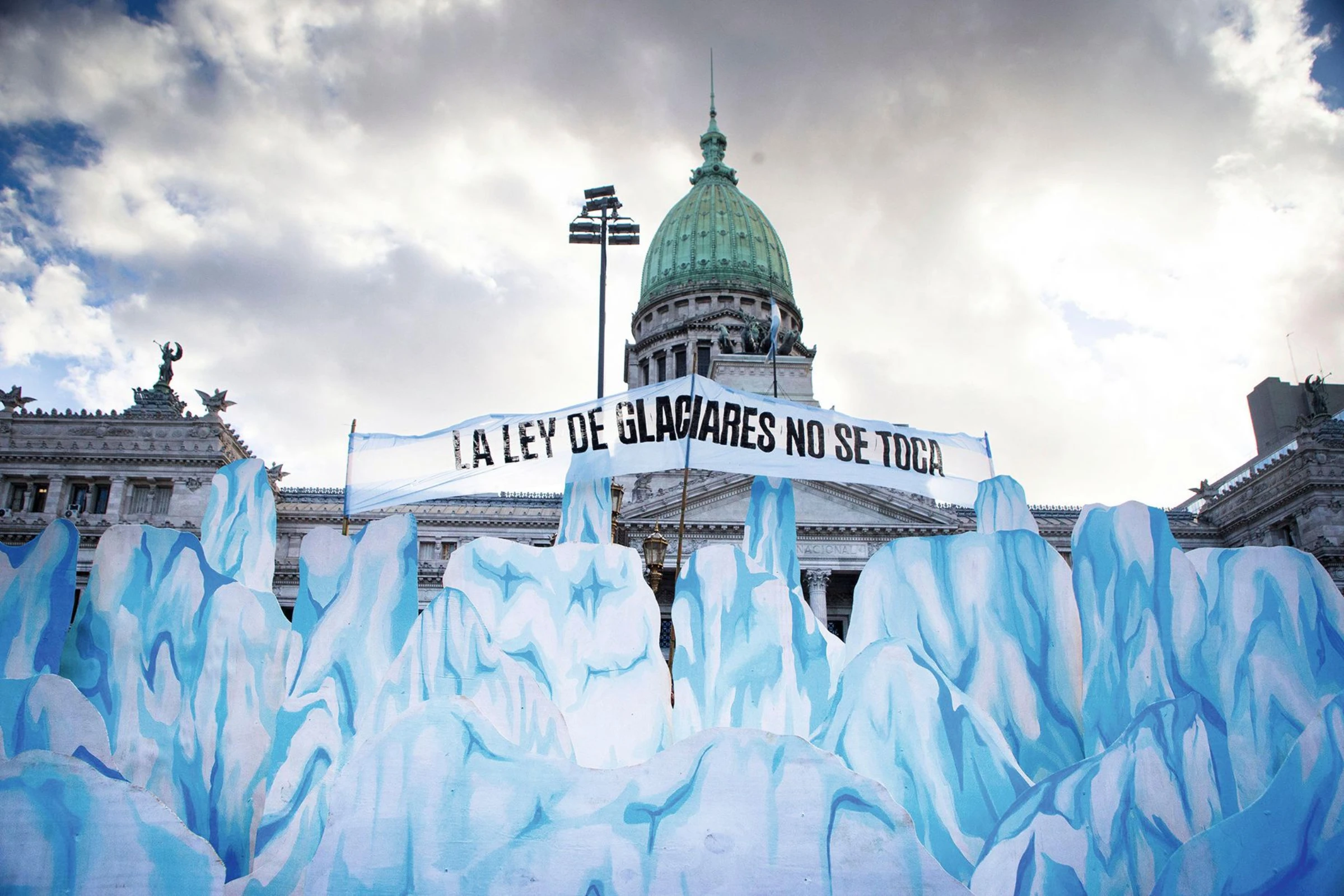
Helmut Ditsch’s monumental painting The Triumph of Nature did not quietly rotate out of view in a neutral administrative vacuum. According to The Art Newspaper, the work was removed from Casa Rosada just before Argentina approved changes to its glacier law that critics say weaken protections for glacial regions and open more room for mining. The official explanation is maintenance. That may be technically true. But politics is full of acts that are technically defensible and symbolically blunt at the same time. When a government removes a huge painting of the Perito Moreno Glacier days before a major environmental rollback, it creates a meaning it then cannot control by repeating the word maintenance.
The image itself sharpened the contradiction. Ditsch’s canvas depicts one of Argentina’s most internationally recognizable landscapes, part of Los Glaciares National Park, a UNESCO World Heritage site. It was not some obscure decorative work that happened to hang in a corridor. It was a large, public-facing symbol of natural grandeur installed in the presidential palace for years across multiple administrations. Its endurance had already made it part of the state’s visual language. Remove it at a politically charged moment and the act reads as more than logistical housekeeping. It reads as a change in what the government wants the palace to say about nature, nationhood and what counts as visible in power.
The government has turned opacity itself into the story
Ditsch told The Art Newspaper he was not officially notified about the painting’s removal and did not know where the work had gone. That detail is crucial. If a loaned artwork disappears from one of the country’s most symbolically loaded buildings and the artist learns about it through press reporting, the problem is not just optics. It is governance. Public institutions borrow authority from artworks all the time. They use them to frame ceremonial rooms, project continuity and stage ideas of national culture. The minimum reciprocal obligation is transparency about where the work is, why it moved and under what authority. Once that clarity disappears, the removal starts to look less like maintenance than executive ownership over a cultural object the state does not in fact own outright.
The same report notes that a portrait of Juan Domingo and Eva Perón was removed from the same room on the same day. That pairing makes the episode harder to dismiss as isolated building management. One image concerns glaciers and environmental patrimony. The other concerns one of the most divisive symbolic lineages in Argentine public life. Together they suggest a government willing to reorganize visibility as part of its broader ideological programme. Under Javier Milei, that pattern is already familiar. The renaming of the Women’s Hall, the replacement of portraits and the rebranding of major cultural spaces have signaled an administration that understands culture not as neutral backdrop but as a battlefield where meaning is asserted by subtraction as often as by addition.
This is an art story because public display is one of the state’s most powerful curatorial acts
Museums are not the only places where curatorial politics happens. Presidential palaces, ministries and official residences also compose narratives through placement, adjacency, scale and omission. What hangs in a reception hall is not a minor decorative decision. It is a choice about what the state wants domestic audiences and foreign visitors to absorb without being directly told. A glacier painting in Casa Rosada can imply continuity with environmental heritage, territorial pride and the aestheticization of national nature. Its disappearance at the exact moment glacial protections are being loosened creates an inverse curatorial statement: what once symbolized permanence is now dispensable when it clashes with extractive policy.
That is why the work’s subject cannot be treated as incidental. Glacier imagery in Argentina has legal, ecological and emotional weight. These ice fields are freshwater reserves and tourism icons, but they are also sites where economic development, environmental science and nationalist rhetoric collide. A painting that monumentalizes them does cultural work even when no one is discussing climate policy in the room. It keeps a certain national self-image in view. Taking it down before a controversial law change risks looking like an attempt to clear the symbolic field before the state acts against the value the image had come to represent.
An internal link is warranted here because this is not an isolated South American anomaly but part of a transnational pattern in which public institutions are asked to absorb ideological direction through symbolic management. We saw a different mechanism at work in our report on Spain’s first returns of Civil War-era seized art, where state institutions were compelled to reckon with their own historical holdings rather than rearrange public memory by stealth. The contrast is instructive. One model enlarges accountability by exposing the archive. The other narrows accountability by moving an image and providing as little explanation as possible. That difference tells you almost everything about the politics of the current Casa Rosada controversy.
The historian Felipe Pigna’s warning in The Art Newspaper is severe, but not easy to dismiss. He places the removal within a longer Argentine history of symbolic erasure under authoritarian and reactionary regimes. That does not mean every act of cultural removal is equivalent. It does mean that in Argentina, where memory politics remains central to democratic life, officials should know that unexplained withdrawals of charged imagery will be read against historical precedents. Once that context enters the frame, maintenance stops sounding neutral and starts sounding like the preferred bureaucratic language for avoiding accountability.
The wider question is what Milei’s Argentina wants public culture to make visible
The strongest reading of this episode is not that one painting was removed for ideological reasons and nothing more. It is that the government has shown a repeated desire to reorganize public symbols so that some histories become harder to encounter and some values become less legible. That approach extends beyond visual art. It includes naming battles, commemorative disputes and the constant production of friction around institutions that carry social memory. In that sense, the Ditsch affair belongs to the same family of conflicts as struggles over archives, plaques and school curricula. The state is deciding what kind of cultural weather it wants around its policy agenda.
For the art world, the case is a reminder that public display sites outside museums deserve the same scrutiny critics bring to exhibitions. Walls of state power are exhibition spaces too, especially in politically volatile moments. Artists, lenders and historians should pay closer attention to what appears, disappears and gets reframed inside them. If Ditsch’s work returns quickly and with a clear explanation, the government may blunt some of the criticism. If not, the removal will keep functioning as a vivid miniature of the administration’s broader method: move the image first, explain later, and act surprised when everyone notices that the room now tells a different story.
That is what makes this more than a dispute over one canvas. It is a test of whether democratic governments can still understand cultural objects as public interlocutors rather than disposable props. When the image in question is a glacier, and the legislative backdrop involves weakening glacier protections, the answer carries consequences well beyond art. The painting is gone from the wall for now. The symbolism of that absence is doing more work each day it remains unexplained.
There is also a legal-cultural lesson for artists who lend work to state sites. Loan agreements often assume a baseline of administrative communication that political volatility can disrupt quickly. If governments begin treating artworks in ceremonial buildings as props subordinate to message management, lenders may become less willing to place important works in those environments at all. That would be a quiet but real institutional cost. Public power likes to surround itself with culture because culture lends depth and continuity to authority. Once governments show they cannot be trusted to handle borrowed art transparently, that relationship frays. The Ditsch removal therefore touches not just symbolism and environmental politics, but the practical terms on which artists and states agree to inhabit the same visual stage.
It is worth stressing that symbolic removals do not need to be permanent to do political work. Temporary disappearance is often enough. A work pulled from view during a legislative debate can shape public interpretation even if it later returns under the banner of restoration. That is why the burden lies with the state to document timelines, conservation reports and communication with the lender. Absent that paperwork, the removal remains legible as message management. In cultural politics, opacity is rarely neutral. It invites the public to conclude that the government understands the symbolism perfectly well and prefers vagueness because vagueness preserves deniability.
Seen this way, the affair is not a niche dispute for environmental lawyers or Argentine culture reporters. It is an unusually clear instance of how images inside government buildings participate in policy weather. States curate themselves continuously, even when they pretend they are merely decorating. When the iconography changes around the same time the law changes, critics are right to ask whether the state is clearing space for a different moral story about land, extraction and memory. Casa Rosada may yet produce a technical explanation robust enough to quiet the issue. Until then, the painting’s absence functions as an image in its own right: an empty spot where environmental symbolism used to stand.