America’s Endangered Places List Becomes a Memory Fight
The National Trust’s 2026 endangered places list links preservation to political memory, showing how historic sites are threatened by erasure as much as decay.
The National Trust's 2026 list makes a blunt point: preservation is now a memory war as much as a real-estate fight
Every year the National Trust for Historic Preservation releases its list of the country’s most endangered historic places. Often the list is treated as an admirable but predictable ritual: a catalogue of threatened buildings, landscapes, and civic sites that need more money, more attention, and fewer developers bearing conceptual knives. This year’s list is sharper than that. As Artforum noted, several of the featured places are endangered not only by decay or redevelopment but by the active political trimming of public memory. The official 2026 list from the National Trust names eleven sites tied to civil rights, immigration, religious refuge, women’s history, queer liberation, and borderland life. In other words, it names parts of the American story that are easiest to marginalize when commemoration gets selective.
The framing is no accident. This is the 250th anniversary season of the United States, and the Trust has explicitly tied the 2026 list to the proposition that all people are created equal. That is a bold standard to invoke in a preservation campaign because it forces an old field to say something more direct about why places matter. Not because age alone ennobles them. Not because beautiful masonry automatically deserves rescue. Because these places hold evidence of struggle, exclusion, improvisation, and hard-won forms of public belonging that become politically useful to erase.
Preservation has always involved politics, but the tone of the 2026 list feels less defensive than previous years. It does not quietly imply that saving sites is a bipartisan nice-to-have. It argues that the stakes are moral and civic. When the list includes the Stonewall National Monument and the President’s House Site in Philadelphia alongside places threatened by neglect or development, it is identifying a continuum of risk. Some places are damaged by bulldozers. Others are damaged by interpretive subtraction, administrative hostility, or the slow institutional withdrawal of context.
Why the list matters beyond the buildings themselves
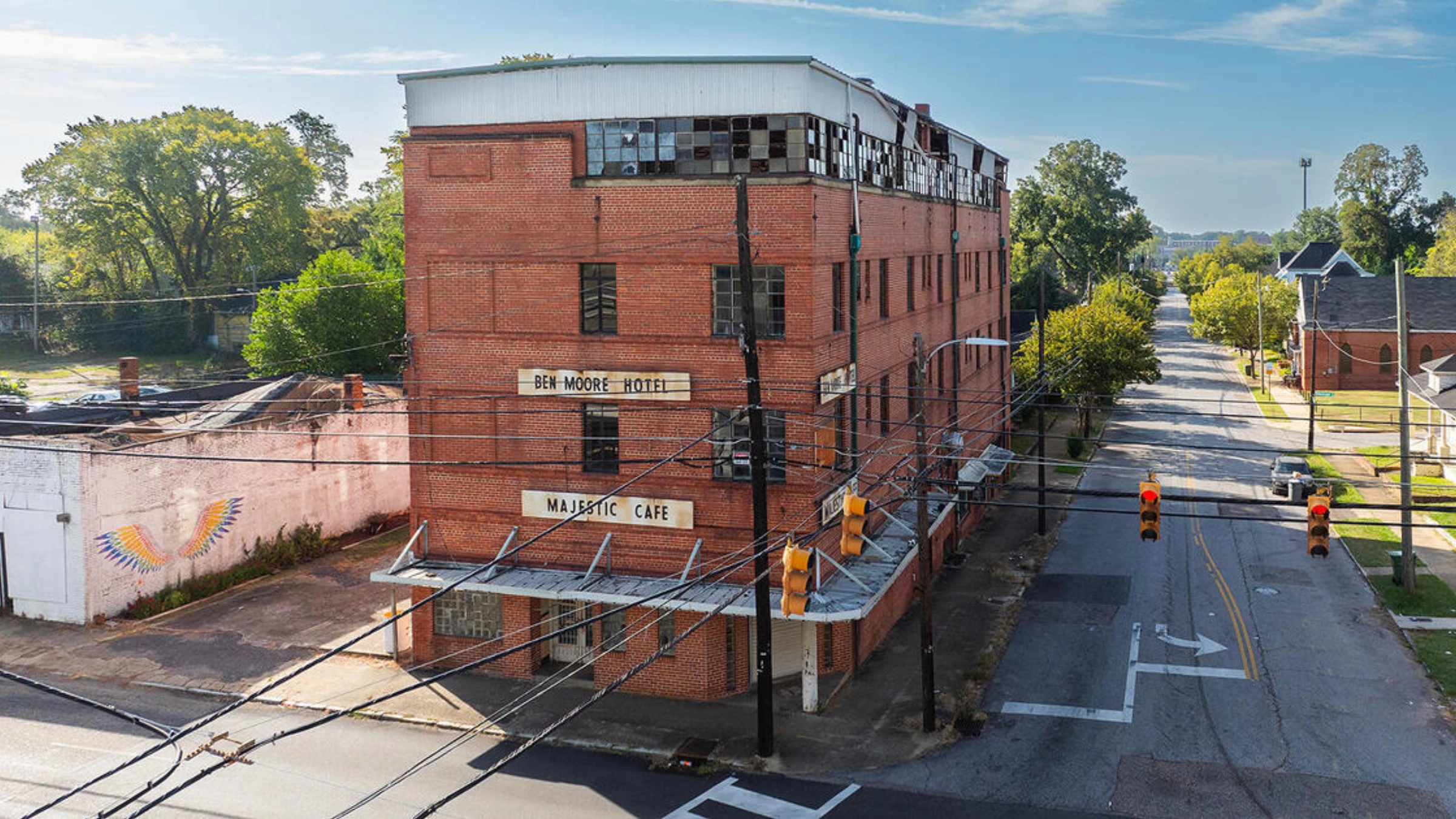
One of the enduring weaknesses of preservation discourse is its tendency to fetishize the object while understating the systems around it. A place becomes important because it is old, architecturally notable, or linked to a famous event. All true, sometimes. But a preservation politics adequate to the present has to explain what kinds of historical imagination a site makes possible. The Ben Moore Hotel in Montgomery is not simply an old hotel. It is a material record of how Black Americans built spaces of refuge, sociality, and mobility under Jim Crow. Stonewall is not simply a landmark tourists can photograph. It is a site through which the state’s relationship to queer life can be measured in real time.
That is why the current political context matters so much. Artforum highlighted the attempted removal of the Pride flag at Stonewall and the removal of interpretive material at the President’s House Site. These are not peripheral disputes. They reveal that public history is now contested through symbols, labels, and omissions as much as through demolition. A monument can remain standing while its meaning is quietly narrowed. A site can stay open while its most difficult truths are softened or removed. Preservation that ignores interpretive power will lose half the battle before it begins.
The National Trust understands this better than many museums do. Its 2026 framing treats endangered places as active carriers of contested memory. Each site on the list also receives a $25,000 grant, which is modest in capital terms but meaningful in strategic ones. The money buys time, visibility, and leverage. More importantly, the list confers narrative attention. In a crowded media environment, that attention can be as valuable as emergency funding because it turns local fights into national tests of principle.
The strongest part of the list is its refusal to separate equality from preservation
The eleven sites span geographies and constituencies that are too often siloed from one another. There is the Angel Island Immigration Station in California, the Women’s Rights National Historical Park in Seneca Falls, the Tule Lake Segregation Center, the Detroit Association of Women’s Clubs, the Greater Chaco Cultural Landscape, and El Corazon Sagrado de la Iglesia de Jesus in Texas, among others. Read together, they form a map of American contradiction. The country’s democratic self-image has always depended on communities fighting to widen the meaning of membership, often in places that mainstream commemoration preferred to ignore until pressure made that impossible.
That breadth is not tokenistic; it is analytic. The list argues that equality is not a single chapter of American history but a recurring conflict staged in different regions, against different authorities, through different forms of assembly. To preserve those places is therefore to preserve evidence of unfinished argument. That is what gives the 2026 list force. It does not present the nation’s difficult sites as tragic remnants to be pitied. It presents them as active instruments for understanding how rights are won, narrowed, and defended.
There is a useful lesson here for museums and public-art institutions. Too many still imagine historical interpretation as a question of balance, as though presenting “multiple perspectives” were sufficient. The Trust’s list is more honest. It does not balance erasure against remembrance. It identifies erasure as a threat condition. That conceptual clarity is one reason the list feels more urgent than many official anniversary programs likely will.
Preservation campaigns succeed when they connect maintenance to public meaning
It is not enough to place a site on a list and congratulate oneself for vigilance. Successful preservation requires an operational argument: who will maintain the place, who will interpret it, who will pay for care, and which public will feel enough ownership to fight for it when the next threat appears. The Trust’s annual list matters because it can gather allies around those questions before a site disappears, but the institution cannot do the local work by itself. Municipal governments, park agencies, tribal authorities, neighborhood groups, educators, and donors all have to convert symbolic designation into durable infrastructure.
That is where many preservation efforts fail. They win the publicity moment and lose the long aftermath. A site is named, mourned, maybe stabilized, then left to cycle through underfunding and periodic crisis. The 2026 list offers a chance to resist that pattern because its selected places arrive with unusually legible stakes. It is easy to explain to a broad public why Stonewall matters. It is possible to tell a compelling story about the President’s House Site, about Angel Island, about the Ben Moore Hotel. The challenge is whether institutions can turn that legibility into repetitive, boring, necessary work: maintenance plans, governance structures, accessible programming, and honest interpretation.
We have seen related questions arise in museum settings, including debates over language, wall text, and institutional self-censorship. Preservation is the architectural face of the same conflict. If sites associated with dissent, migration, Black civic life, Indigenous stewardship, or queer history are kept physically intact but interpretively thinned, then the public gets heritage without consequence. That is the polished version of erasure, and it may be more dangerous than open hostility because it looks responsible while doing less.
What the 2026 list says about the next phase of public culture
The National Trust has handed the country a useful challenge at exactly the right time. As 250th-anniversary programming proliferates, the question will not simply be what gets celebrated. It will be what kinds of historical friction institutions are willing to preserve without deodorizing. The 2026 endangered list suggests that the most important sites are often the ones that expose the unfinished business of citizenship. They are not patriotic décor. They are places where the official national script fails to contain what actually happened.
That is also why the list matters to the art world. Artists, curators, and historians increasingly work in environments where public memory is a live battleground rather than a settled archive. Sites of history are becoming stages on which interpretation, access, and identity are renegotiated in public. Anyone working seriously with monuments, archives, or socially engaged practice should pay attention. These are not side stories for the heritage beat. They are indicators of how culture will be fought over in the next few years.
There is also an art-world reason to take this seriously now. Institutions from museums to biennials are increasingly being forced to defend not just what they show but the language and histories that frame it. We have already seen how interpretive conflict can overtake institutional ceremony in our coverage of the 2026 Venice Biennale opening. Preservation is a parallel front in the same cultural argument: whose past stays visible, and who gets to decide.
The Trust cannot resolve those fights alone. But by making equality, not just nostalgia, the frame for preservation in 2026, it has raised the standard. Good. We do not need another season of tasteful concern for old buildings abstracted from the lives that made them matter. We need a preservation politics willing to say that when memory is narrowed, the public is narrowed with it. This year’s list says exactly that.