World Cup Public Art Hits New York and New Jersey
ARTS 14C’s World Cup sculpture trail turns museum networks, civic branding, and artist visibility into one sprawling summer public-art test
What The Art of the Game is really staging
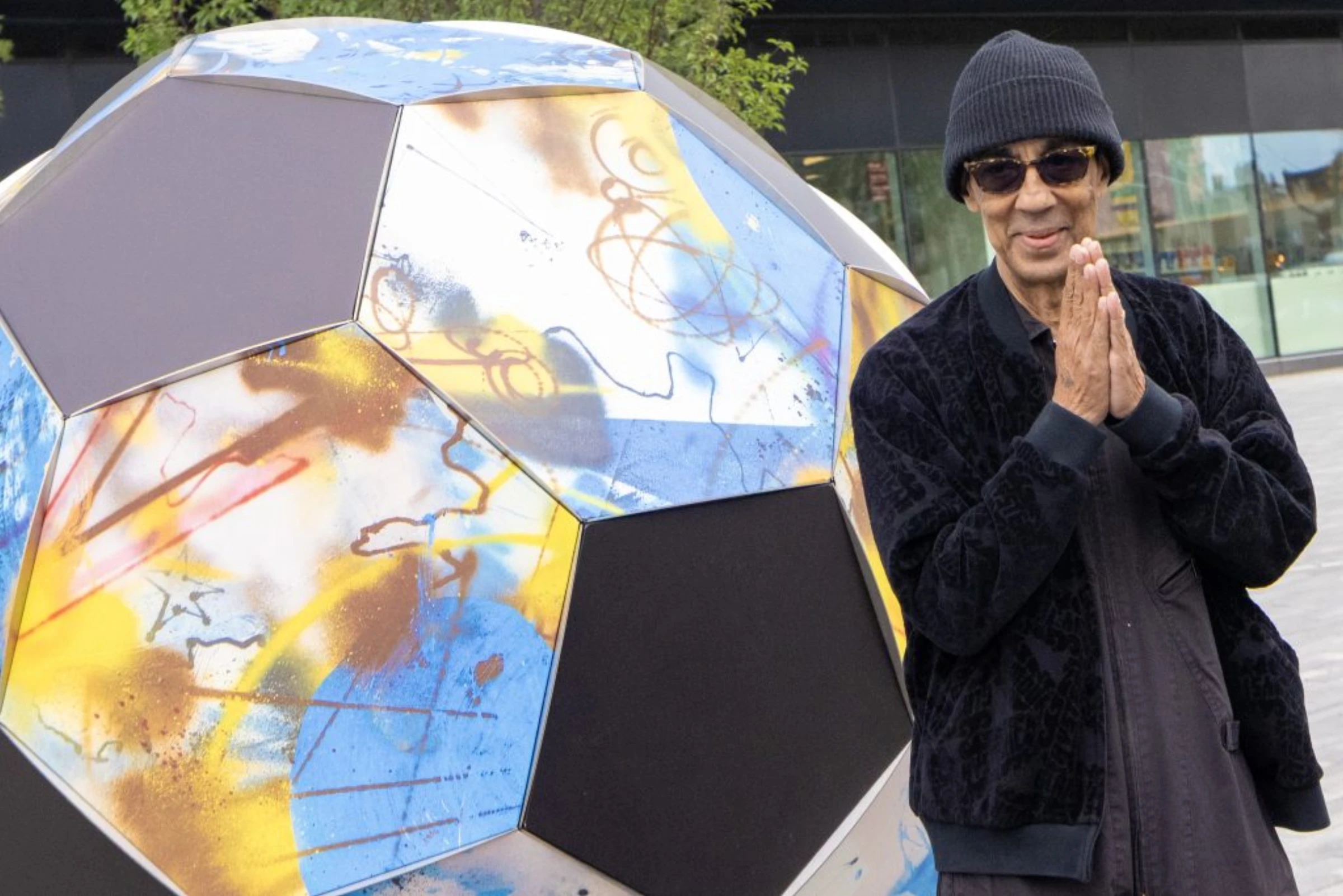
The 2026 World Cup has delivered the usual avalanche of branding, but one of the more interesting cultural side projects is genuinely about public art rather than corporate wallpaper. As ARTnews reported, ARTS 14C has commissioned 23 contemporary artists to design monumental soccer-ball sculptures installed across New York and New Jersey for the summer. The organization’s own project page, The Art of the Game, makes clear that this is not a loose community mural program. It is a tightly networked initiative assembled with the NYNJ World Cup Host Committee and a striking advisory circle that includes Max Hollein, Thelma Golden, Anne Pasternak, Scott Rothkopf, Glenn Lowry, Lisa Phillips, and other senior cultural figures.
That list is what gives the project weight. Public art tied to mega-events is usually judged by how cheerful it looks in photographs or how effectively it flatters the host city. Here, the organizational structure signals a larger ambition. ARTS 14C is using the World Cup as leverage to bring museum authority, philanthropic memory, and street-level visibility into a single urban circuit. Agnes Gund, whose involvement ARTnews describes as catalytic before her death last year, functions almost as the project’s presiding spirit. Her role matters because she represents a lineage of art patronage that can connect elite institutions to civic-scale experimentation without pretending the power imbalance is not there.
Why the artist roster matters more than the soccer-ball format
It would be easy to dismiss giant painted soccer balls as event decoration. The roster complicates that. Futura 2000, Katherine Bernhardt, Hank Willis Thomas, Fred Wilson, Tomokazu Matsuyama, Bony Ramirez, Edgar Heap of Birds, and Taína H. Cruz are not interchangeable crowd-pleasers. They bring different histories of public address, symbolic compression, and institutional critique. Once you ask artists like these to work on an object as overdetermined as a soccer ball, the question stops being whether the form is subtle and becomes whether the commission structure lets specificity survive the spectacle.
The answer appears to be: partly. The World Cup itself is an engine of flattening. It turns cities into backdrops and culture into ambient legitimacy. But a distributed sculpture trail can also redirect attention from stadium interiors to neighborhoods, plazas, and pedestrian habits. ARTnews notes that works were fabricated at Powerhouse Arts and assembled at Mana Contemporary, while several installations sit in highly visible sites across the region. That fabrication pipeline matters because it ties the project to existing cultural infrastructure rather than treating art as an afterthought bolted onto sports programming.
The stronger pieces in projects like this tend to be the ones that exploit the commission’s built-in absurdity. A soccer ball is already a global icon, a nationalist prop, a children’s toy, a luxury-branded object, and a television shape. Artists who can hold those contradictions in view may produce something richer than a civic mascot. Those who cannot will produce decoration. The project’s success will depend less on the initial press and more on whether individual works retain enough visual intelligence to resist becoming selfie furniture.
The institutional politics behind the feel-good story
ARTS 14C presents the project as a broad cultural coalition, and that is accurate, but coalition is not the same as neutrality. The advisory board listed on the project page is a snapshot of how regional art power currently organizes itself: museum directors, philanthropic figures, nonprofit executives, and civic intermediaries. That is not a criticism so much as the condition under which serious public art now gets financed and distributed. If you want 23 works across two states timed to the World Cup, you need logistics, permissions, donors, and institutional endorsement. What disappears in that structure is the fantasy that public art simply belongs to everyone without mediation.
That said, mediation is not the enemy here. The more useful question is whether the mediation produces lasting public value. ARTnews reports that five sculptures will enter a Christie’s online auction in July with proceeds shared between artists, ARTS 14C, and Studio in a School, the nonprofit Agnes Gund founded in 1977. That revenue design is smart because it extends the project beyond temporary spectacle and routes at least some value back into arts education and artist support. It also exposes the project’s hybrid identity: part civic festival, part philanthropic tribute, part market platform.
This hybrid model is becoming standard. Cities want art that humanizes mega-events. Nonprofits want visibility they can convert into future fundraising. Artists want wide public reach without being reduced to unpaid atmosphere. Auction houses and sponsors want proximity to goodwill. When it works, everyone gets something. When it fails, public space becomes a soft-power showroom for organizations congratulating themselves. The Art of the Game seems aware of that danger, which is one reason it deserves more attention than the novelty of its format suggests.
The project also deserves to be read against the region's recurring habit of outsourcing civic image-making to temporary spectacle. New York and New Jersey know how to host attention, but they are less reliable at converting event money into durable cultural memory. A sculpture trail spread across plazas and transit-adjacent spaces offers one answer to that problem because it works at pedestrian scale. People encounter it on the way somewhere else. That matters more than it sounds. Public art tied to mega-events usually fails when it asks viewers to arrive already convinced that a branded occasion deserves reverence. It works better when the encounter is informal, a small interruption in daily routine that opens a different relation to the city. If ARTS 14C can keep even a portion of that spirit alive after the tournament, the project will have earned more than its photo-op value.
There is also a strong labor story under the surface. Fabrication at Powerhouse Arts and assembly at Mana Contemporary show how these projects depend on technicians, fabricators, installers, and nonprofit staff whose work disappears behind the names of famous artists and museum directors. Mega-event art often borrows the glamour of celebrity while quietly relying on regional production ecosystems. Naming those ecosystems matters because they are where public-art capacity actually lives. The World Cup may supply the occasion, but the infrastructure belongs to the local art world that will still be there once the final whistle blows.
Agnes Gund's lingering presence gives the project another resonance. ARTnews describes her as instrumental in assembling support, and that matters because Gund embodied a version of patronage that treated museums, schools, and public culture as mutually reinforcing rather than separate silos. Invoking her legacy could have become empty sentimentality. Instead, the project seems to use that legacy operationally, connecting the commission trail to Studio in a School and to a network of museum directors willing to lend symbolic capital to a civic undertaking. In a cultural moment when philanthropy is often reduced to naming rights, that broader connective model is worth noticing. It shows how patronage can still function as institution-building rather than mere image polishing.
That regional emphasis may become the project's most durable contribution. New Jersey in particular is often used as logistical support for New York culture rather than being treated as a site of cultural authorship in its own right. A project that places major commissions across both states, and that names Jersey City institutions as essential rather than incidental, pushes back against that hierarchy. It argues that cultural prestige can be produced through networked regional space, not only inherited from Manhattan addresses. That is a civic proposition as much as an artistic one.
What the World Cup project could leave behind
The strongest claim made around the project is not that it beautifies the tournament, but that some works may remain on public view beyond Labor Day. If that happens, the initiative will have done more than produce a seasonal sculpture trail. It will have used a global sports event to seed long-term public artworks, or at least long-term expectations for them, in places that are often treated as transit zones rather than cultural destinations. That matters in a region where cultural attention still tilts heavily toward Manhattan even when fabrication, residency, and public experimentation increasingly happen elsewhere.
There is already a useful internal comparison for readers who have been tracking how sports spectacle is translated into visual culture. Our earlier guide on reading World Cup public art argued that these commissions are really arguments about who gets to narrate a city during a global event. The ARTS 14C project puts that argument into practice. Its real achievement will not be judged by how many photos circulate this week, but by whether local publics remember the sculptures after the tournament noise subsides.
For now, The Art of the Game looks like a serious attempt to turn civic hype into cultural infrastructure. That is a harder job than installing oversized objects in photogenic places. It requires enough curatorial intelligence to resist pure branding and enough organizational discipline to leave something behind once the fans go home. New York and New Jersey have no shortage of spectacle. What they need are projects that make spectacle answer to art. This one, at least, is trying.