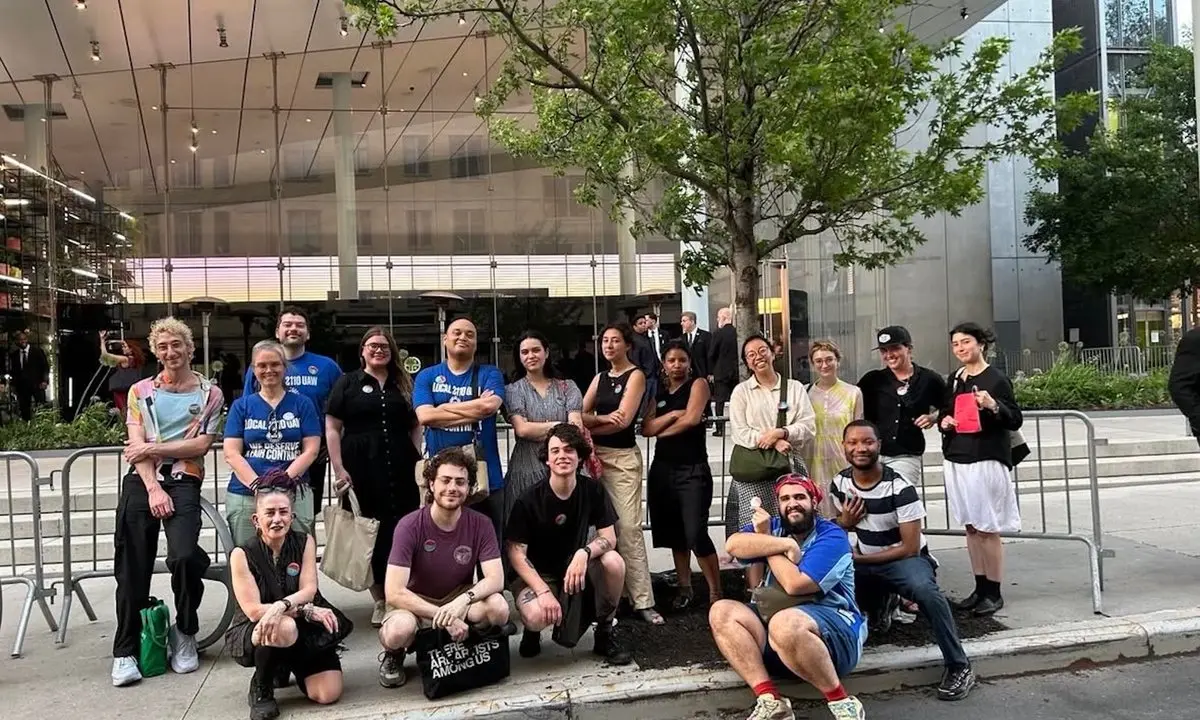
Whitney Workers Take Contract Fight to Gala
Whitney staff used the museum's donor gala to pressure management before their first contract expires, testing how visible museum labor can become in 2026
Whitney workers used a donor night to make the labor question impossible to ignore
When the Whitney Museum of American Art staged its annual gala on 19 May, the institution wanted the evening to center Julie Mehretu, philanthropist Fern Kaye Tessler, and former director Adam D. Weinberg. Instead, another picture entered the frame. As The Art Newspaper reported, members of the Whitney Museum Union lined Gansevoort Street outside the event, handing guests pins, flyers, and signs urging support for a new contract before the current agreement expires next month. It was a small action in numerical terms, but not a small one symbolically. Museum galas are engineered displays of institutional confidence. To confront donors at the door is to insist that the polished version of the museum cannot be separated from the labor conditions that make that polish possible.
The optics mattered because the Whitney is no longer a museum where unionization can be treated as an experimental side note. The union, affiliated with UAW Local 2110, represents roughly 185 staff members across curatorial, education, conservation, visitor services, and administration. The museum voluntarily recognized the union in 2021, and the first contract, ratified in 2023, raised the floor for workers who had been earning $17 an hour to $22 retroactive to January 2023, with later increases scheduled to reach $24 by June 2025. That first agreement was a real gain, but it also established a new baseline expectation: if the museum could get to one contract, it could not plausibly present a second round of bargaining as an unfortunate disruption to otherwise normal operations. Bargaining is now part of the Whitney's operating reality.
The first contract changed the stakes of the second one
That is what makes this moment worth more than a routine labor update. The first Whitney contract took 16 months to negotiate. In museum time, that is not a blip. It is an entire exhibition cycle, multiple fundraising seasons, and a long stretch of internal uncertainty for workers whose salaries often lag behind the public prestige of the institutions they serve. The union says the earlier contract brought average compensation gains of around 15 percent, plus signing bonuses and cumulative raises. Those figures matter because they demonstrate what collective bargaining achieved in concrete terms, not just rhetorically. Workers now enter negotiations knowing the last campaign produced measurable results. Management enters the same process knowing staff have proof that public pressure works.
The action outside the gala also showed how museum labor tactics have matured. Workers did not shut the event down. They did not need to. They targeted the most vulnerable point in the museum's public image: the brief walk between curb and cocktail. Donors, trustees, artists, and patrons had to pass through a reminder that the museum's mission talk sits on top of payroll decisions, salary bands, and bargaining tables. This is why high-profile events have become such useful pressure points across the sector. A museum can ignore a quietly worded internal memo. It cannot easily ignore a labor message delivered at the threshold of its own prestige performance.
The Whitney said it is committed to a fair and reasonable contract, and institutions usually say some version of that line when negotiations become visible. The issue is not whether management can produce conciliatory language. The issue is whether the museum can reconcile its public commitment to artists, ideas, and civic value with the more ordinary but more consequential question of what it costs to work there. Museums have grown comfortable discussing equity in galleries, catalogues, and panels. Labor negotiations test whether that language extends to the people staffing the coat check, installing the show, handling school visits, processing objects, and doing the administrative maintenance that keeps the building functioning.
Museum labor is no longer a niche story inside the art world
The Whitney is not operating in isolation. Over the last several years, union drives and contract fights have moved through museums, nonprofits, and adjacent cultural organizations with unusual speed. New York has been especially visible, but the pattern is national: staff at arts institutions increasingly reject the idea that symbolic compensation, mission alignment, or proximity to artists should offset stagnant wages and high living costs. Workers who once accepted museum employment as a prestige discount now scrutinize it as a labor arrangement. That shift is cultural as much as economic. It means institutions can no longer rely on devotion to the field as a substitute for durable workplace standards.
The Whitney has its own history here. Four years ago, workers staged a similar action during the museum's spring fundraising gala. That repetition is revealing. The museum has not found a way to separate its fundraising theater from labor friction because the two belong to the same system. Donor cultivation brings in money; staff labor turns mission into daily reality; rising costs make the gap between institutional glamour and worker stability harder to defend. Readers who followed our guide to reading museum funding crises will recognize the pattern. Financial pressure inside museums rarely appears first as an abstract spreadsheet problem. It appears as conflict over who absorbs the institution's risk.
There is another reason this fight matters. The Whitney remains one of the most watched museums in the United States, and its labor precedents travel. If workers at a globally visible New York institution can normalize bargaining as part of the museum calendar, that strengthens the hand of staff elsewhere. If management succeeds in shrinking those gains, that result travels too. In the museum sector, policy often spreads less through formal declarations than through imitation, caution, and reputational pressure. Institutions watch what peers can get away with. Workers do the same.
What comes next is a test of credibility, not branding
The current contract expires next month, which gives both sides a narrow window to prove whether the museum's public language about fairness means anything beyond event-night diplomacy. A second contract is usually more revealing than a first one. The first can be framed as a historic accommodation or a temporary reset. The second shows whether bargaining has been integrated into governance or is still treated internally as a reputational nuisance. If the Whitney wants to present itself as a serious civic institution rather than a brand wrapped around a building, it has to show that serious institutions can handle organized labor without resentment or delay tactics.
The bargaining dispute also lands at a moment when museums are under renewed scrutiny for the gap between public values and internal compensation structures. The Whitney asks visitors to see itself as a home for ambitious contemporary art and civic debate, and it has every right to make that claim. But claims about civic relevance become flimsy when the workers who deliver public programming, manage collections, support artists, and keep visitor services running must periodically escalate simply to be heard. One useful benchmark is not whether the museum says the right things in a statement, but whether it can make room for meaningful wage growth, stronger protections, and a negotiating process that does not depend on workers creating public embarrassment to move forward. Labor visibility is costly because management often leaves workers with few quieter options.
There is a donor education angle here too. Many patrons still imagine their gifts as direct support for exhibitions and culture, not as participation in an employment system. Yet every gala table, sponsorship package, and acquisition gift is entangled with staffing decisions. A museum that celebrates contemporary artists while resisting the ordinary costs of sustaining its own workforce is not neutral; it is choosing where generosity stops. That is why the union's action outside a fundraising event was so effective. It reframed philanthropy as a question about conditions, not just collections. Anyone serious about supporting the Whitney Museum should be serious about whether the museum's workers can afford to stay there long enough to build expertise.
What makes the Whitney episode especially revealing is that nothing about the dispute is obscure. The museum knows what New York costs. It knows what its staff jobs require. It knows that a workplace spread across curatorial, education, conservation, visitor services, and administration cannot be sustained indefinitely on prestige alone. That clarity cuts both ways. If negotiations drag, the museum will not be able to claim confusion about the stakes. It will be making a choice about whether one of the world's most visible contemporary art institutions wants to treat labor stability as part of its mission or as an expense best managed out of public view.
For workers, the challenge is to keep public sympathy attached to the material stakes of the contract rather than letting the story dissolve into personality or spectacle. The rally worked because it made a structural argument in visual form. People who arrived for a gala were asked to consider what kind of museum they were funding. That is the question that will remain after the flowers are gone and the donor tables have been cleared. Museums spend enormous energy curating how they are seen. The Whitney's workers just reminded everyone that labor can curate that view too.