Tate Britain Reframes Whistler Through Van Gogh's Eyes
Tate Britain's new Whistler exhibition reopens the artist's mother portrait through Vincent van Gogh, turning a familiar icon back into a modern problem
Tate Britain's Whistler exhibition puts one painting under a harder, richer light
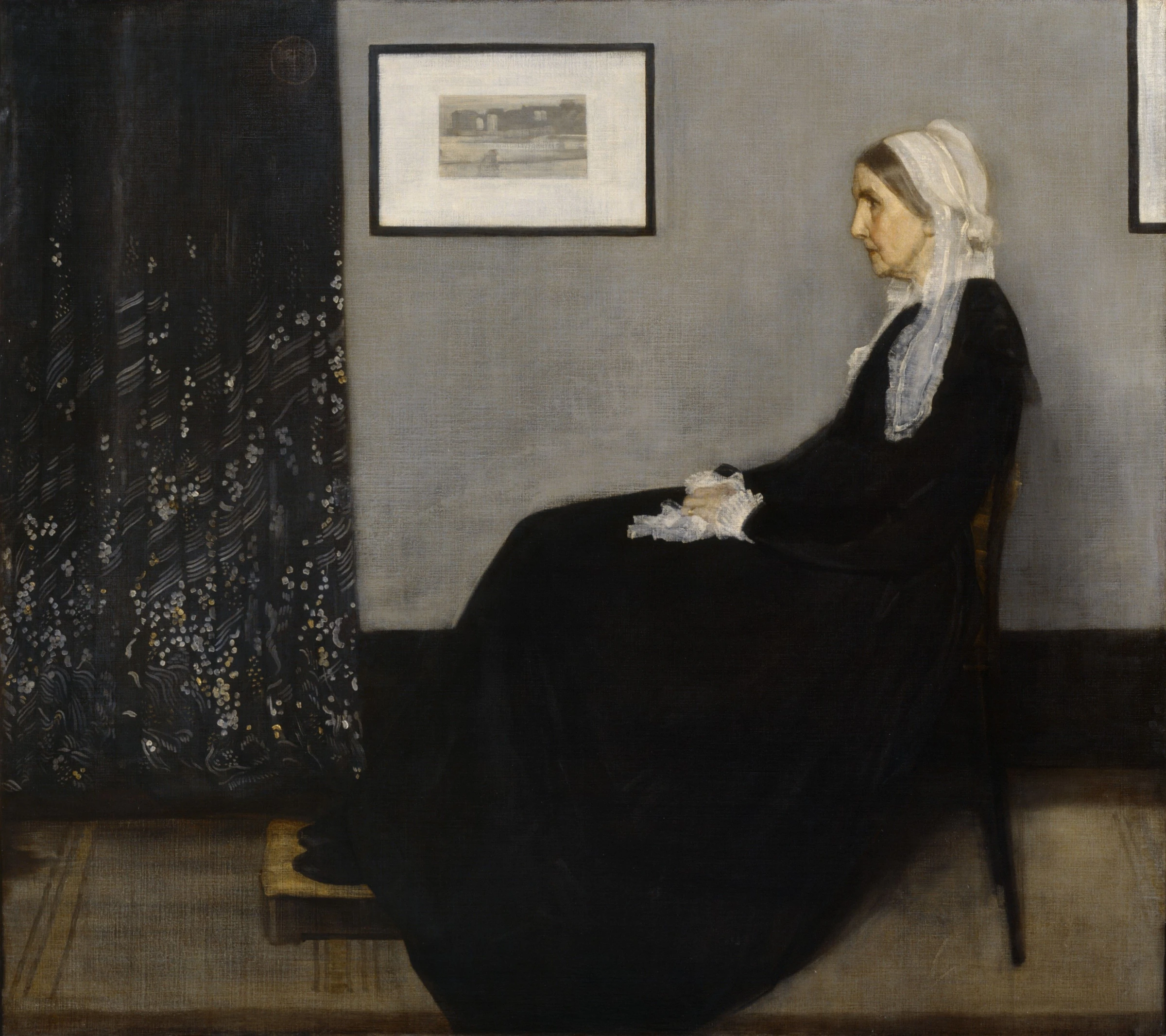
Tate Britain's forthcoming James McNeill Whistler exhibition could easily have coasted on familiarity. Arrangement in Grey and Black No. 1, usually reduced in popular memory to Whistler's Mother, is one of those paintings so over-reproduced that viewers often arrive at the real object already numbed by recognition. What gives this show sharper edges is the way it reopens the painting through Vincent van Gogh's response to it. As Martin Bailey reports in The Art Newspaper, Van Gogh wrote in 1889 that Whistler's portrait of his mother reminded him of his own mother, Anna. That small historical detail changes the frame. The work stops being an icon of dutiful motherhood and becomes something stranger: a portrait filtered through another artist's memory, another family structure and another modernity.
The exhibition opens at Tate Britain on 21 May before traveling to the Van Gogh Museum in Amsterdam in October. That itinerary is not incidental. It formalizes a conversation between two artists who are rarely brought into direct relation, even though both were intensely concerned with how mood, memory and formal reduction can charge an image far beyond likeness. In curatorial terms, the show has an obvious crowd-pleasing centerpiece. Editorially, though, its real interest lies in the possibility that Whistler's most familiar picture can still be made unfamiliar.
The portrait of Anna Whistler is more severe and more modern than its legend suggests
Whistler painted his mother in 1871 after another model failed to appear, a circumstance that has long fed the anecdotal life of the canvas. Yet the resulting image is anything but casual. The formal balance is exacting: a seated figure in profile, black dress cutting against gray wall, framed print to the left, curtain to the right, floor line locking the composition down. The painting's commonly used nickname has helped sentimentalize it, but Whistler's own title makes the artist's priorities clear. This was an arrangement before it was a family tribute. Tone, proportion, restraint and pictorial discipline mattered more than narrative sweetness.
That emphasis is part of why the work still feels modern. Anna Whistler is not idealized into softness. She appears dignified, yes, but also compressed by the rigor of the composition. The portrait is about age, stillness and structure. Bailey notes that the Musée d'Orsay is lending the picture with its original frame, designed by Whistler himself. That detail matters because it restores the work's objecthood. Reproductions flatten the image into cultural cliché. The original frame reminds viewers that Whistler controlled the painting as a total visual experience, not as an endlessly detachable meme of motherhood.
The modernity of the work also lies in its resistance to easy emotional access. This is not a sentimental mother-and-son picture in the Victorian mode. It withholds overt narrative, almost demanding that viewers confront arrangement before affection. That is likely one reason Van Gogh's response is so revealing. He did not describe a generic maternal symbol; he saw his own mother emerging through Whistler's formal economy. The painting's emotional power comes precisely from how little it insists on one fixed reading.
Van Gogh's identification opens a productive art-historical detour
Bailey's account is strongest when it follows the thread connecting Whistler, the Goupil network and the Van Gogh family. Whether Vincent saw the original painting in London in 1874 remains uncertain, but the probabilities are tantalizing. He was in the city while Whistler's exhibition was on view, and he later worked within a commercial-art system that had multiple points of contact with Whistler's circulation. Even if Van Gogh knew the work only through one of the prints published by 1889, that still tells us something important about the period: reproductive media did not merely disseminate masterpieces, they shaped how artists internalized them.
This matters because art history too often treats influence as if it moves only through direct encounters with originals. In reality, many nineteenth-century artists built their imaginative worlds through engravings, lithographs, journals, shop windows and conversations around trade networks like the Musée d'Orsay's Whistler holding and the old Goupil apparatus that connected London and Paris. Bailey even points to Whistler lithographs released by Boussod & Valadon in 1887, which Theo van Gogh likely encountered in Paris. That is not a minor footnote. It suggests a more entangled field of influence, one in which Whistler's tonal experimentation and Van Gogh's chromatic intensity were not isolated phenomena but adjacent responses to a shared modern visual environment.
The comparison between Whistler's mother and Van Gogh's painted portrait of his own mother is especially telling. Whistler's image is austere, nearly monochrome, locked into an architecture of restraint. Van Gogh's is more chromatic, more psychologically animated, less ceremonial. Yet both transform maternal portraiture into something conceptually charged. One distills. The other intensifies. Seen together, they map two very different roads out of conventional portrait painting.
Why this exhibition matters now, beyond a single famous image
Tate's exhibition lands in a museum culture that is increasingly forced to justify canonical shows not only through attendance but through argument. Another Whistler retrospective would be easy to dismiss as respectable maintenance work unless it could show what is still at stake in looking again. The Van Gogh angle helps, but the bigger opportunity is to rescue Whistler from his own overfamiliar branding. He is too often reduced to a handful of marketable identities: aesthete, dandy, mother painter, author of peacock rooms and nocturnes. Those labels are not false, but they can shrink the artist's actual ambition.
Whistler was deeply invested in the autonomy of pictorial form, in the relation between painting and music, and in a modern language of tonal orchestration that later artists could not easily ignore. A museum that merely celebrates him misses the point. A museum that stages him as a problem, as an artist whose work destabilized the expectations of portraiture and atmospheric painting, has a much stronger case. Tate is positioned to make that case because it can connect Whistler's London life to a broader network of transnational modernism, then hand the exhibition to the Van Gogh Museum, where those connections will resonate differently.
There is also a timely institutional lesson here. Major museums increasingly depend on recognizable masterpieces to anchor ticketed programming, but audiences are quick to sense when recognition is being used as a substitute for thought. The challenge is to turn familiarity into inquiry. If Tate succeeds, this show will not simply remind visitors that Whistler's Mother is famous. It will remind them why the painting became famous in the first place, and what has been lost in the process of turning it into shorthand.
That lost complexity includes class, migration and artistic self-fashioning. Whistler was an American in London crafting a persona as carefully as a surface, and the portrait's afterlife has often erased that cosmopolitan friction under the blanket title of maternal devotion. A good exhibition can put that friction back. It can show how a painting becomes a national icon only after being stripped of some of its formal and social oddity. That is a more interesting story than simple canonization, and it is the story Tate has the chance to tell.
What viewers should watch for when the exhibition opens
The most revealing test of the exhibition may be whether it gets visitors to look slowly at the internal tensions of the painting: its balance between intimacy and distance, domesticity and abstraction, filial subject and formal arrangement. Viewers should also watch how Tate handles the links to Whistler's prints and nocturnes, since those works help explain why the portrait's restraint was part of a much larger project rather than an isolated stylistic quirk. If the show effectively threads those pieces together, it can restore Whistler as a disruptive intelligence rather than a safe canonical name.
Another useful pressure point will be the exhibition design itself. Does Tate stage the picture as a lone celebrity object, or does it let neighboring works complicate it? If the museum surrounds the painting with enough tonal experiments, prints and transnational context, viewers may finally see that its severity belongs to a whole worldview rather than to one famous sitter. The success of the exhibition will depend on whether it can move people from recognition to comparison, and from comparison to argument. That small shift is the difference between passive familiarity and active interpretation in public.
There is a further payoff in the exhibition's Amsterdam leg. By traveling to the Van Gogh Museum under the subtitle Dandy and Disrupter, the project invites a two-way reassessment. Whistler becomes more legible within Van Gogh's orbit, and Van Gogh becomes less singular, more embedded in a network of looking, remembering and borrowing. That is the kind of curatorial move museums should be making more often: not inflating masterpieces into untouchable icons, but setting them against other minds until their strangeness returns. In that sense, Tate's Whistler show is not just about one mother's portrait. It is about how modern art keeps changing when we stop mistaking familiarity for understanding.