Anna Weyant Paints Marc Jacobs for Vanity Fair Cover
Painter Anna Weyant brings her Dutch Old Master style to Vanity Fair, capturing Marc Jacobs for the 2026 Style issue cover
A Painter Crosses Into Fashion's Highest Platform
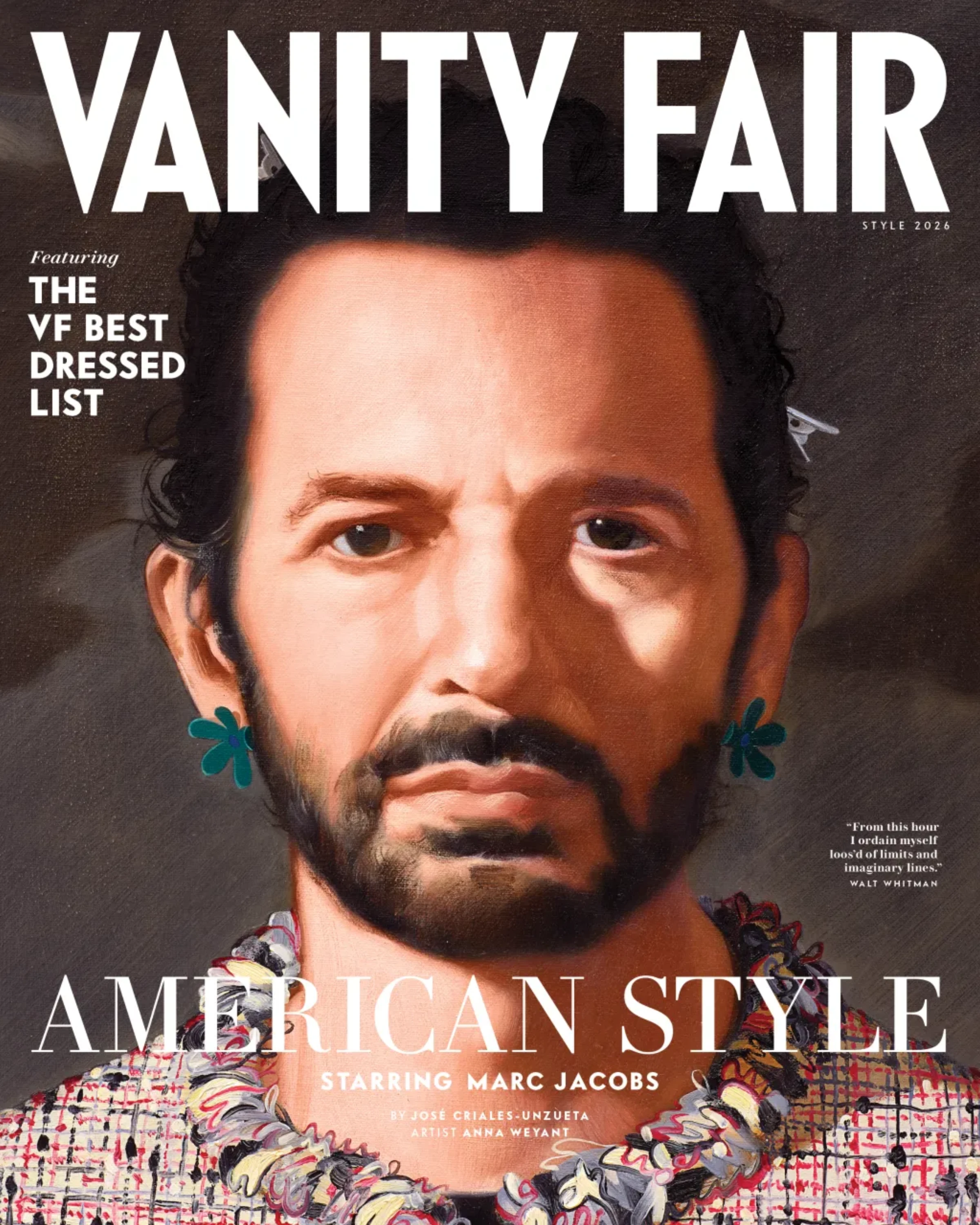
Anna Weyant, one of the most closely watched painters in contemporary art, has painted designer Marc Jacobs for the cover of Vanity Fair's 2026 Style issue. The commission places Weyant's work in front of a readership that extends far beyond gallery walls, marking a significant moment in the expanding relationship between fine art and fashion media. The cover story, titled "Marc Jacobs Cannot Tell a Lie," delves into Jacobs' four decades in fashion and the recent sale of his namesake label, Marc Jacobs International, valued at $850 million.
In Weyant's portrait, Jacobs faces the viewer with stone-faced composure against a dark background, meeting the gaze directly. The painting's Dutch Old Master style, which has become Weyant's signature, is tempered by subtle hints of flamboyance: teal flower earrings, the ruffled collar of a Chanel tweed top, salon hair clips. Were it not for these accessories, the composition would recall the sober directness of a government identification photo. The painting says, plainly, "this is me, take me as I am."
That straightforwardness is a running theme in the Vanity Fair feature, where Jacobs reflects on his career with unusual candor. "All I've ever been is a fashion victim," he tells the magazine. "I don't think of that as a bad thing." Model Kaia Gerber, interviewed for the same piece, echoes others who know him personally: "Marc has never really tried to be anyone other than himself."
The Weyant-Jacobs Creative History
This is not the first collaboration between Weyant and Jacobs. The designer previously commissioned Weyant to paint Gerber wearing a Fall 2024 creation for a Vogue cover in December of that year. "I love Anna's women, and I love the idea of Kaia seen by Anna," Jacobs reportedly said at the time. For his September 2025 show at New York's Academy Mansion, Jacobs also collaborated with Weyant on the set design, which she transformed into an immersive installation called The Dollhouse. Models walked through the artwork wearing dollhouse-themed dresses of Jacobs' design.
The dollhouse motif has recurred throughout Weyant's oeuvre. Her figures, often young women, exist in dreamlike spaces charged with what the artist has described as "low-stakes trauma." Yet within that unease, there is silliness, wit, and an unexpected physical resilience in bodies that appear porcelain-fragile. That tension between vulnerability and strength is precisely what makes her portrait of Jacobs so effective. He is rendered with the same unsettling stillness that characterizes her gallery work, but the painting also carries the warmth of an ongoing creative relationship.
Weyant is represented by Gagosian, the global gallery network. Her painting Falling Woman (2020) sold for $1.6 million at Sotheby's in 2020, establishing a record for the artist and signaling the market's confidence in her trajectory. That a painter with her auction history and institutional profile would accept a magazine cover commission speaks to the shifting boundaries between commercial and fine art, particularly when the subject is a designer with genuine cultural authority.
Jacobs Speaks Out on LVMH and the Label Sale
The Vanity Fair feature is notable not only for the cover artwork but for Jacobs' unusually blunt assessment of his business situation. He criticizes LVMH, the luxury conglomerate that controlled his label, with a frankness that corporate partners typically discourage. "LVMH has kept us and done the least possible they can in terms of growing our business," he said, though he acknowledged this was not necessarily their fault. The label was sold to G-III Apparel Group in partnership with WHP Global. Jacobs expressed doubts about the new owners' commercial priorities, noting that G-III has "a less elegant connotation in the industry" because it operates through licensing agreements.
These comments are striking coming from a designer who has spent decades inside the luxury system. Jacobs built his brand under LVMH's umbrella for years, and his willingness to speak candidly about the relationship suggests either a liberation from corporate constraints or a calculated decision to shape the narrative around the sale. Either way, the interview reads less like a press release and more like a genuine reflection from someone who has nothing left to lose by being honest.
Jacobs also discusses his personal life in the piece, noting that his routines include patronizing art galleries. "I get a good feeling about being honest," he said. "It excites me to be open, and it excites me to reveal things that somebody else would keep secret." That sensibility aligns him with Weyant's artistic project more than might be immediately apparent. Both artist and subject share an interest in surfaces that conceal complexities beneath them.
What the Commission Signals
The Vanity Fair cover arrives at a moment when the lines between fine art, fashion, and publishing are increasingly blurred. Major magazines have turned to contemporary artists for cover commissions before, but Weyant's involvement carries specific weight. She is a painter whose work commands seven-figure auction results and whose gallery representation places her at the top tier of the contemporary market. Her willingness to paint a fashion designer for a mass-circulation magazine suggests that the old hierarchies between "serious" painting and commercial commission are continuing to erode.
For Weyant, the cover also represents a expansion of her audience. Her gallery exhibitions at Gagosian attract collectors, curators, and art professionals. A Vanity Fair cover reaches millions of readers who may never set foot in a Chelsea gallery. Whether this exposure translates into broader cultural recognition for her painting practice remains to be seen, but it undeniably positions her as an artist who can operate across multiple worlds without compromising her visual language.
For Jacobs, the portrait caps a period of public visibility that has included both professional transition and personal reflection. The sale of his label, the candid interviews, the continued collaboration with artists like Weyant: all of it paints a picture of a designer who is thinking about legacy rather than the next collection cycle. The choice of Weyant as portraitist, with her old-master gravitas and contemporary edge, was a deliberate one. The painting does not flatter him in the conventional sense. It presents him as he apparently wishes to be seen: unadorned, direct, and entirely himself.
Weyant's gallery exhibitions have consistently drawn critical attention for their ability to conjure atmosphere from minimal means. Her 2023 show at Gagosian in New York presented paintings of young women in domestic settings that seemed to vibrate with suppressed narrative, each canvas carrying the weight of a short story. Critics noted her ability to merge technical precision, borrowed from centuries of portraiture tradition, with subject matter that feels urgently contemporary. The VF cover extends this project into a different register: the subject is a public figure, the audience is general readership, and the painting must function as both artwork and magazine cover. That Weyant manages both without compromise is a testament to the strength of her underlying visual language.
The collaboration also raises questions about authorship and control in commissioned portraiture. When a painter works from a live sitter for a gallery exhibition, the artist controls every aspect of the presentation. When the same painter creates a magazine cover, the artwork enters a commercial context governed by editorial decisions, typography, and layout. Weyant's painting appears to have survived this process intact. The composition is uncluttered, the figure dominates the frame, and the painting reads as a painting first and a cover second. That outcome is not guaranteed in editorial commissions, and it speaks to both Weyant's leverage as an in-demand artist and Vanity Fair's willingness to let the artwork speak for itself.
The broader trend of magazines commissioning fine artists for covers has accelerated in recent years. Publications that once relied exclusively on photography have increasingly turned to painters, illustrators, and mixed-media artists to create cover images that stand out in a crowded visual field. The strategy reflects a recognition that painted covers carry a different kind of authority than photographic ones. They feel intentional, considered, and singular in a way that mass-produced photography often does not. For artists, these commissions offer exposure to audiences that extend well beyond the gallery ecosystem, potentially expanding the cultural conversation around their work.
The 2026 Style issue of Vanity Fair is available on newsstands now. For readers interested in the intersection of painting and fashion that this cover represents, the full feature offers a rare depth of access to both artist and subject. The collaboration between Weyant and Jacobs demonstrates that contemporary portraiture can still hold cultural authority in an image-saturated media landscape, particularly when both artist and subject share a commitment to honesty over flattery. Whether this cover becomes a defining image of its moment or simply a notable commission in Weyant's growing body of work, it confirms that the boundary between fine art and commercial media is more permeable than it has been in decades, and that painters who can navigate that boundary without compromising their vision are uniquely positioned to shape visual culture across multiple audiences simultaneously, and the Weyant-Jacobs cover may well become a reference point for how such collaborations can function when both parties bring genuine creative authority to the table.