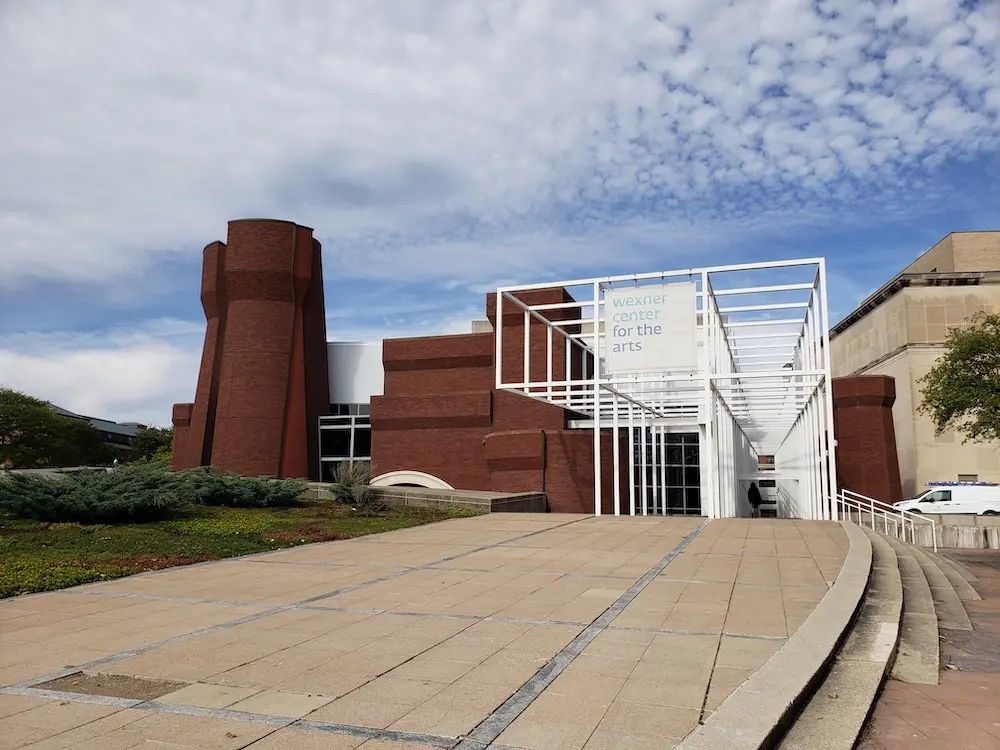
Wexner Center Workers Push to Drop the Wexner Name
Unionized staff at the Wexner Center want the institution renamed, arguing that Les Wexner's ties to Jeffrey Epstein have made the title morally untenable.
Staff Have Turned a Naming Controversy Into a Legitimacy Test
The campaign to remove the Wexner name from the Wexner Center for the Arts is not just another reputational flare-up around a donor with toxic associations. It is a challenge from inside the institution, led by the people who have to ask artists, audiences and community partners to cross the threshold every day. According to Artforum, unionized workers affiliated with AFSCME Ohio Council 8, Local 332 have asked Ohio State University to strip the center of Les Wexner's name because of his long relationship with Jeffrey Epstein. Their argument is not cautious. They say the name itself compromises the institution's moral standing.
That directness is what makes the story important. Naming disputes in the art world often begin with outside pressure: activists, petitioners, journalists or social media campaigns. Here the pressure comes from staff, and staff are usually the last people management can dismiss as unserious outsiders. When workers say that the institution's own title harms its relationship with artists and publics, they are making a governance argument, not merely a branding complaint. They are saying that the museum's public face is out of joint with the values its programming claims to serve.
The specific burden of the Wexner case is obvious. Les Wexner gave $25 million toward the center's construction in the late 1980s, and the institution was named for his father. But Wexner's name is now inseparable from his long association with Epstein, a fact that has only hardened as more reporting and court material have accumulated. Wexner has said he did not know the extent of Epstein's crimes and has denied meeting Virginia Giuffre, yet those denials have not ended the legitimacy problem. An arts institution does not get to decide that its patrons and workers must bracket what the name evokes when they enter the building.
The Workers Are Framing the Problem as Institutional Ethics, Not Public Relations
There is an important difference between saying that a donor relationship is embarrassing and saying that it makes artistic work harder to do honestly. Wexner Workers United chose the second frame. In their view, the building's current name asks artists and visitors to tolerate a form of moral contradiction before they have even seen the programme. That reading is sharper than the usual museum line that history is complicated and names are layered. Of course history is complicated. The question is whether a public-facing art institution can still ask communities to overlook an association with trafficking, abuse and impunity while speaking the language of cultural openness and civic care.
Ohio State University's response, also reported by Artforum, was procedural. The university pointed to its established process for requests regarding space and entity names. That is institutionally neat and politically evasive. Procedure matters, but procedure also has a way of flattening urgent ethical claims into administrative workflow. The workers are not confused about how forms get filed. They are saying the institution is behind the moral reality already visible to everyone else.
The workers are also forcing a question that museum boards usually try to postpone indefinitely: when does a naming gift stop functioning as a record of generosity and start functioning as an active reputational burden? Once that threshold has been crossed, neutrality is over. Keeping the name is no longer the absence of action. It is a decision to preserve one version of institutional memory over another, even when staff and visitors read the building differently every time they approach it.
This gap between ethical urgency and procedural calm is common in donor crises. Universities and museums often answer substantive criticism with process because process buys time and diffuses responsibility. But time is not neutral. The longer a compromised name stays in place, the longer staff have to defend an institutional contradiction they did not create. If management does not see that as a labor issue as well as an ethical one, it is reading the situation far too narrowly.
The Art World Already Has a Precedent for What Workers Are Asking
The workers themselves pointed to the most obvious comparison: the removal of the Sackler name from the Metropolitan Museum of Art and earlier action at the Louvre. Those cases matter because they established that naming rights are not sacred property. They are contingent public honors. Once the honor becomes incompatible with the institution's mission, the institution can decide that keeping the name costs more than removing it.
That precedent is still unevenly applied. Some institutions moved quickly on Sackler once the political center shifted. Others waited until pressure became unbearable. The delay often reflected the same fear that may now be operating in Columbus: if one donor name can be challenged, then the myth of permanent patronal immunity starts to crack. Boards prefer to imagine that philanthropy and moral legitimacy can be kept in separate files. Workers are forcing the opposite conclusion. In a public institution, the funding history is part of the meaning.
The Wexner Center's position is especially delicate because it sits within a university, not outside one. That means the naming issue is entangled with educational values, student life and public accountability in ways that differ from a private museum board's calculations. A university arts center cannot convincingly claim that names are only historical markers with no effect on the present. Universities spend enormous energy teaching students how institutions signal belonging and exclusion. The building's name is one of the loudest signals it has.
That public reading will matter well beyond Columbus because university museums have become some of the most contested sites in American cultural life. They promise experimentation, public dialogue and serious criticism, yet many remain structurally dependent on donor histories that were never meant to face this level of scrutiny. The Wexner dispute shows how quickly those old arrangements can become contemporary liabilities once workers decide that institutional values are not credible unless they extend to the name over the door.
What This Fight Says About the Next Phase of Patronage Politics
The bigger art-world story is that the age of passive donor legacy is over. Institutions used to assume that once a wealthy patron's name was attached to a wing or center, the arrangement would harden into background architecture. That is no longer true. Staff, artists and audiences now treat naming as active speech. A name can endorse, excuse or normalize. It can tell visitors what kind of compromise the institution considers livable.
That shift does not mean every legacy donor name is about to fall. It does mean museums and art centers can no longer hide behind the fiction that naming disputes are external noise. They are governance disputes about what institutions are willing to honor publicly. We have already seen related tensions in sponsorship battles, from opioid wealth to fossil fuel money to luxury alliances that strain the language of public mission. Our reporting on Chanel's partnership with the Centre Pompidou described a friendlier version of the same structural question: when money stabilizes an institution, what else does it stabilize with it?
In Columbus the question is harsher because the name is not underwriting future programming. It is a monument to an old donation that now reads differently in public. The university can either recognize that changed meaning or pretend the institution still operates under the assumptions of the late 1980s. Workers have already made clear that the latter position is unsustainable.
There is a strategic lesson here for every institution still hoping a difficult donor association can simply age into the wallpaper. It cannot. Public memory keeps moving. Staff turnover brings new expectations. Artists increasingly ask where money came from and what names they are being asked to legitimate by participating. The institutions that move first will look responsive. The ones that wait for total consensus will discover that legitimacy usually erodes long before governance catches up.
What comes next will show whether the Wexner Center understands the political intelligence of its own staff. The university may route the request through committees, consultations and formal review. That is predictable. But a purely procedural response would miss the point. The real issue is whether the center wants to keep asking artists and visitors to step into a building whose title many now experience as an ethical compromise before a single work is seen. Once the question is posed that way, the old defense of donor permanence starts to look weak.
If the name stays, the institution will carry the issue into every future conversation about labor, community trust and curatorial credibility. If it goes, Columbus joins the growing list of institutions that have accepted a simple truth the art world resisted for too long: philanthropy can build a museum, but it does not own its moral language forever. That is the decision now sitting in front of Ohio State. Workers have already done the hard part by naming the contradiction plainly.
That is why this story will keep resonating even if the formal review takes months. The workers have already shifted the frame from donor history to institutional self-respect. Once a staff-led campaign reaches that point, the burden moves to management to explain why preserving the name serves the public mission better than retiring it. That is a much harder argument than invoking procedure, and it is one many institutions eventually discover they cannot make without sounding less principled than the workers challenging them.