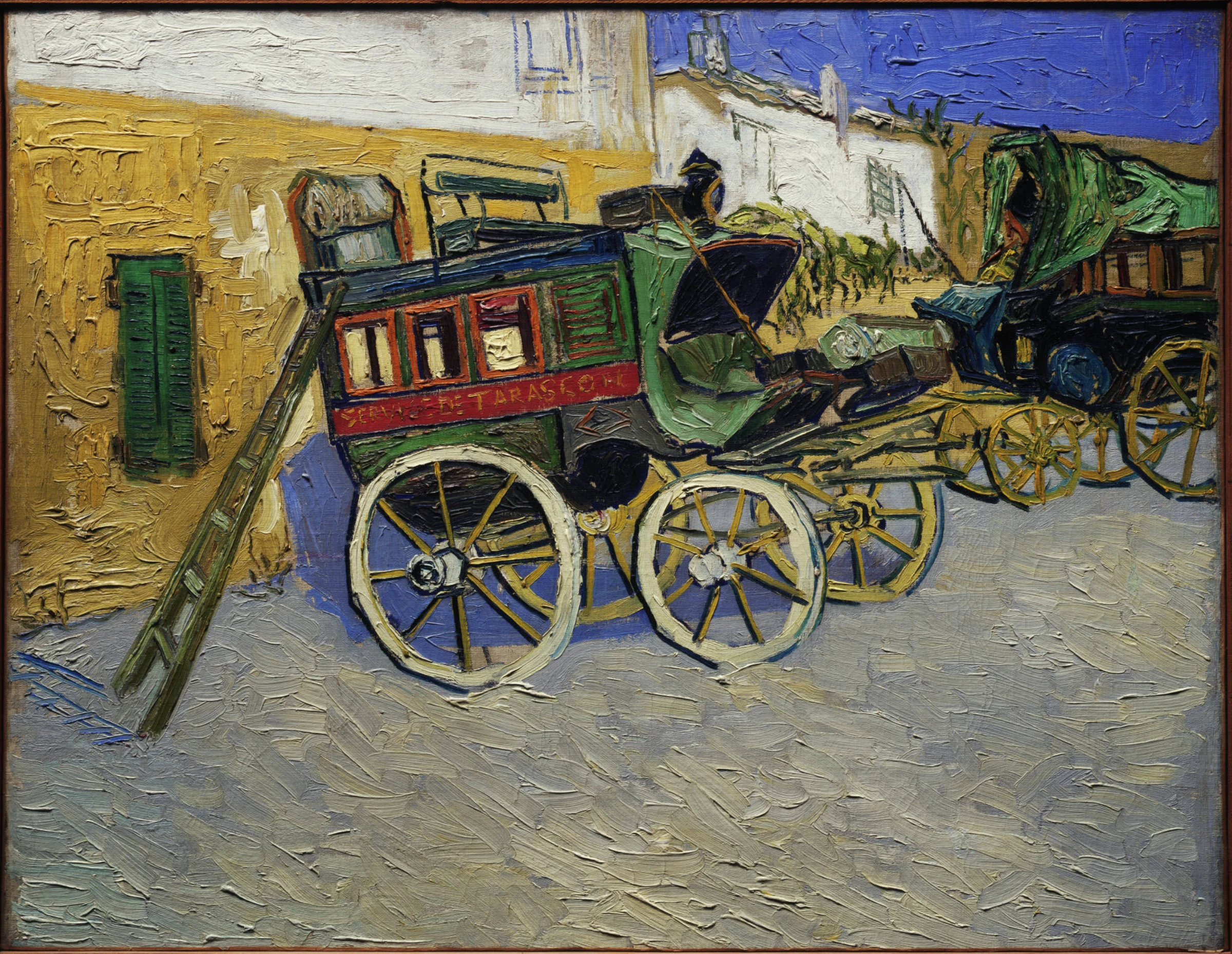
Van Gogh's Tarascon Stagecoach Donated to LACMA
Van Gogh's 1888 Tarascon Stagecoach leads 63 Pearlman Foundation works donated to LACMA, Brooklyn Museum and MoMA in a landmark touring exhibition
A Van Gogh Masterpiece Finds a Permanent Home
Vincent van Gogh's Tarascon Stagecoach (October 1888), one of the most vibrant works from his Arles period, has been donated to the Los Angeles County Museum of Art as part of a landmark distribution of 63 works from the Henry and Rose Pearlman Foundation. The painting was unveiled at LACMA earlier this year and will soon travel to the Brooklyn Museum for the exhibition Cezanne to Modigliani: Gifts of Modern Art from the Pearlman Collection, opening October 2 and running through April 18, 2027. The exhibition will subsequently move to the Museum of Modern Art in New York later in 2027.
The Pearlman Foundation's decision to distribute its collection across three major American museums represents one of the most significant acts of cultural philanthropy in recent decades. Six works went to LACMA, including the Van Gogh, while 29 were donated to the Brooklyn Museum of Art and 28 to MoMA. All 63 works will be displayed together at each venue before being integrated into the museums' permanent collections. The foundation's decision to end its long-term loan to Princeton University Art Museum and distribute the works to public museums reflects a broader shift in how private collectors and foundations think about the long-term stewardship of their collections, prioritizing maximum public access over single-institution custodianship.
The Painting's Remarkable Provenance
Tarascon Stagecoach depicts a horse-drawn coach in the yard of the Auberge de la Poste, the staging post on the boulevard surrounding Arles' ramparts where coaches departed for Tarascon, a town 15 kilometers to the north. Van Gogh had visited Tarascon at least once before painting the work, riding on the same type of vehicle he depicted. On October 13, 1888, he sketched the painting in a letter to his brother Theo, describing its colors in detail: green, red, yellow wheels, black, blue, and orange against a simple grey sand foreground with pink and yellow walls and green louvred shutters. The pink pigment has since faded to nearly white, but the red sign reading "Service de Tarascon" remains the composition's focal point.
The painting's journey from Van Gogh's studio to LACMA spans more than a century and multiple continents. Theo van Gogh originally left the work with the Parisian art dealer Pere Julien Tanguy, who sold it to the Italian sculptor Medardo Rosso in the early 1890s. Rosso reportedly hung it in his studio but faced such criticism from colleagues that he banished it to the attic. In 1895, Rosso gave the painting to his friend, the Uruguayan artist Milo Beretta, making it the first Van Gogh to reach the Americas. After Beretta's death in 1935, his six daughters stored the painting in a bank vault before selling it to Argentine dealer Paula de Koenigsberg in 1946.
The self-made New York entrepreneur Henry Pearlman acquired Tarascon Stagecoach in 1950 through a complicated exchange that involved cash, four genre paintings, two Renoirs, and a Soutine. Pearlman had made his fortune from refrigeration services and became a major collector of Impressionist, Post-Impressionist and Expressionist art after World War II. On Pearlman's death in 1974, his paintings passed to the Henry and Rose Pearlman Foundation, which lent the collection to the Princeton University Art Museum for nearly 50 years. The collection was periodically toured internationally, traveling to Oxford, Aix-en-Provence, Atlanta and Vancouver between 2014 and 2016.
Why This Donation Matters for American Museums
The Pearlman Foundation's distribution strategy represents a deliberate shift from the model of lending an intact private collection to a single university museum. By splitting the works among three major institutions in Los Angeles and New York, the foundation ensures that the collection reaches broader audiences while entering the permanent collections of museums with robust conservation resources and extensive exhibition programs. The decision also reflects a broader trend in American cultural philanthropy, where donors increasingly favor multipurpose gifts that maximize public access over single-institution bequests. University museums, while excellent scholarly environments, often lack the exhibition space, conservation budget, and visitor traffic of major civic museums.
The touring exhibition format means that visitors at each venue will experience the Pearlman Collection as a cohesive group before the works are dispersed into permanent collection galleries. This approach honors Henry Pearlman's original vision of keeping the collection together while acknowledging the practical benefits of distributing works across institutions with different curatorial strengths. The Brooklyn Museum will receive the largest share at 29 works, significantly strengthening its modern European holdings. By placing works at LACMA, Brooklyn, and MoMA, the foundation ensures that the collection will be seen by millions of visitors annually and maintained to the highest museum standards. Similar decisions have shaped other institutional transformations, including the Uffizi's ongoing renovation driven by private and public investment.
Van Gogh in Arles and the Tarascon Connection
Van Gogh painted Tarascon Stagecoach during his most productive period in Arles, the same year he produced The Night Cafe and began decorating the Yellow House in anticipation of Paul Gauguin's arrival. The painting reflects Van Gogh's fascination with the southern French landscape and its distinctive quality of light. His choice of subject was influenced by his reading of Alphonse Daudet's Tartarin de Tarascon (1872), a satirical novel that includes a chapter in which an old stagecoach narrates its hard life. Van Gogh was reading the book that October and found in it a literary parallel to his own fascination with the disappearing world of horse-drawn transport. He told Theo he was exhausted after completing the painting, remarking that he was knocked out and needed to go have supper.
The painting stands as one of the few Van Gogh works that directly depicts a scene of everyday provincial commerce rather than landscape, portrait, or still life. Its emphasis on the stagecoach's colorful livery and the architectural setting of the Auberge de la Poste demonstrates Van Gogh's ability to transform mundane observation into a composition of extraordinary visual energy. The work also carries historical significance as the first Van Gogh painting to reach the Americas, predating by 17 years the arrival of Van Gogh works in the United States. Its permanent installation at LACMA completes a journey that began in Arles, passed through Paris, Montevideo, Buenos Aires, and New York, and now anchors the museum's Post-Impressionist holdings.
Henry Pearlman's approach to collecting was guided by personal passion rather than investment strategy. He acquired works that spoke to him, often through complex trades and exchanges that reflected the informal nature of the postwar art market. The Pearlman Collection includes significant works by Cezanne, Modigliani, Soutine, Manet, and Renoir, alongside the Van Gogh. Together, these works constitute one of the finest private collections of modern European art assembled in the United States during the twentieth century. The foundation's decision to donate rather than sell these works represents a substantial act of cultural generosity, one that will shape the permanent collection holdings of three major American museums for generations to come. For visitors to the upcoming Brooklyn Museum exhibition, the Pearlman Collection offers a rare opportunity to see a private collector's vision preserved intact before it enters museum collections permanently.
The Pearlman donation also raises interesting questions about the future of private collecting in America. As the contemporary art market has become increasingly dominated by institutional buyers and ultra-wealthy speculators, the model of the passionate individual collector assembling a group of works through personal taste and persistence has become rarer. Henry Pearlman represents an earlier generation of collector who built relationships with dealers rather than auction houses, who traded works as much as he bought them, and who lived with his collection in his office rather than storing it in a freeport. The foundation's decision to donate the entire collection rather than sell it at auction stands in contrast to the recent trend of estate sales that have generated headlines for record prices but dispersed collections that took decades to assemble. By choosing museum donation over auction dispersal, the Pearlman Foundation has ensured that the collection's integrity as a group will be preserved and that its scholarly value as a coherent representation of one collector's vision will remain accessible to researchers and the public.
The exhibition tour beginning at the Brooklyn Museum in October will be accompanied by a scholarly catalog that documents the collection's history and individual works. For students of modern European art, the catalog and exhibition provide an opportunity to study works that have been relatively inaccessible during their decades at Princeton. The Pearlman Collection includes several works by Modigliani that are considered among the finest in private hands, including portraits of the poet Jean Cocteau and the sculptor Leon Indenbaum, both painted in 1916 during Modigliani's most productive period. The collection also features significant works by Cezanne, including watercolors and paintings that bridge the gap between Impressionism and the structural innovations that would later influence Cubism. Together with the Van Gogh, these works constitute a survey of the artistic innovations that reshaped European painting in the decades around the turn of the twentieth century, assembled by a collector who approached the project with both passion and intellectual rigor.