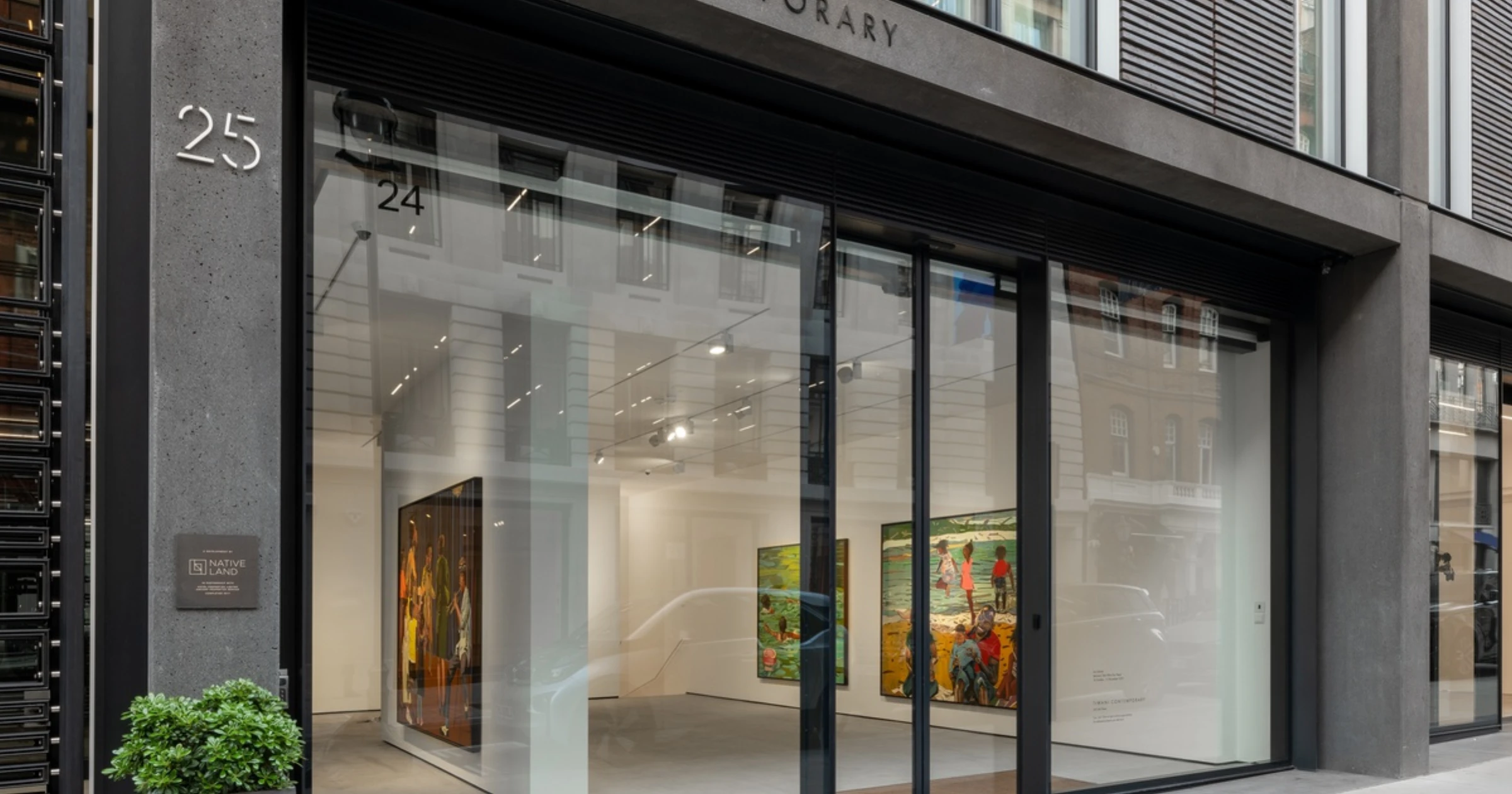
Tiwani Contemporary Closes and Exposes a Market Blind Spot
Tiwani Contemporary closed after 15 years, exposing how weakly the market still supports the galleries that built demand for African diasporic art.
Tiwani built a lane for African diasporic art long before the market treated that work as essential
Tiwani Contemporary's closure after 15 years is not just another story about a gallery that could not make the numbers work. It is a story about who gets rewarded for building a market and who gets stranded once that market becomes fashionable. As The Art Newspaper reported, the London and Lagos gallery has ceased operations after directors concluded that rising costs and wider market uncertainty made its commercial model unsustainable. That wording sounds technical, almost bloodless. The real implication is harsher. One of the few year-round spaces in the UK devoted to artists from Africa and its diaspora helped create cultural value that the broader market was happy to celebrate, but far less willing to stabilize.
Tiwani mattered because it occupied a space between advocacy, scholarship, dealer labor, and institution-building. Founded by Maria Varnava in 2011, the gallery entered a Western market that still treated serious engagement with African contemporary art as specialist terrain rather than central business. It spent years doing the slower work that larger players often avoid: introducing artists patiently, educating collectors, building curatorial trust, and giving artists a consistent platform. The current gallery website still carries the imprint of that mission. Even in closure, what stands out is not a speculative house that flamed out at the top of a frenzy, but a platform that made an ecology more legible and then got caught in the cost structure of the system it helped broaden.
The closure is a warning about how narrow the market remains beneath its rhetoric of expansion
The art trade has spent the last decade congratulating itself for finally paying attention to African and diasporic artists. Auction results rose, fair presentations multiplied, institutions revised their acquisition strategies, and a global language of correction and inclusion took hold. But Tiwani's closure suggests that recognition at the level of discourse does not automatically create durability at the level of infrastructure. If a gallery with Tiwani's track record, relationships, and profile cannot keep its London operation viable, then the market is still far more fragile and selective than its public narrative implies. It may welcome the artists, but it does not necessarily protect the platforms that first invested in them.
That distinction matters. There is a big difference between a market that buys a handful of star names and one that supports the institutions, secondary businesses, and mid-tier galleries needed to sustain a field. Tiwani represented or showed artists such as Gareth Nyandoro, Dawit L. Petros, Joy Labinjo, and Michaela Yearwood-Dan at key stages of their development. Those careers are now legible to a much wider collector base. Yet the economics of maintaining space in London, supporting Lagos activity, shipping works internationally, appearing at fairs, and carrying payroll have become punishing. Readers who followed our guide to mid-market fair discipline will recognize the pattern: visibility is expensive, and the market often rewards the most visible moment rather than the institution that made the visibility possible.
Lagos and London were never just locations; they were a proposition about audience and power
Tiwani's importance also came from geography. The gallery did not simply export African artists into London. It tried to work across London and Lagos, insisting that a gallery serving artists from the continent and its diaspora should not behave as if Europe were the only serious center of validation. That proposition now looks even more important because so many conversations about global art still route value through a handful of cities. The gallery's own framing emphasized dialogue, research, and transnational exchange. Those ambitions are admirable, but they are also expensive. Maintaining that bridge in a cooling market requires a collector base and institutional ecosystem more committed than the rhetoric of globality often suggests.
The announcement that the Lagos operation will cease in its current format while restructuring is explored leaves open a narrow possibility that some part of Tiwani's project will survive. But restructuring is not a neutral pause. It usually means contraction, renegotiation, and a painful sorting of what can continue under pressure. The gallery's withdrawal from Liste Basel next month is especially telling. Fairs are often presented as gateways to liquidity and prestige, yet they also function as capital-intensive tollbooths. For galleries already carrying rent, salaries, shipping, insurance, and production costs, a fair can become less an opportunity than a high-priced bet that must pay out fast. When even respected platforms pull back, the fair economy starts to look less like a ladder and more like a tax.
The industry now has to decide whether it values the infrastructure behind its taste
Tiwani's statement says the business could not sustain its current commercial model. That should force a broader question onto collectors, museums, and larger galleries that have benefited from the field Tiwani helped cultivate: what exactly do they think support means? If support begins and ends with buying works after an artist has been de-risked by smaller galleries, then the sector is merely harvesting value, not sustaining it. A healthier market would not just celebrate inclusion in catalog essays and acquisition press releases. It would direct capital toward the galleries that do developmental labor long before institutional endorsement arrives.
There is also a curatorial cost to this closure. A gallery like Tiwani does more than sell. It shapes discourse, commissions writing, convenes audiences, and places artists in relation to one another outside the faster logic of the auction room. The loss of that mediating layer narrows the texture of the field. The artists will continue to circulate, and some will continue to thrive, but the particular intelligence of a program built over 15 years is harder to replace. A collector can buy a work quickly. Rebuilding trust, audience, and curatorial continuity takes much longer.
The collapse also makes the phrase "wider market uncertainties" sound less like boilerplate and more like a diagnosis. Those uncertainties are not abstract macroeconomic weather. They are experienced as delayed payments, cautious buying, fewer speculative leaps, higher operational bills, and a harsher divide between blue-chip confidence and everyone else. A city like London compounds that pressure with extraordinary property costs and a collector landscape increasingly drawn to the security of giant brands. Under those conditions, mission-driven galleries are often praised symbolically while being priced out materially.
What happens next will determine whether Tiwani's closure becomes a private tragedy or a public lesson. Museums that collected artists first championed by the gallery can document that lineage more openly. Collectors who claim long-term belief in African and diasporic art can think harder about where they spend beyond the obvious trophy names. Other galleries may absorb some artists, but that alone would not answer the structural question. The hard truth is that the market likes to speak about discovery, but it underinvests in the institutions that make discovery possible. Tiwani Contemporary just exposed that contradiction with brutal clarity.
Collectors and museums cannot treat this as someone else's business failure
It would be convenient for the wider sector to file Tiwani away as a regrettable but isolated casualty of a difficult year. That reading would let larger institutions keep enjoying the symbolic prestige of diversity without confronting the economics that make serious representation possible. But the gallery's history makes that dodge harder. Museums increasingly want collection narratives that acknowledge African modernisms, diasporic exchanges, and the uneven geographies of contemporary practice. Collectors want access to artists whose markets now feel globally significant. Both of those desires depended on organizations willing to spend years doing interpretive and relational work before the market looked inevitable. If those organizations disappear, the field becomes more extractive and less intelligent at the same time.
There is a labor question here too. Smaller and mid-sized galleries are often discussed through owners and artists, but they also rely on registrars, installers, assistants, writers, fair staff, and administrators whose work makes a coherent program possible. When a mission-driven gallery closes, it does not just erase an address from a map. It disperses a set of specialized working relationships that are hard to reassemble. The market has become very good at praising programs retrospectively. It is less good at funding the ordinary operating continuity that lets those programs survive long enough to matter. Tiwani's closure is therefore a judgment on the system around it, not just on the spreadsheet inside one business.
That is why this story should linger. A market that truly believed in the depth of African and diasporic art would have found better ways to sustain the galleries that made that belief legible in the first place. Instead, the burden of education, audience-building, and trust creation remains concentrated on a relatively small number of spaces that are expected to perform cultural correction and commercial discipline simultaneously. Tiwani did that work for years. Its shutdown is not proof that the mission was misplaced. It is proof that the market still outsources too much foundational work to institutions it does not support strongly enough when conditions turn.
That is the uncomfortable benchmark Tiwani leaves behind. If the next phase of the market simply redistributes its artists into larger rosters while forgetting the gallery that first held the line, then the sector will have proved that it values outcomes more than infrastructure. A healthier response would involve more transparent institutional acknowledgment, more serious collector loyalty to developmental galleries, and less lazy celebration of diversity as an aesthetic fact detached from the businesses that made it visible. Tiwani's closure should not be romanticized. It should be read as a warning that the market still depends on conviction it does not reliably repay.