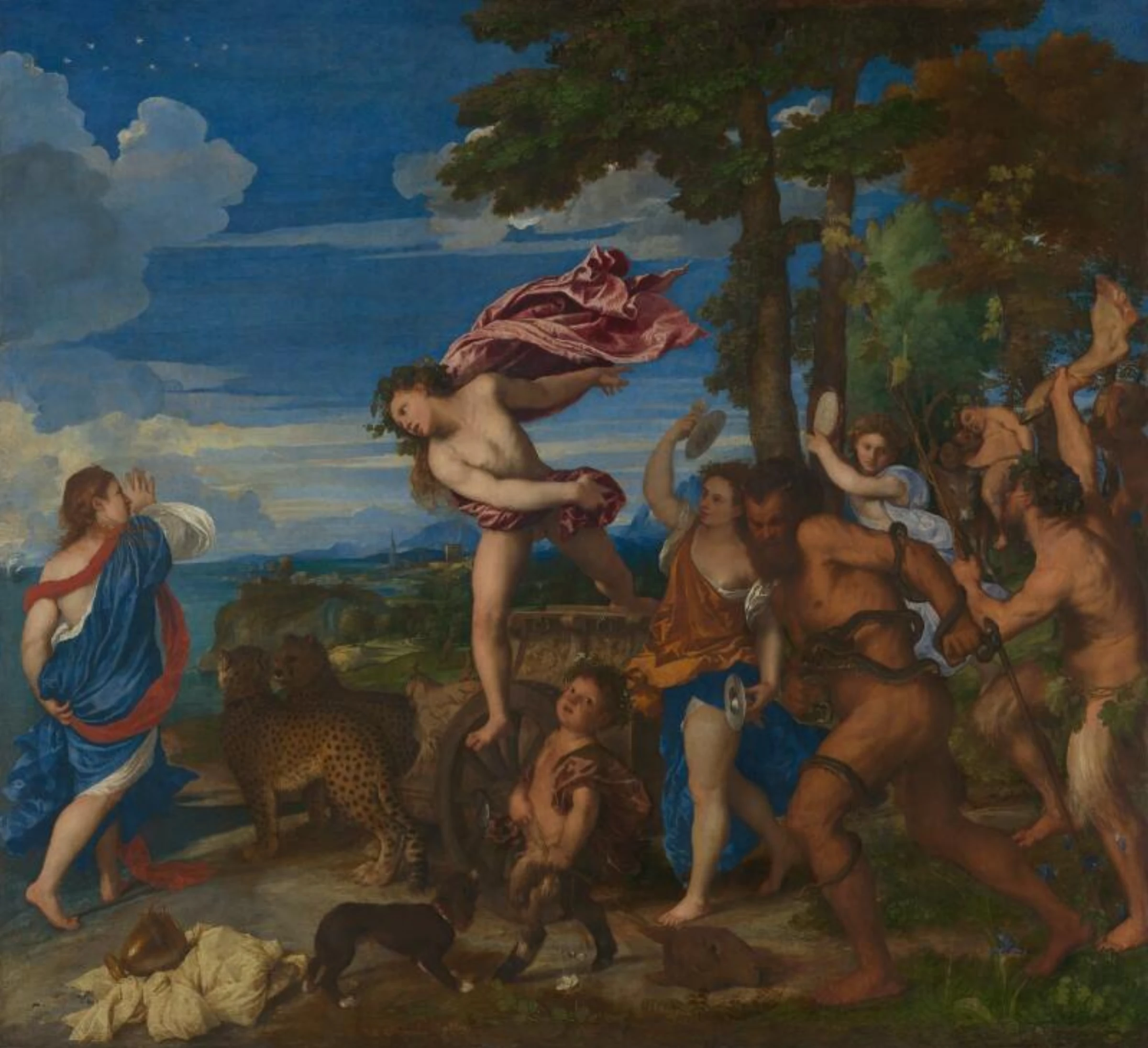
National Gallery to Restore Titian's Bacchus and Ariadne With New Conservation Grant
A Bank of America conservation grant will support major treatment of Titian's Bacchus and Ariadne at the National Gallery, part of a global funding slate that includes the Rijksmuseum's Night Watch and projects in Paris, Tokyo, Lima, and Montreal.
The National Gallery, London is preparing a major conservation intervention on Titian's Bacchus and Ariadne (1520 to 1523), enabled in part by this year's conservation funding cycle from Bank of America's Art Conservation Project. Work is scheduled to begin as construction activity in the gallery's research center requires temporary movement of works. For a painting of this visibility, that logistical trigger is becoming a conservation opportunity.
The treatment plan focuses on structural stabilization. Conservators intend to remove the work from the rigid secondary support installed during a 1960s restoration and place it on a new fabric support more appropriate to the original canvas behavior. That shift is not cosmetic. Support systems determine long-term stress across paint layers, and decisions made during earlier conservation eras, often with good intentions and limited materials science, can become risk factors decades later.
For museum professionals, this project reflects a larger trend in high-value collection care: revisiting legacy restorations with updated conservation ethics and better technical imaging. Rather than pursuing visible transformation, current best practice prioritizes reversibility, structural stability, and meticulous documentation. The public often sees conservation as cleaning, but at this level it is closer to long-term risk management for irreplaceable cultural assets.
The grant context is also instructive. Alongside the Titian, this year's funded projects include the ongoing treatment of Rembrandt's The Night Watch at the Rijksmuseum, bronze conservation at the Arc de Triomphe under the Centre des Monuments Nationaux, stabilization work on the Scroll of Hungry Ghosts at the Tokyo National Museum, and painting conservation in Lima and Montreal. The list demonstrates that conservation philanthropy now spans old master painting, modern works, architectural elements, and fragile works on paper.
Collectors should read this as a reminder that conservation history is part of value history. Condition is not a static report but a layered record of past treatment decisions, materials, and environmental exposure. Institutional projects like this one often shape private-market expectations, especially for works with complex restoration legacies. As museums publish more process documentation, due diligence standards in private transactions tend to become more technical and less speculative.
There is also a public trust dimension. Conservation grants can attract skepticism when brand visibility appears to outpace disclosure. In this case, the relevant test is transparency around method, timeline, and outcomes. The National Gallery's research framework gives the institution a platform to communicate those details in professional terms rather than promotional language. That communication matters because conservation narratives can easily drift into heroic storytelling detached from material evidence.
For audiences, the short-term result is temporary disruption and eventual return. For the field, the more important result is accumulated technical knowledge. Each major intervention on a canonical work contributes comparative data that informs treatment choices elsewhere, from climate strategy to adhesive behavior to varnish removal protocols. In that sense, this grant is less about a single masterpiece and more about maintaining an ecosystem of expertise that keeps collections legible for future publics.
The decision to proceed now, and to pair infrastructure timing with structural treatment, is sound institutional practice. It addresses risk before emergency, aligns funding with technical need, and keeps one of the gallery's defining paintings within a rigorous conservation horizon.