How Collectors and Curators Should Read Art-Fair Signals in a Slower Market
A practical framework for separating marketing noise from real quality signals at contemporary art fairs, with due-diligence steps you can run before, during, and after the event.
Most collectors still evaluate fairs with expansion-era instincts: bigger map, bigger buzz, bigger spend. That playbook is now expensive and increasingly unreliable. In a slower market, the edge comes from distinguishing durable signals from curated noise. This guide offers a practical method for collectors and curators who need to make good decisions under time pressure, without outsourcing judgment to social momentum.
1) Start with fair structure, not fair hype. Before you step onto the floor, read how the fair defines its sections and selection criteria. On Art Brussels sections, for example, the segmentation reveals how organizers position discovery, mid-career programs, and established galleries. Similar structural clues can be extracted from Art Basel, Independent, and The Armory Show frameworks. You are not reading for marketing copy. You are reading for curation logic and incentives.
2) Build a target list with three tiers. Tier A is conviction works you would buy or borrow if condition and price align. Tier B is watchlist artists where your goal is intelligence gathering. Tier C is open exploration for asymmetrical discovery. Assigning tiers before arrival prevents the most common fair error: spending peak attention on booths that are popular but irrelevant to your program.
3) Pre-check institutional context for your top artists. For each Tier A artist, review whether there is credible museum and non-commercial validation. Use primary sources like Tate, MoMA, Guggenheim, and artist foundations. You are looking for trajectory quality, not logo collecting. A single strong institutional context can matter more than five weak fair placements.
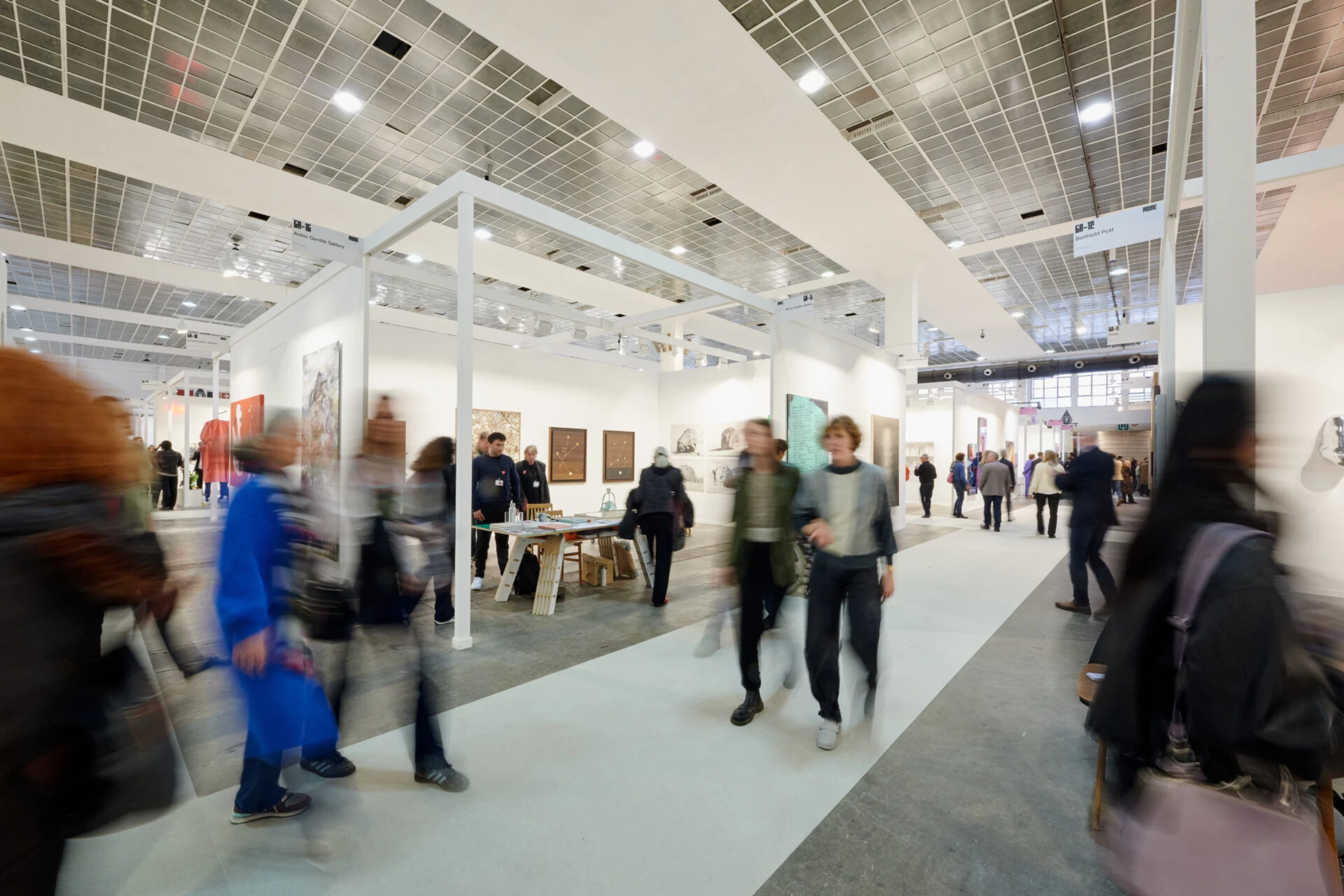
4) Use booth readability as a quality proxy. A good booth has internal argument: formal cohesion, disciplined hanging, and a clear thesis about why these works belong together now. A weak booth is a menu. In a compressed cycle, galleries with strong conviction usually show tighter editing, fewer speculative outliers, and better documentation on demand.
5) Ask three non-negotiable questions at every serious booth. First: what is the artist's next 18-month institutional calendar? Second: which works in this presentation are genuinely available versus soft-reserved theater? Third: what does primary market support look like after the sale, including placement discipline and resale policy? If answers are evasive, downgrade immediately.
6) Separate price confidence from resale fantasy. Fair floors reward urgency language. Your job is to convert urgency into comparables. Request recent primary pricing bands by medium and scale, then ask where this work sits inside that range. For secondary-sensitive artists, cross-check auction behavior via official auction-house resources such as Christie's, Sotheby's, and Phillips. Do not use one headline lot as a pricing model.
7) Condition and fabrication data are strategic, not administrative. Ask for condition report, fabrication notes, install requirements, and edition details before emotional commitment hardens. Large-scale installation and tech-based works can carry hidden long-term costs. Curators should map these costs against institutional capacity early, especially for touring or collection integration scenarios.
8) Track attention quality, not crowd volume. A packed booth tells you very little. Instead, watch who is engaging deeply, advisors, curators, competing dealers, and known institutional buyers, and how long conversations last. Time-on-work is a better indicator than photo traffic. Build a simple note system in real time: 1 to 5 for formal strength, market positioning, documentation quality, and institutional fit.
9) Watch for overproduction risk. In late-cycle moments, some programs scale output faster than demand can absorb. Ask how many works by this artist the gallery has placed in the last 12 months by comparable medium and size. Ask where they went. Serious galleries can answer without theatrics. If inventory velocity sounds too easy, assume placement discipline is weakening.
10) For curators, test exhibition viability at booth level. Can the artist sustain a room, not just one striking piece? Is there enough conceptual and material range to justify institutional framing? Are archival materials, loans, and production support available? If you cannot imagine the artist in your institution beyond one fair hit, move the lead to research status.
11) Use post-fair 72-hour discipline. Most bad decisions happen after the fair, when fatigue and FOMO combine. Within 72 hours, rerank your shortlist against your original Tier A criteria, not against memory of booth excitement. Request missing documents. Reconfirm availability and terms. If the work still scores high after this cooling period, proceed with confidence.
12) Build a long game scorecard. After each fair cycle, review outcomes: which purchases held intellectual value after six months, which research leads matured into institutional opportunities, which galleries provided reliable follow-through. Over two years, this scorecard becomes your private advantage. It also protects you from narrative whiplash when market sentiment swings.
13) Treat fair participation itself as data. A gallery's fair choices, cadence, and booth strategy reveal operating health. Programs that overextend across too many fairs often show inconsistency in quality and collector care. Programs that choose fewer fairs and present stronger, better-supported booths can offer more stable long-term relationships.
14) Calibrate ambition to your mandate. Private collectors can move faster than institutions, but both benefit from explicit thresholds. Define in advance how much risk you are willing to take on emerging names, how much budget is reserved for proven trajectories, and what share goes to works that deepen your collection narrative rather than chase market heat.
15) Final principle: fewer decisions, better decisions. In a compressed market, winning does not mean buying more. It means buying and borrowing with better reasons, better timing, and better documentation. The collectors and curators who outperform this cycle will not be the ones who saw every booth. They will be the ones who built a repeatable method for reading signals under noise.