Turquoise Mosaic Skull Repatriated to Mexico from Netherlands
A Mixtec human skull adorned with turquoise mosaic returns to Mexico after six decades in a Dutch museum, following a grassroots campaign by Mixtec community
What Happened
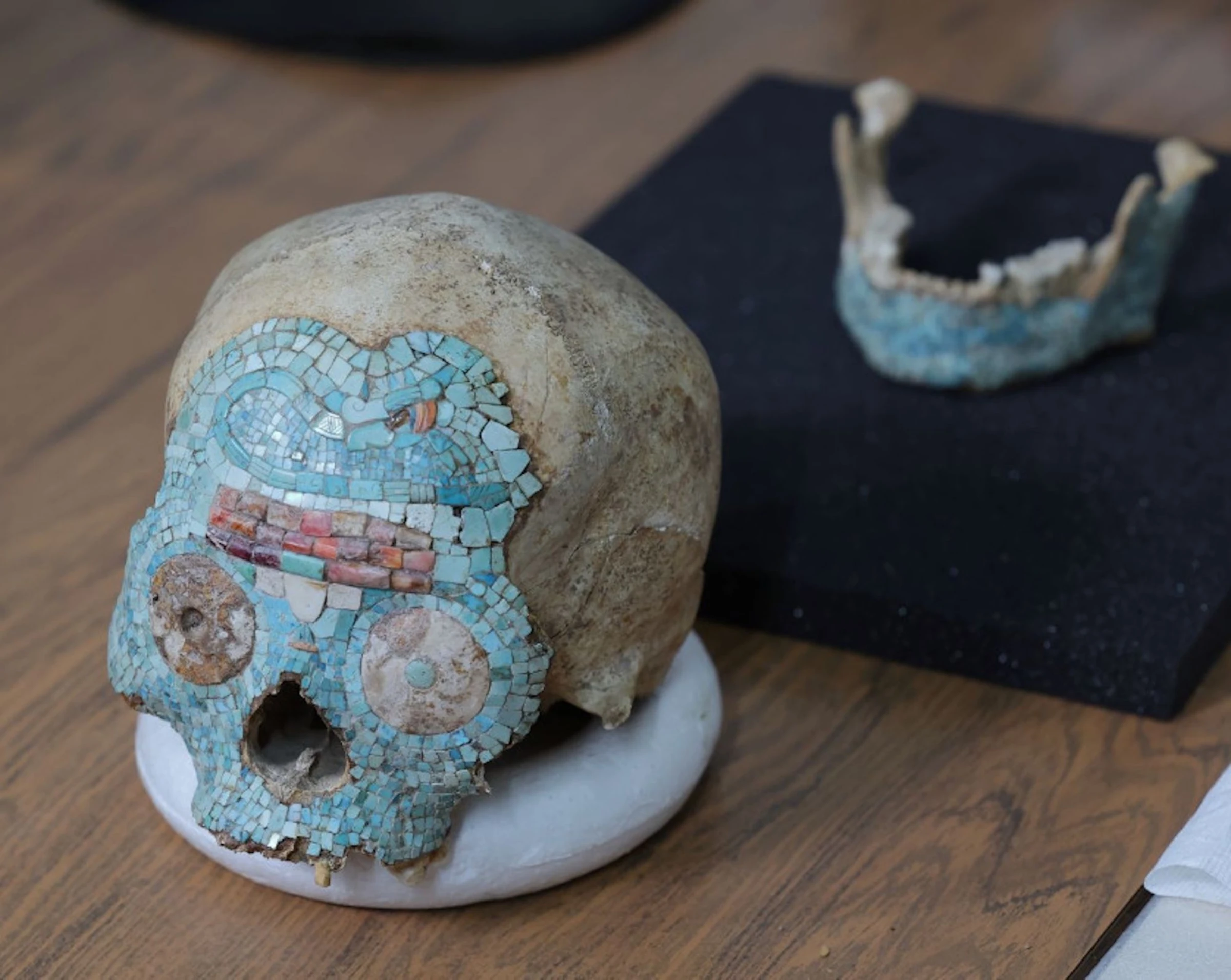
A Mixtec human skull adorned with turquoise, shell, jadeite and quartz has been repatriated to Mexico after spending more than six decades in the collection of the Wereldmuseum in Leiden, Netherlands. The skull, whose mosaic embellishment was likely assembled in modern times from pre-Hispanic materials, arrived in Mexico in May 2025 and is now in the custody of Mexico's National Institute of Anthropology and History (INAH). It is destined for the Yucu Saa Community Museum in Villa de Tututepec, Oaxaca, where it will go on display in April 2027.
The repatriation follows a grassroots campaign led by the Nchivi Nuu Savi collective, a Mixtec cultural organization founded in 2020 to promote the Nuu Savi language, culture and rights, and the Mexican artist Daniel Aguilar Ruvalcaba, who discovered the skull's location during a residency at the Rijksakademie in Amsterdam in 2022. The campaign gathered 1,020 petition signatures from Tututepec residents demanding that the skull be displayed at their community museum rather than at a national institution. The collective organized community workshops, built alliances with cultural organizations across Mexico, and worked with international heritage advocates to pressure both Dutch and Mexican authorities to act.
The case highlights the growing movement for community-led repatriation efforts in Mexico, where Indigenous communities are increasingly asserting their right to steward their own cultural heritage. It also raises complex questions about authenticity, provenance, and the ethics of displaying human remains that have been modified for the art market, questions that conventional museum practice has been slow to address.
The Skull's Complex History
The skull's provenance is murky. In 1964, the Wereldmuseum's then-director Pieter Hendrik Pott acquired it from the American dealer Robert Stolper. No provenance records accompanied the acquisition, but the skull was believed to date to the Late Postclassic Period (AD 1300 to 1521) and was displayed in the museum's Central and South American gallery for decades. The lack of documentation is itself a symptom of the trade in looted cultural objects that flourished in the mid-20th century, when museums routinely acquired objects from dealers without asking questions about their origins.
Concerns about the skull's authenticity prompted analyses in 2011 and 2012, published in a 2013 paper by the archaeologist Martin Berger. The studies revealed that the skull belonged to a male between 35 and 49 years of age from southern Mexico, supporting a Mixtec association. The mosaic materials are pre-Hispanic, though some shells were likely buried earlier, and 99 percent of the adhesive is modern. Berger concluded that the skull as it appears today is a modern combination of ancient elements, likely created in the border region of Puebla and Oaxaca, where turquoise has been found in dry caves along with burials.
The skull is one of ten similar examples worldwide, most of which are also modern combinations. The only turquoise-mosaic skull found in a proper archaeological context is the one from Monte Alban's Tomb Seven in Oaxaca, discovered in the 1930s, which differs in form and function from the other known examples. For Berger, the Wereldmuseum skull illustrates how Indigenous ancestors were disrespected in service of the international art market, but also how they can be reappropriated into community histories through repatriation. The fact that the skull was modified using ancient materials to create a marketable object speaks to the way looters and dealers treated Indigenous remains as raw material for commercial production.
The Campaign for Return
Aguilar's discovery of the skull during his Amsterdam residency catalyzed a multi-year campaign. He partnered with the Nchivi Nuu Savi collective, and the Yucu Saa community museum later joined the effort, holding community workshops to build local engagement with the repatriation cause. The group worked on a formal restitution petition, but in 2023, Mexican authorities made a separate request to the Dutch government, which was approved in December 2024. Aguilar says the collective's campaign was disregarded by Mexican officials, prompting the Tututepec residents to petition INAH directly for display at their community museum.
There was a fair amount of institutional ghosting, Aguilar reports, with authorities taking over a year to respond to the community's demands. The experience reflects a pattern seen in repatriation cases worldwide, where state institutions often position themselves as the legitimate recipients of returned cultural property, bypassing the communities whose advocacy made the return possible. Mexican culture minister Claudia Curiel eventually acknowledged the collective's initiative, stating that the government recognizes the collective's work, whose work contributed to the skull's return and its reconnection with community memory. The tension between the community-led campaign and the state-to-state diplomatic process reflects a broader debate within the repatriation movement about who speaks for Indigenous heritage.
The Nchivi Nuu Savi collective has framed the return as an act of historical justice and dignity. A representative of the collective described the lack of provenance as a consequence of violence, stating that the return is also an act of recognition and respect for ancestors, their memory, and the bond between the living community and those who came before them. This framing shifts the conversation from archaeological authenticity to cultural rights, suggesting that the question of who gets to care for ancestral remains is as important as the question of whether the objects are genuine. The collective's approach may serve as a model for other Indigenous communities in Mexico and beyond who are seeking the return of cultural objects from international museums.
What Comes Next
The skull will first be exhibited at the Museo de las Culturas de Oaxaca before its planned display at the Yucu Saa Community Museum in Villa de Tututepec in April 2027. Raul Lopez Nicolas, the director of the Yucu Saa Museum, says the institution is currently working to improve security and exhibition conditions to meet the standards required for display. The delay reflects the practical challenges of community-led heritage stewardship, where institutions in rural areas often lack the infrastructure of national museums. The community has committed to investing in the necessary improvements, viewing the skull's eventual display as a milestone in the broader project of reclaiming Mixtec cultural heritage.
For those who advocated for the ancestor's return, the case could set a meaningful precedent for future restitution efforts in Mexico. Lopez argues that well-organized communities can safeguard heritage under the highest standards, debunking the centralist notion that significant cultural objects can only be exhibited at big national museums. The success of the Tututepec campaign may embolden other Indigenous communities in Mexico to pursue similar repatriation claims, potentially reshaping the landscape of cultural heritage management in a country with one of the world's richest archaeological traditions. The case also demonstrates that repatriation is not solely a matter of diplomatic negotiation between states, but can be driven by community organizing and cultural activism from below.
The case also speaks to broader international debates about the repatriation of cultural objects from European and North American museums to their countries of origin. The Wereldmuseum's willingness to return the skull, once a formal request was made, stands in contrast to the more contentious repatriation battles involving institutions like the British Museum and the Pergamon Museum in Berlin. Whether the Mexican case signals a shift in the global politics of repatriation remains to be seen, but the Mixtec community of Tututepec has demonstrated that organized, community-led campaigns can succeed even against the inertia of institutional resistance and state bureaucracy. The skull's return is a small victory in a much larger struggle, but it is one that may echo far beyond Oaxaca and beyond the specific circumstances of this single repatriation case.
The Wereldmuseum, for its part, has undergone significant changes in its approach to colonial-era collections in recent years. The museum has conducted provenance research on its holdings, engaged with source communities, and developed a repatriation policy that is more transparent than many of its peer institutions. The skull's return is consistent with a broader shift in Dutch museum practice, accelerated by the Dutch government's 2021 commitment to return cultural objects taken from former colonies. The Netherlands has emerged as a leader in European repatriation efforts, establishing a dedicated committee to review claims and developing guidelines that other countries have looked to as a model. The skull case, while modest in scale, adds to the growing body of precedent that is gradually reshaping the relationship between European museums and the communities whose cultural heritage they hold.
For the Mixtec community of Tututepec, the return of the skull is not the end of a campaign but the beginning of a new chapter. The community must now prepare to receive and display the skull, building the infrastructure and developing the interpretive frameworks that will make the object meaningful to future generations. The Yucu Saa Community Museum, which will serve as the skull's permanent home, is a small institution by any standard, but it represents a growing movement of community museums in Mexico that are reclaiming the right to tell their own stories. If the Tututepec model proves successful, it may inspire other communities to pursue similar claims, creating a network of community museums that challenges the monopoly of national institutions on cultural heritage display and interpretation.