Tbilisi Reclaims Rusudan Gachechiladze as a Modernist Anchor
ATINATI's Tbilisi exhibition on Rusudan Gachechiladze argues that Georgian modernism cannot be told without the sculptor's formal daring and teaching legacy.
ATINATI is using one exhibition to redraw the map of Georgian modernism
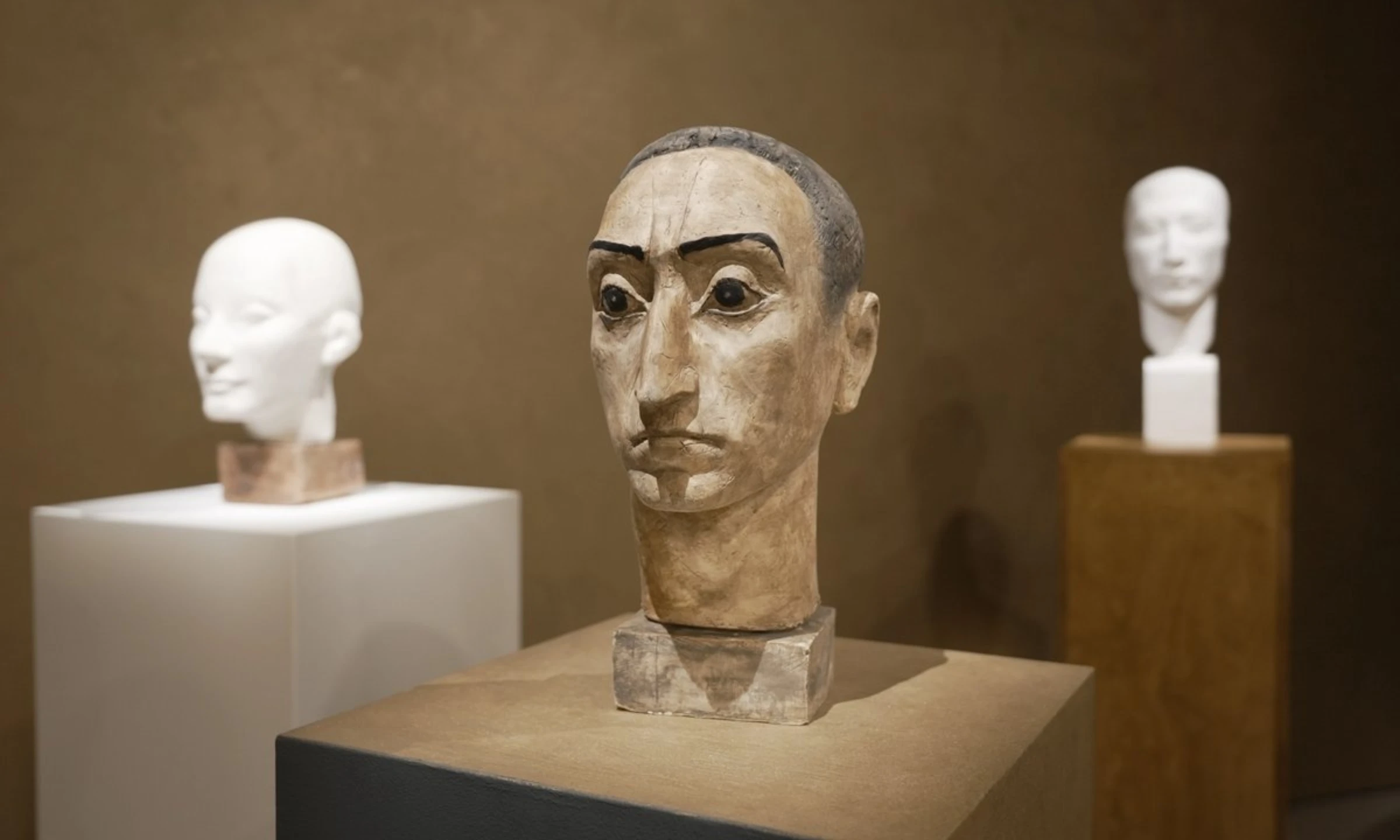
The new Rusudan Gachechiladze exhibition at ATINATI's Cultural Center in Tbilisi is not simply a memorial show for an admired sculptor who died last November. It is a pointed curatorial argument about where Georgian modernism lives and who gets written into its story. As The Art Newspaper reported, the exhibition gathers portrait heads, bronzes, plasters, and later works on paper to position Gachechiladze as a central figure in postwar Georgian sculpture. That matters because artists from the Soviet period are often flattened into regional footnotes or trapped inside an exhausted realism versus dissent framework. ATINATI is arguing for something richer: that Gachechiladze developed a formal language capable of belonging simultaneously to Georgian cultural history and a broader modernist conversation.
Born in 1937 and active both as artist and teacher at the Tbilisi State Academy of Arts, Gachechiladze worked within an institutional system that rewarded official conventions while still finding room for experiment. Her portrait sculpture moved away from literal likeness toward a more reduced, psychologically charged form. That shift sounds technical, but it is the heart of the story. Modernism in many smaller or politically constrained art histories is not only about breaking publicly with the past. It is often about testing how much structure, simplification, and expressive freedom can be smuggled into established genres before the genre itself starts to feel transformed.
The exhibition treats plaster not as a lesser medium but as evidence of a damaged cultural record
One of the most revealing aspects of the show is its insistence on plaster. Many of Gachechiladze's works survive in plaster rather than in durable cast materials, a fact that could easily be used to diminish them or relegate them to the status of studies. Instead, ATINATI turns that vulnerability into part of the exhibition's meaning. The persistence of plaster speaks to the material conditions of Soviet and post Soviet cultural production, to uneven preservation, and to the fragility of sculptural legacies that were never fully institutionalized. In other words, the medium records not only the artist's choices but the history of what the system did and did not sustain.
That gives the show a quiet political charge. To exhibit these works now, drawn from a collection of more than 3,000 objects assembled by ATINATI, is to say that preservation cannot be left entirely to state narratives or to the accidents of inheritance. Nonprofit initiatives, private collections with public ambition, and digitally savvy cultural platforms are increasingly doing the work of reconstructing local modernist genealogies. This is true in Tbilisi as much as in many other cities outside the old Western canon.
The later drawings included in the exhibition deepen that point. They show Gachechiladze continuing to think sculpturally through line in her seventies and eighties, producing athletes, riders, religious figures, and allegorical bodies that carry forward the same constructive logic found in the earlier sculpture. That continuity matters. It stops the artist from being remembered as a period piece and instead presents a long practice of formal inquiry that adapted while remaining recognizably her own.
ATINATI is also making a claim about women's authority inside Georgian sculpture
Sofio Chakvetadze's comments in the article are especially telling on this front. She describes Gachechiladze not only as a formal innovator but as a figure who strengthened the visibility of women within Georgian sculpture. That should not be treated as a supplementary virtue. It is part of the core art historical argument. A field shaped by academies, public commissions, and patriarchal institutional memory rarely grants women sculptors automatic centrality. A show like this works against that tendency by linking artistic force, pedagogical impact, and historical visibility in a single frame.
There is also a broader regional significance here. Postwar modernism in Eastern Europe and the Caucasus is often narrated through painting, architecture, and avant garde episodes that can be more easily internationalized. Sculpture, especially portrait sculpture, is harder to market as radical. Gachechiladze's work complicates that hierarchy. Her heads compress intimacy and monumentality, local subjecthood and international form. They suggest that portraiture, far from being conservative by definition, can become a site of formal pressure where likeness is pushed toward structure and psychology.
That is why the exhibition title matters less than the installation logic. By showing portrait heads beside bronzes and late drawings, ATINATI makes an argument about continuity across media and decades. The institution is not merely celebrating a respected elder. It is rebuilding the conditions under which viewers can see a coherent oeuvre.
What this show signals for the writing of smaller art histories
Exhibitions like this one do not always register loudly in the international art press, but they often do the hardest historiographic work. They restore scale, sequence, and seriousness to artists whose legacies have been dispersed by political transition, weak conservation, or provincializing habits in global art history. In that sense, ATINATI's project belongs to a wider movement in which local institutions and foundations take responsibility for narrating their own modernisms rather than waiting to be rediscovered from abroad.
The most interesting part of the Gachechiladze story is that it resists easy packaging. She was neither an underground myth nor a conveniently exportable dissident. She was a teacher, a sculptor of portrait heads, a maker of plaster works, and an artist who negotiated the Soviet system without being reducible to it. Those are exactly the kinds of careers that get lost when art history is written only through market stars and monumental breakthroughs. Recovering them requires patient exhibition making, not just headline rhetoric.
ATINATI appears to understand that. The institution has been using its collection and cultural center to build a more continuous account of Georgian art from modernism to the present, and this exhibition sharpens that mission. If the show succeeds, its effect will not be limited to one artist's reputation. It will give viewers a stronger vocabulary for understanding how Georgian sculpture evolved, how women shaped that evolution, and how much cultural memory depends on institutions willing to do the slower work of preservation and reframing. That is what makes this more than a local tribute. It is an editorial intervention in the canon, and a necessary one.
The exhibition also opens a question about scale and translation. Many national art histories become visible internationally only when they can be reduced to a handful of exportable names or movements. Georgia, like many places with layered imperial and post imperial histories, is often read that way from outside. Gachechiladze does not fit the convenient template. Her sculpture is neither folkloric branding nor spectacular rupture. It is disciplined, intimate, and formally insistent. That makes her harder to package, but it also makes her more valuable to serious art history. She demonstrates how a regional modernism can be fully modern without needing to mimic the heroic narratives that usually dominate the canon.
There is a museum studies lesson here too. When institutions recover artists through focused, collection driven exhibitions, they do more than correct omission. They create the evidentiary basis future scholars, curators, and collectors can build on. Cataloguing, installing, photographing, and publicly arguing for an artist changes the archive itself. In that sense, ATINATI is not merely preserving Gachechiladze's legacy. It is expanding the conditions under which that legacy can travel. A work that was once locally known but poorly contextualized can become legible to international researchers once an institution gives it sequence and argument.
That argument is strengthened by the teaching dimension of Gachechiladze's career. Artists who teach for decades often reshape a field less through headline masterpieces than through habits of looking, standards of discipline, and permission structures for younger practitioners. Chakvetadze's emphasis on Gachechiladze's pedagogical influence suggests that the exhibition is tracing a dispersed authorship, one that lives not only in finished objects but in the formal confidence of later Georgian sculptors. Recovering such a figure requires more than biographical respect. It requires showing how a studio language moved outward through institutions, students, and the broader cultural imagination.
That is why the exhibition deserves attention beyond Georgia. It models a way of writing smaller art histories without apology or provincial defensiveness. Instead of begging for international validation, it starts from the internal importance of the work and builds outward. The resulting picture is sharper than the familiar discourse of discovery. Gachechiladze does not need to be invented as significant by an external market. She needs to be presented well enough that viewers can see the significance already there. ATINATI appears to understand that distinction, and it gives the show its authority.
There is even a useful parallel with our recent reporting on Tate's reconstruction of its 1926 modern foreign galleries. In both cases, the institution is not just hanging works on walls. It is rebuilding an account of how art history was organized, who counted, and what earlier narratives left out. ATINATI does that work on a different scale and with far fewer resources, but the intellectual move is similar. Revision is not a fashionable add on to display. It is one of the main jobs serious cultural institutions perform when they want the past to become newly visible.