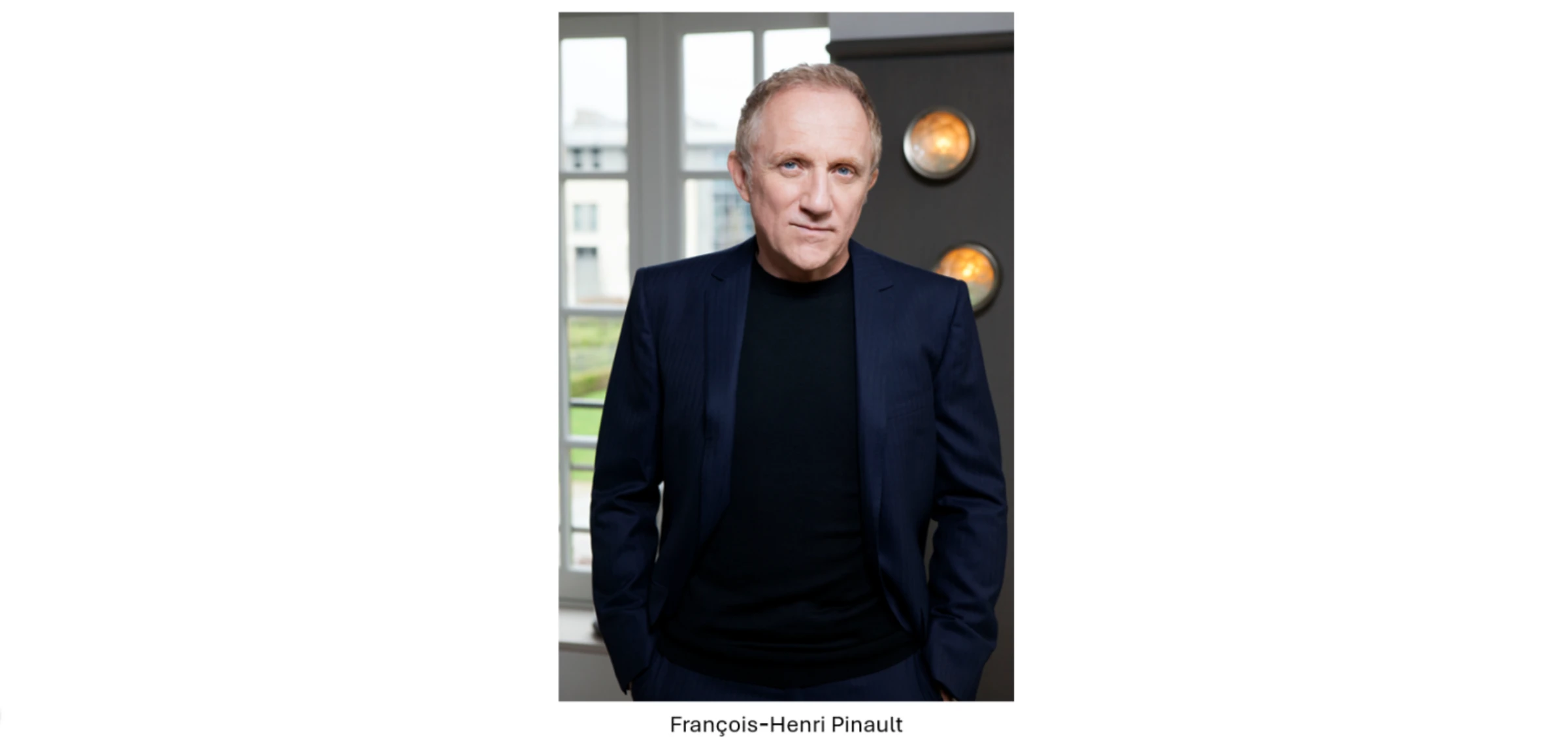
Christie's London Tightens the Pinault Grip
François-Henri Pinault taking the chair at Christie’s London makes family control more explicit at a delicate moment for the global auction trade.
This is not a routine appointment but a governance signal
Christie's London has named François-Henri Pinault chairman and non-executive director, a move first reported by Artforum and rooted in the firm's 22 May board announcement. On paper, the change can look straightforward: the head of Kering and president of Groupe Artémis takes a more formal board role at the auction business his family already owns. In practice, it reads as a clear consolidation of authority at a moment when the art market is anxious about leadership, margins, and the difference between luxury branding and auction-house expertise. Christie's is not merely rotating directors. It is signaling that the Pinault family wants tighter, more visible authorship over the firm's next phase.
That matters because Christie's has spent the last several years navigating a market that remains globally powerful but uneven in mood. Trophy objects still ignite bidding wars, as we saw in the recent marquee sales season, but the broader trade is more cautious, more financing-dependent, and more exposed to geopolitical and wealth-cycle shocks than auction-house publicity usually admits. In that environment, governance decisions matter more than ceremonial job titles suggest. A board chair can shape how aggressively a company pursues guarantees, how it thinks about private sales versus public auction theatre, and how much it leans into luxury adjacency as opposed to specialist credibility.
The appointment sharpens the family line through Christie’s
François-Henri Pinault is not an outside fixer parachuted in to stabilize the business. He sits at the center of the ownership structure already. As Christie's own announcement makes clear, he is both chairman of Kering and president of Groupe Artémis, the Pinault family's holding company and Christie's parent. That dual role collapses the supposed distance between shareholder and steward. It suggests the family no longer wants Christie's London to look like a prestigious outpost overseen at arm's length. It wants a more legible chain of command, with a recognizable Pinault name attached directly to the board.
There is also succession texture here. François-Henri Pinault is replacing Guillaume Cerutti in the board-chair role after Cerutti's brief and puzzling detour to the Pinault Collection. Cerutti had been Christie's CEO from 2017 to 2025 before moving to lead the family collection, only to leave that role after thirteen months. Those shifts matter because they hint at a family empire still refining the boundary between its commercial arm, its collecting apparatus, and its cultural prestige assets. When one of the world's most influential art-market families starts redrawing those internal lines in public, the story is not personnel. It is power management.
Christie's will naturally frame the move as continuity, and in one sense it is. The Pinault family has owned the auction house since 1998. But continuity can still harden into concentration. Readers who followed our recent coverage of the auction market's dependence on high-value spectacle will understand why that matters. When markets get thinner below the trophy tier, owners tend to assert themselves more directly. The question is whether this produces clarity or overcentralization.
Luxury logic and art-market logic are not always the same thing
François-Henri Pinault arrives with formidable experience in luxury, global branding, and capital discipline. Those are strengths. They are not identical to auction-house judgment. The temptation in today's market is to imagine that art businesses can be run as extensions of luxury culture, where prestige, exclusivity, and clienteling solve most strategic problems. Sometimes that works. Christie's has undeniably benefited from operating near the Pinault ecosystem of fashion, prestige retail, and cultural influence. But auctions are also weird, cyclical, specialist institutions built on scholarship, relationships, guarantees, consignor psychology, and market timing. They require connoisseurship and risk tolerance in combinations that do not map neatly onto the luxury sector.
That tension is why this appointment deserves scrutiny rather than automatic applause. If Christie's London becomes more of a family-branded luxury platform, it may gain coherence at the top while losing some of the autonomy and specialist trust that made auction houses distinct in the first place. If, on the other hand, Pinault's board role brings sharper discipline without flattening expertise, Christie's could emerge more decisive than rivals that remain caught between old-house tradition and new-market volatility. The outcome depends on what kind of control this is: symbolic, strategic, or operational.
The addition of Bryan Lourd, a powerful entertainment agent, to the London board underlines the broader strategy. Christie's appears to be reinforcing itself not only through art-market veterans but through adjacent influence networks: luxury, entertainment, global celebrity, and ultra-high-net-worth client management. That is intelligent in commercial terms. It is also revealing. The auction house of 2026 increasingly behaves less like a neutral marketplace and more like a hybrid platform where culture, wealth signaling, and relationship capital blur together.
London remains essential even as the market globalizes
The fact that this shift centers on Christie's London rather than some abstract global role is important. London remains one of the auction world's symbolic command centers even as Hong Kong, New York, Paris, and digital sales platforms redistribute influence. To tighten board oversight there is to say that London still matters as a reputational stage. It is the place where old-market authority is displayed, even when capital and bidding have become more internationally dispersed. For the Pinault family, visibly taking the chair in London says something about where institutional seriousness is still performed.
That seriousness comes at a complicated time for the city. London's art trade continues to navigate post-Brexit friction, competition from Paris, and the broader question of whether Britain can retain its historic market centrality while wealth, logistics, and political confidence shift elsewhere. A stronger owner presence can be read as reassurance: Christie's is not retreating from London. But it can also be read as defensive positioning. When markets feel stable, elite families often let structures run with less fanfare. When they tighten the line of sight, they usually see turbulence ahead.
What the move says about confidence and control
None of this means Christie's is in trouble. It means ownership is choosing visibility over distance, and that choice usually carries strategic intent. Auction houses survive on confidence, but confidence is not just about hammer totals. It is about the belief among consignors, buyers, guarantors, and staff that the institution has a coherent center. By installing François-Henri Pinault more directly in the London board structure, the family is trying to make that center unmistakable.
The harder question is what kind of confidence this produces. There is a version in which the move reassures top clients that Christie's remains firmly backed, globally connected, and willing to make long-horizon bets. There is another version in which it confirms how concentrated the upper art market has become, with auction houses, luxury conglomerates, celebrity networks, and family collections all circling the same narrow band of wealth. Both readings can be true at once. The art trade has become expert at presenting consolidation as elegance.
There is an internal labor dimension here as well, even if auction-house governance stories rarely mention it. Specialists, dealmakers, client strategists, and operations staff all read appointments like this as clues about which kinds of authority will carry weight inside the company. A chair drawn more visibly from ownership can strengthen confidence if staff believe decisions will be faster and priorities clearer. It can also narrow the room for dissent if employees conclude that strategic debate has already been settled at the family level. In markets dependent on personal expertise, morale is not cosmetic. Top talent follows the institutions where autonomy and backing still feel compatible.
For consignors, the move may be attractive precisely because it looks concentrated. Sellers of major property want to know who can underwrite ambition, authorize risk, and stand behind the spectacle if a sale becomes complicated. A more visibly Pinault-led Christie’s can promise that kind of conviction. But conviction has a cost. The more the house identifies itself with family power and luxury authority, the more closely each underperforming season, guarantee misfire, or strategic wobble will attach to that same family signature. Consolidation clarifies accountability as well as command.
The broader art market should read this appointment as another sign that the era of supposedly neutral intermediaries is fading. Auction houses are no longer just matching engines between sellers and buyers. They are increasingly branded ecosystems with owners, affiliated collections, financial products, media strategies, and relationship networks that stretch far beyond the saleroom. Christie’s London tightening the Pinault grip does not break that trend. It names it out loud.
One more thing to watch is whether this governance shift changes the texture of Christie's public language. Auction houses have become fluent in talking simultaneously to collectors, fashion-adjacent clients, finance-minded observers, and cultural institutions. That balancing act is hard to sustain when ownership becomes more visibly personalized. A Pinault-chaired London board will be expected to project both scholarship and strategic aggression, both heritage and growth. If the rhetoric tips too far toward luxury confidence, specialists may bristle. If it stays too cautious, the appointment will look ornamental. The language around the next major seasons will reveal which version of Christie’s is being built.
What happens next will tell us whether this was mainly pageantry or a real shift in governance culture. Watch for changes in senior hiring, cross-platform luxury partnerships, private sales emphasis, and how Christie's positions itself against Sotheby's and newer data-driven market platforms. Governance stories matter because they prefigure commercial behavior. The appointment of François-Henri Pinault is not interesting because a powerful man got a powerful seat. It is interesting because it shows one of the art market's most consequential dynasties deciding that indirect influence is no longer enough.