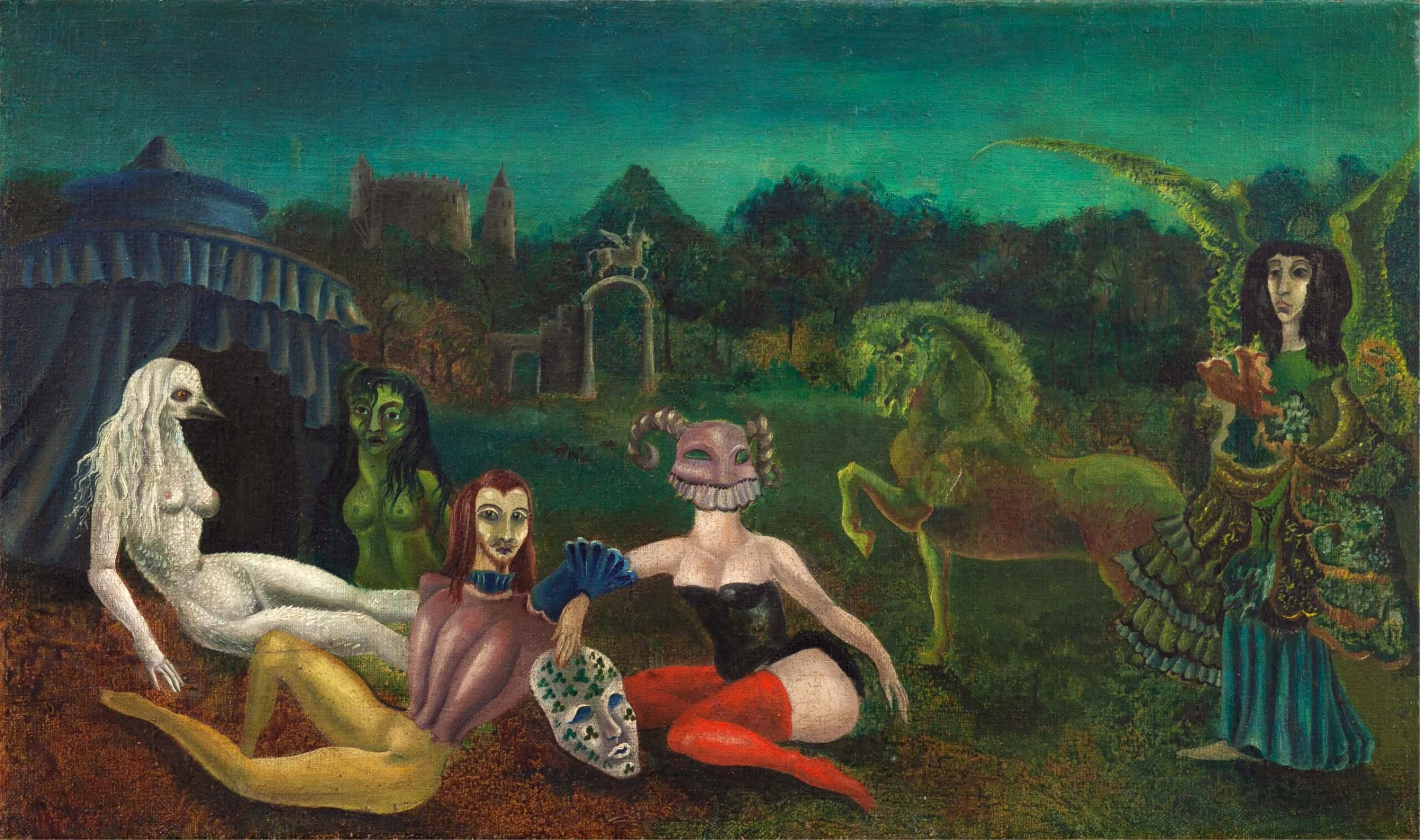
Lost Leonora Carrington Painting Gets First Public Showing
A Freud Museum extension turns a rediscovered 1940 Carrington canvas into a test of how institutions frame trauma, recovery, and market heat.
Freud Museum turns a rediscovery into a public event
Leonora Carrington's Villa Pilar, a 1940 painting missing for decades, will go on public view for the first time at the Freud Museum's exhibition Leonora Carrington: The Symptomatic Surreal. The immediate news, first flagged by Artforum, is simple enough: the London show has been extended to 10 August so that the long-lost canvas can join the exhibition from 1 July. But the larger significance lies in how institutions now package rediscovery. This is not just a fresh object entering a checklist. It is a work born out of psychiatric confinement, reappearing inside a museum context built to foreground the psychological violence and formal ambition of Carrington's Santander period.
That framing matters because Carrington's wartime biography is too often reduced to a dramatic anecdote on the way to her later myth. The Freud Museum has built the exhibition around her drawings, letters, and early paintings from 1938 to 1941, insisting that the work made around her hospitalization belongs at the center of her story rather than at its margins. By adding Villa Pilar, the museum is not merely expanding attendance potential. It is making a sharper curatorial claim that the visual world Carrington built under duress deserves to be read closely, materially, and institutionally, not just biographically.
The rediscovery also lands in a market environment that treats the phrase long-lost with predictable excitement. Carrington's profile has risen steadily in museums and salesrooms alike, and every resurfacing object is now vulnerable to being read first as a market event. The Freud Museum's challenge is to resist that flattening. It must hold together two truths at once: rediscovered works can indeed reshape scholarship, and they can also become instant trophies in a market hungry for scarcity narratives. Serious institutions have to keep the first truth from being devoured by the second.
Why the Santander paintings carry unusual weight
Carrington arrived in Santander after a brutal collapse triggered by war, displacement, and the arrest of Max Ernst in Nazi-occupied France. Her time at Sanatorium Morales left marks across her writing and painting that would shape the rest of her career. The Freud Museum notes that the exhibition follows her movement from occupied France through Spain to New York, where she rejoined Surrealists in exile in 1941. That itinerary is not decorative background. It is the map of a body and imagination forced through political catastrophe.
The works from this period matter because they show Carrington forming a language for psychic extremity without surrendering formal precision. The museum describes recurring motifs of horses and the underworld, while Artforum notes the animal-human hybrid figures that haunt both Down Below and Villa Pilar. These are not illustrations of breakdown. They are acts of reordering. Carrington turns confinement, coercion, and fear into a pictorial system whose logic is her own. That is why the rediscovered painting is more than a newly available image. It is another piece of evidence for how early and how fiercely she developed the symbolic architecture that later made her one of Surrealism's most singular figures.
There is also a local dimension. After London, the exhibition will travel to Faro Santander, bringing the work back into the city where this chapter unfolded. That matters because rediscovery stories are often written from the vantage of global art capitals, as if cultural meaning only crystallizes once London or New York notices. In this case the Santander context is not peripheral. It is foundational. If the project succeeds, the work will not simply be absorbed into Carrington brand management. It will remain tied to a specific geography of trauma, treatment, and survival.
Institutions love rediscovery stories because they do several jobs at once
Museums are drawn to rediscovered works for reasons that are intellectual, logistical, and promotional all at once. A rediscovery promises scholarship, press coverage, urgency, and scarcity in a single package. It can extend a run, revive a press cycle, and persuade audiences that a show they thought they understood has changed in meaningful ways. The Freud Museum is hardly unique in recognizing that power. What distinguishes strong institutions from weak ones is whether the work itself survives the promotional machinery.
Here the signs are encouraging. The exhibition had already been organized around Carrington's symptomatic, wartime, and psychologically charged output rather than around a generic celebration of a famous Surrealist. Adding Villa Pilar therefore feels like an extension of the argument rather than a cynical appendage. It helps that the museum can pair the work with Down Below and with documentary materials that let viewers see how image, writing, and lived crisis fed each other. That density is the best defense against the now-standard rediscovery script in which a lost masterpiece is announced, toured, monetized, and only thinly interpreted.
Readers who saw our earlier coverage of Carrington's resurfaced Villa Pilar painting will recognize the continuity. The story was never just that a work turned up. It was that the institutions around it had to decide what kind of story the resurfacing would tell. Will Carrington be presented as a damaged visionary redeemed by rediscovery, or as a formal and intellectual force whose difficult work has too often been sentimentalized? The answer will shape how this painting enters the public imagination.
What this means for Carrington scholarship and for viewers now
For scholars, the public showing of Villa Pilar offers the chance to compare a once-hidden work against the better-known paintings and texts of 1940 in real space rather than by rumor. Questions of scale, surface, palette, and compositional rhythm can finally move beyond reproduction. That may sound technical, but it is exactly how art history gets revised. Rediscoveries matter not because they are dramatic but because they alter the evidentiary field. A single work can sharpen arguments about chronology, motif, influence, and the evolution of an artist's symbolic language.
For ordinary viewers, the stakes are different but no less real. Carrington is widely admired, yet she is often consumed in fragments: the rebellious debutante, the Surrealist lover, the occult icon, the feminist cult figure. The Freud Museum show asks for a more disciplined attention. It asks visitors to look at drawings, letters, and paintings produced under catastrophic pressure and to recognize how exacting the work remains. That is harder than admiring Carrington's myth. It is also more rewarding.
There is, finally, a quiet institutional lesson here. When museums extend shows to accommodate a rediscovered work, the extension can read like marketing spin. In this case it can also be read as a sign that curators were willing to let the exhibition remain alive to new evidence. That is what serious exhibitions should do. They should be arguments sturdy enough to hold new material without collapsing into spectacle. If Villa Pilar changes how this exhibition is seen, good. That means the show is behaving like scholarship rather than branding.
One detail worth holding onto is the show's insistence on letters and sketchbooks alongside finished pictures. That curatorial choice cuts against the market reflex to isolate one rediscovered canvas and treat it as a self-sufficient miracle object. Carrington's wartime production was not a sequence of disconnected masterpieces. It was a dense field of notes, images, correspondences, and recurring signs through which she worked out how to survive intellectually as well as physically. Museums that foreground process rather than just revelation give viewers a better chance of understanding how an artist thinks under pressure. That matters especially for Carrington, whose legend has too often floated free of the rigor visible in the work itself.
There is also a conservation question lurking beneath the press cycle. A work held privately for decades can look stable in reproduction while still carrying material surprises once it enters a museum's lighting, transport, and display systems. Public display does not only reveal iconography. It reveals condition, handling history, and the practical realities of stewardship. That matters for Carrington because so much of the current enthusiasm around her work risks floating above the physical object itself. Museums earn trust when they make rediscoveries visible as things with surfaces, fragilities, and histories of care, not just as headlines with a good backstory.
Just as important is the matter of audience education. Carrington now attracts viewers from several overlapping publics: surrealism specialists, feminist art readers, younger audiences drawn by her icon status, and collectors tracking a rapidly canonized market. Those groups do not enter the gallery with the same expectations, and a rediscovered work can easily become a mirror for whatever each group already wants from her. The institution's job is not to flatten those expectations into consensus but to sharpen them into better questions. A rediscovery is most valuable when it makes viewers less certain and more attentive.
What comes next is straightforward on paper but revealing in practice. London gets the first public display from 1 July, and Santander receives the work when the show travels in September. Watch how each institution talks about the painting. Watch whether the language centers biography, market rarity, or formal invention. And watch whether future Carrington exhibitions treat the Santander material as a difficult core rather than as a dramatic side chapter. Rediscovered works do not speak for themselves. Institutions decide the accent. This summer, the Freud Museum has a chance to get that accent right.