Mnuchin Rothko Anchors Sotheby's May 2026 Sale
Mark Rothko's 1957 canvas from Robert Mnuchin's estate sold for $85.7 million as Sotheby's opened New York's May auctions with a cautious but credible rebound
Mark Rothko's 1957 canvas steadies the first big New York sale
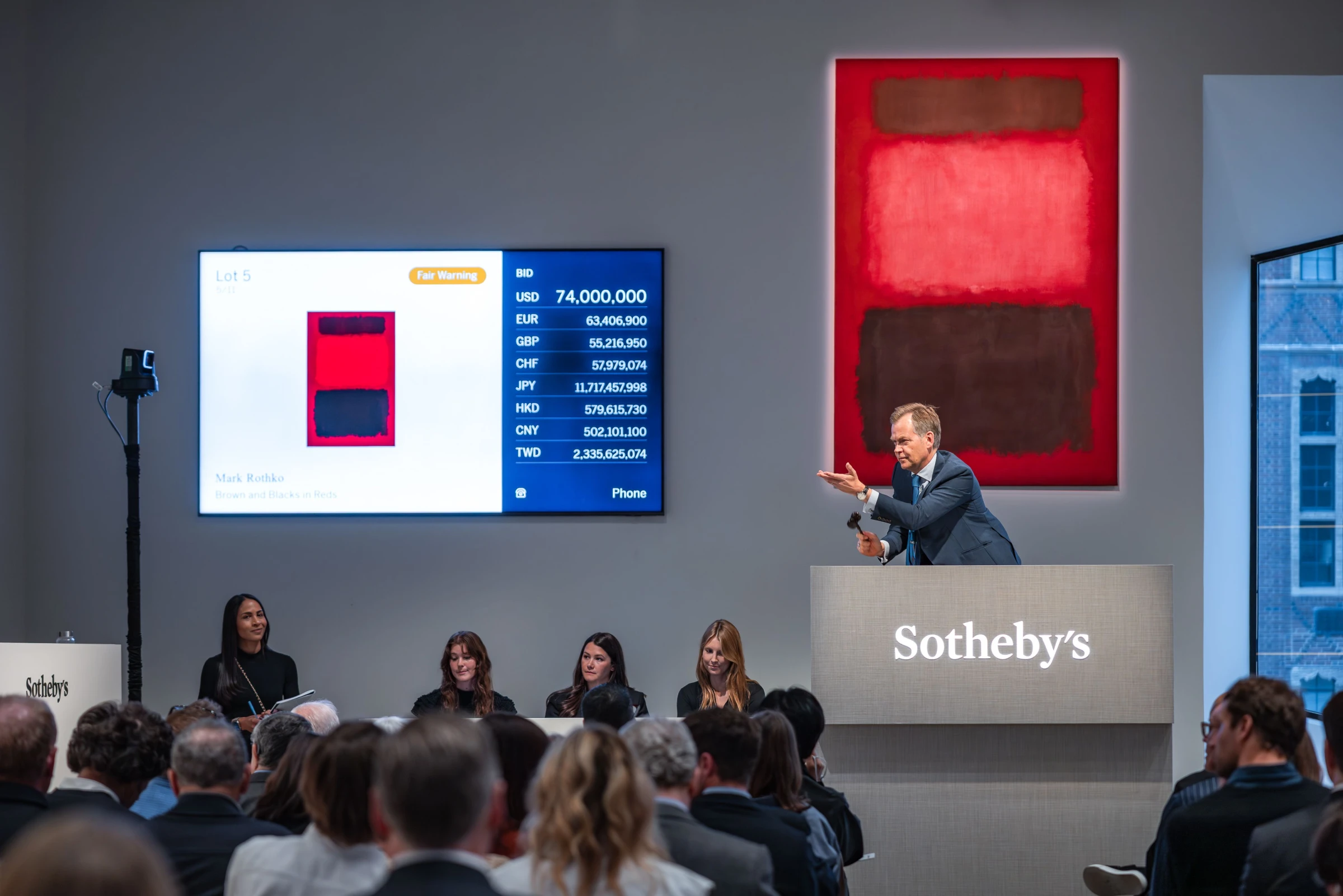
Sotheby's opened New York's May auctions with the kind of result the market badly wanted: not delirium, not collapse, but a sale that looked expensive, disciplined and broadly defensible. The evening's headline lot was Mark Rothko's Brown and Blacks in Reds from 1957, consigned from the estate of dealer Robert Mnuchin and sold for $85.7m with fees after reaching a $74m hammer price. That figure left the picture just below Rothko's auction record, but it still gave the night a clear center of gravity. According to The Art Newspaper's sale report, Sotheby's combined Mnuchin's collection with a contemporary evening session to total $433.1m with fees, a figure that landed within estimate and, more important, without the air of emergency discounting that has haunted recent seasons.
The structure of the sale mattered as much as the headline number. Mnuchin's 11 works were all guaranteed, either by the house or a third party, turning that section into a calculated risk-management exercise rather than a test of raw demand. In practice, that meant Sotheby's could stage certainty where the broader market has lately offered very little. Yet guarantees do not invent bidders out of thin air, and the Rothko still had to perform in public. Its result, paired with solid prices for works by Willem de Kooning, Joan Miró, Franz Kline and Jeff Koons, gave Sotheby's what it needed: a persuasive opening statement at the start of a season crowded by fairs, macroeconomic anxiety and collector hesitation.
Robert Mnuchin's collection carried prestige, price history and a familiar logic
Mnuchin's estate was always likely to draw attention because it condensed several decades of upper-tier market behavior into a compact group of blue chip works. Mnuchin was not merely a collector but a Wall Street figure turned dealer whose name had long been associated with strategic buying, especially in postwar American art. Sotheby's leaned into that pedigree, presenting his group as both a memorial sale and an argument for connoisseurship. The strategy worked because the provenance was easy to understand and because the price history of several works made the profit narrative impossible to ignore. The Rothko had been bought at Christie's in 2003 for just under $6.8m with fees; now it returned at more than twelve times that figure.
That kind of appreciation does not simply flatter the seller. It reassures bidders that the top end of the market still rewards long holds, museum-grade material and impeccable provenance. This is exactly the story auction houses want to tell in 2026, when collectors are more selective and financing conditions are less forgiving than they were during the ultra-liquid years. Sotheby's backed the Mnuchin group with guarantees because the house understood that prestige alone no longer closes the deal. But prestige still matters. A Rothko with Seagram-era history, a late de Kooning, a Kline shown at Mnuchin Gallery, and a 1949 Rothko from the same estate together created a sale with internal coherence. For collectors deciding where to place capital, coherence is not trivial. It signals curation, and curation can still function as a form of market insulation.
The Mnuchin tranche also revealed how much of the present auction season is built on works with prior lives at rival houses. The Art Newspaper noted the irony that several of the night's major lots had themselves come through Christie's in earlier years. That is not just anecdotal trivia. It is evidence that the market's most expensive objects circulate through a very small ecosystem where houses compete not only for bidders, but for the right to narrate an artwork's previous successes. Each new sale is also a rewrite of a price history.
Beyond the trophy lot, the room showed selective confidence rather than mania
The rest of the evening reinforced a pattern that has become typical of the current cycle: buyers are willing to compete, but not indiscriminately. Works with strong provenance, clear market comparables or unusually fresh narratives drew bids. The younger end of the sale produced records for Ding Shilun and Yu Nishimura, suggesting that appetite for emerging names has not vanished so much as narrowed toward artists who can be framed as institutionally legible and internationally mobile. Meanwhile, better-known figures such as Ed Ruscha, Alma Thomas, Helen Frankenthaler, Agnes Martin and Joan Mitchell delivered competent results that kept the sale moving without generating the kind of euphoric overshoot that auction houses once advertised as proof of vitality.
That distinction matters. A healthy market is not necessarily one in which every estimate is crushed. In fact, after several years of volatility, a sale that behaves rationally may be the more convincing sign. Sotheby's mixed guaranteed blue chip property with a contemporary section that could still surface upside, especially in the so-called Now category. The result was a room that looked managed but not dead. Bidders were present, telephone banks were active and private dealers were still prepared to jump in when price, quality and timing aligned. What the market did not show was abandon. Even Jean-Michel Basquiat's Museum Security, which reached $52.7m with fees, read less like speculative frenzy than like a reminder that canonical names retain their force when the work is strong enough.
Collectors have become more exacting about what counts as strong enough. The biggest winners in this environment are not simply famous artists, but famous artists represented by works that feel both scarce and easy to place within an accepted art-historical narrative. That is why Rothko still matters at this level. The artist's market is deep, the critical consensus is stable and the best works bridge private collecting and museum ambition. Sotheby's was not selling mere luxury inventory. It was selling reassurance in the form of art history.
What the sale says about guarantees, liquidity and the May auction season
The most honest reading of Sotheby's night is that the market has not rebounded into exuberance; it has reorganized around risk control. Guarantees are the clearest sign of that shift. They allow houses to secure valuable consignments, but they also move a portion of the risk offstage, redistributing it among the house, third-party backers and, indirectly, the financialized logic that now sits behind much top-tier art dealing. When observers point to a high sell-through rate, the first question in 2026 is no longer whether bidders showed up. It is how much of the result was pre-engineered before the auctioneer took the podium.
That does not make the result fake. It makes it contemporary. Today's auction market is a hybrid structure in which public bidding, private guarantees, advisory influence and branding all interact. Sotheby's knows this, and the Mnuchin sale was designed accordingly. By opening the season early, in the middle of fair week, the house also inserted itself into a wider scramble for collector attention. Buyers in town for Independent, Frieze New York and the surrounding fair ecosystem were reminded that major auction houses still control the market's loudest theater.
The timing also matters because the next sales at Christie's and Phillips will now be read against Sotheby's benchmark. A merely acceptable result can feel like weakness if a rival has already posted a stable total. Sotheby's succeeded in setting the conversation. It placed a near-record Rothko at the top of the season, flashed respectable depth across categories and made the market appear sober rather than panicked. In a softer economy, that may be the closest thing to bullishness available.
What comes next after the Rothko headline
The key question now is whether this opening result reflects genuine seasonal momentum or simply a well-insulated single evening built around carefully selected property. If Christie's and Phillips post similarly disciplined totals, the May season could solidify the idea that high-end collectors remain active so long as supply is selective and pricing is realistic. If those houses struggle, Sotheby's performance may look less like a rising tide and more like a one-night demonstration of how effectively guarantees can engineer confidence.
There is also a subtler issue beneath the totals: what kinds of consignments owners will feel comfortable releasing later in the year. Sellers watching this auction will have seen evidence that first-rate postwar material can still move cleanly, but they will also have noticed how carefully the evening was insulated. That may encourage more blue chip consignments while discouraging middling property from coming to market unless expectations are reset. In that sense, Sotheby's did not just sell art. It helped shape the supply psychology for the next cycle of consignors, advisors and estates.
Either way, the Mnuchin Rothko has done its work. It reasserted the staying power of postwar abstraction at the very top of the market and reminded sellers that the best material can still command extraordinary numbers without requiring speculative hysteria. It also exposed the limits of today's optimism. The art market in 2026 is still willing to spend, but it wants every condition controlled first. That is not the swagger of a boom. It is the posture of wealth that has learned to demand certainty before applause. For Sotheby's, one well-pitched night was enough. For the rest of the season, it is only the opening argument.