ROM's Widad Kawar Acquisition Redraws Arab Dress History
ROM's Widad Kawar acquisition gives Toronto a major public archive of Arab dress and heritage arts with real stakes for diaspora history and museum practice
Toronto Lands a Collection That Changes the Map
The Royal Ontario Museum has acquired the Widad Kawar Collection of Arab Dress and Heritage Arts, a group of nearly 600 garments, accessories, and domestic objects assembled over decades by Palestinian collector and textile historian Widad Kamel Kawar. The basic announcement, reported by Artforum and expanded in the museum's own official release, sounds like standard acquisitions news. It is not. This is a structural move that materially enlarges what a North American museum can show, teach, conserve, and argue about the Arab world.
ROM says the acquisition spans the Levant and other Arab countries including Egypt, Iraq, Libya, Morocco, Oman, Saudi Arabia, Sudan, the United Arab Emirates, and Yemen. The institution also says the transfer turns its holdings into the largest public collection of its kind in North America. That claim matters because Arab dress has too often been split between anthropology, folklore display, fashion, and decorative arts, with the result that living cultural histories are flattened into craft or costume. Kawar's collection resists that reduction. It is not just a cache of attractive textiles. It is a record of social life, women's labor, regional identity, migration, ceremony, and survival.
Why Widad Kawar's Method Matters as Much as the Objects
Kawar's authority does not rest on accumulation alone. According to ROM, she spent decades documenting the makers behind the garments and interviewing embroiderers, weavers, silversmiths, and other artisans to preserve the stories attached to each object. That documentary ethic is a critical distinction. Too many museum collections arrive severed from use, memory, and community knowledge. Kawar spent a lifetime trying to prevent that severing. Her archive is powerful because it treats garments not as isolated masterpieces but as containers of biography, geography, and social structure.
That approach is visible at Tiraz: Widad Kawar Home for Arab Dress in Amman, which she founded in 2014 as a space for preservation and public access. The ROM acquisition should therefore be read in two directions at once. On one hand, it is a major gain for Toronto. On the other, it asks whether global institutions can receive regionally grounded collections without draining them of the scholarship and politics that made them meaningful in the first place. Museums love to say they are preserving heritage. The harder work is preserving context, language, and accountability once heritage enters a larger institution.
ROM Is Betting That Diaspora Audiences Will Treat This as Their Own History
ROM's statement is explicit about audience. Kawar said she chose the museum in part because Canada is home to communities from across the Arab world and because she believed they would find joy and recognition in seeing their cultural heritage publicly cared for. That is a different rationale from the old encyclopedic museum script, where institutions justify collecting the world in order to educate a generalized public. Here the museum is being asked to serve specific diasporic constituencies whose family histories, textiles, techniques, and memories are implicated in the collection itself.
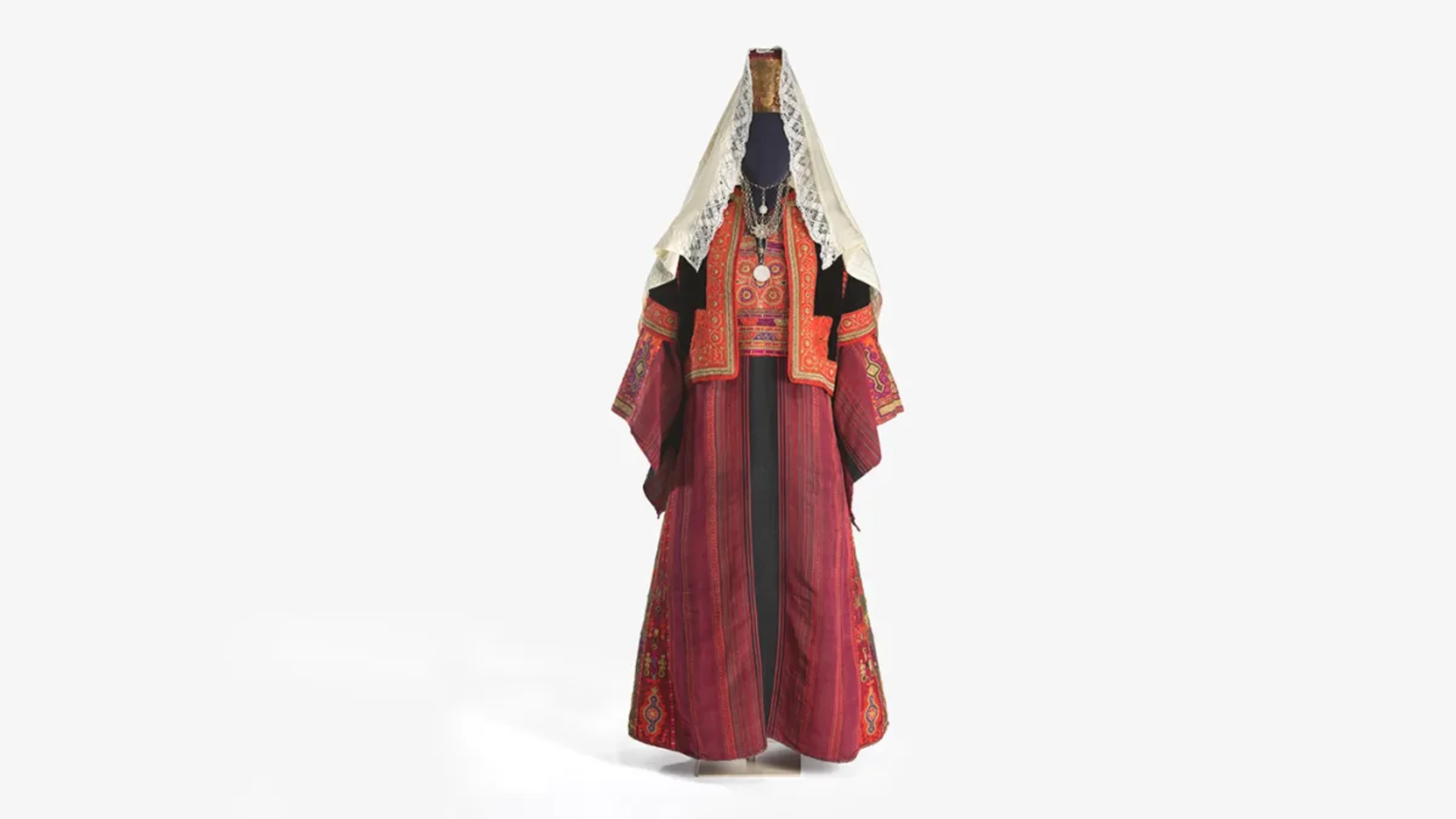
This can be productive, but only if ROM avoids the temptation to convert the acquisition into a simple diversity triumph. Arab textiles have entered North American museums before, often through exoticizing frames that treat embroidery as timeless ornament and sidestep the histories of displacement, colonial extraction, and political fracture that shape both the region and its diaspora. The value of the Kawar collection lies in its precision. Bridal garments, headdresses, jewelry, and domestic objects carry clues about class, village life, urban transformation, marriage, trade, and the changing conditions of women's work. If the museum exhibits the collection as atmosphere rather than evidence, it will have missed the point.
There is also the matter of chronology. ROM describes the acquisition as centered on carefully selected twentieth-century objects, which means the museum is not simply collecting deep history in the abstract. It is collecting the material record of a century marked by colonial partition, mass displacement, postwar nationalism, labor migration, and the constant remaking of family and regional identity. Dress registers those pressures with unusual clarity. Stitch patterns, imported fabrics, hybrid tailoring, and altered ceremonial use can tell a social historian as much as an archive of official documents. If the museum does this right, the collection could push viewers away from the stale split between art and ethnography and toward a more rigorous understanding of how people wore politics on the body.
The Institutional Stakes Go Beyond One Acquisition
ROM notes that curators Fahmida Suleman and Sarah Fee worked with Kawar and her team in Jordan to determine which 586 objects would enter the collection. That process suggests a more collaborative model than the older museum habit of simply buying or accepting gifts and writing retrospective meaning around them. It also raises the bar for what responsible collecting should look like. Institutions often rush to announce gifts as proof of ambition. artworld.today's guide on how to read museum acquisition roundups made the point that the important questions are scale, fit, interpretive capacity, and public consequence. ROM appears to have answered those questions more seriously than most.
There is still a politics to where such collections end up. Some readers will reasonably ask why one of the largest public collections of Arab dress in North America should be in Toronto rather than in a museum in the region from which the material emerged. The fact that Kawar personally chose ROM does not erase that question; it reframes it. Her choice seems to have been guided by trust in the museum's conservation record, existing holdings, and the demographic reality of Toronto as a city shaped by migration. That does not settle every debate, but it does locate the acquisition within a logic of stewardship rather than simple market transfer.
It also sharpens comparison with other institutional acquisition headlines, many of which amount to incremental collecting around already secure canons. This is different. ROM is not merely buying prestige; it is accepting the obligation to care for an archive whose value depends on language, family history, regional literacy, and public trust. That is harder than hanging another canonical painting in a familiar wing. It requires conservation expertise, but it also requires humility about who holds knowledge. The museum will need to keep active relationships with scholars, makers, and community members who can stop the collection from being translated into a generic multicultural success story.
What Comes Next Will Determine Whether This Is Transformative
ROM says an elaborately embroidered bridal gown and jacket from the acquisition are already on temporary display, with a larger original exhibition in development. The real test starts there. Will the museum build interpretation with scholars and community members who can speak to the specific histories embedded in these objects? Will it commission new research, translations, and programming that keep the collection legible across generations? Will it connect dress to political history rather than presenting it as a safe aesthetic category? Those choices will decide whether the acquisition becomes a landmark or just another proud institutional announcement.
For now, the significance is clear. Kawar did not simply donate beautiful things. She transferred a method, an argument, and a challenge. The argument is that Arab dress belongs at the center of serious art-historical and material-cultural discourse. The challenge is that once a museum accepts such an archive, it must earn the right to interpret it. ROM has secured a collection capable of redrawing public understanding of Arab textile history in North America. Now it has to prove it knows what to do with that responsibility.
That opportunity extends beyond exhibition design. A collection like this can reshape teaching, loan networks, conservation priorities, and the questions future scholars ask about Arab modernity. It can also force a museum to become more precise in public language, because garments tied to place, family, and ceremony do not tolerate vague multicultural framing for long. If ROM invests in the research infrastructure this acquisition deserves, the result could influence other museums across North America that hold smaller, less visible dress collections and have not yet learned how to interpret them with comparable seriousness.
There is another reason this matters now. Museums across North America are scrambling to prove relevance to diasporic audiences without always changing the shape of their collections or scholarship. ROM has, at least on paper, made a more serious move. It now has the chance to connect textiles to migration history, women's knowledge systems, regional aesthetics, and questions of cultural continuity that are usually left fragmented across departments. If it follows through, the collection could become a benchmark for how institutions handle living heritage without reducing it to ornament or nostalgia.
For curators elsewhere, the acquisition should feel like a challenge rather than a feel-good headline. If one museum can make a long-term commitment to a collection with this degree of social and historical depth, then others will have less excuse for treating textiles from the Arab world as occasional supplements to fashion shows or decorative-arts rotations. The field can either learn from the scale of this move or continue pretending that such material is too specialized for broad public investment. ROM has chosen a side. Now the rest of the sector gets to show whether it was paying attention.