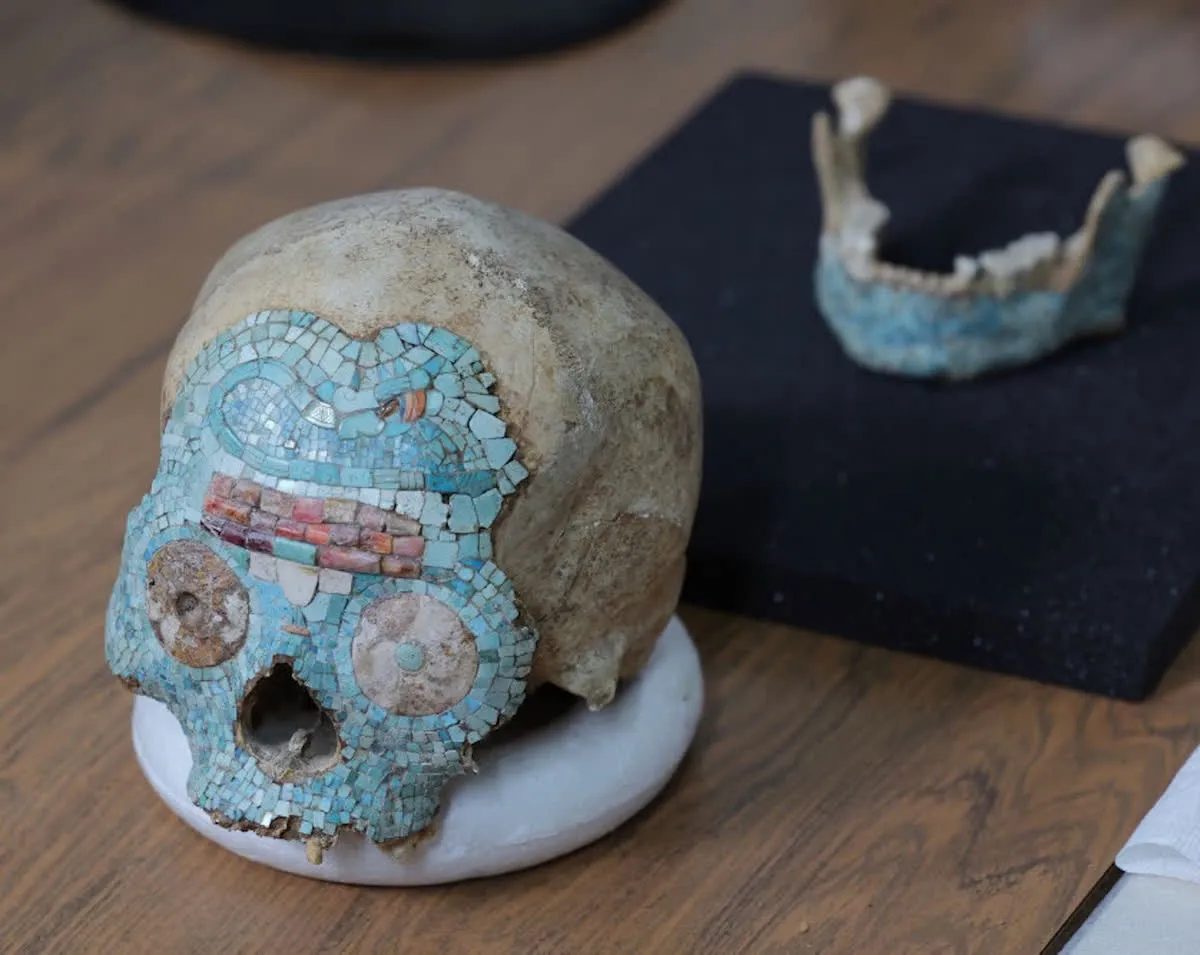
Repatriated Turquoise Skull Returns to Oaxaca
A pre-Hispanic turquoise mosaic skull repatriated from the Netherlands will go on display in a community museum in Oaxaca in 2027
What Happened
An ancient Mesoamerican skull decorated with turquoise, quartz and jadeite mosaic has been repatriated to Mexico from the Netherlands and will go on display in a community museum in Oaxaca in April 2027. The skull, which dates to the Late Postclassic period (1200-1521 CE), was acquired by the Leiden Museum in the Netherlands in 1964 from an American dealer without provenance records. After a two-year campaign by an indigenous-led cultural organization and a contemporary artist, Mexican authorities secured its return, and it is now in the possession of the National Institute of Anthropology and History (INAH). The skull will eventually be displayed at the Yucu Saa Community Museum in Villa de Tututepec, Oaxaca, the region from which it likely originated.
The repatriation process began in 2022, when the contemporary artist Daniel Aguilar Ruvalcaba learned about the skull while at the Rijksakademie in Amsterdam. Aguilar sought the help of the Nohivi Nuu Savi collective, an indigenous-led cultural organization, to launch a restitution campaign. In 2023, Mexican authorities made a formal request to the Dutch government for the skull's return. Dutch officials confirmed the request in December 2024, and the skull was repatriated to Mexico in May 2025. After its arrival, residents of Tututepec petitioned for recognition of the collective's role and emphasized the importance of returning the remains to the region of its origin rather than keeping them in a national museum in Mexico City. The decision to display the skull in a community museum represents a significant shift in repatriation practice, prioritizing local communities over national institutions.
The Skull and Its Significance
The skull is decorated with turquoise, quartz and jadeite, applied in a mosaic-like tesserae that forms a snake design. The materials used in the decoration are from the pre-Hispanic era, and the technique used to adorn the skull has been documented in Mesoamerica during the Late Postclassic period. However, analysis revealed that 99 percent of the adhesive used to attach the mosaic is modern, suggesting that the skull may have been restored or reassembled at some point after its original creation. Alejandro Bautista Valdespino, the deputy director of the Registry of Movable Archaeological Monuments, explained in an INAH press release that the skull constitutes pre-Hispanic human skeletal remains originating from national territory, which supported the formal request for restitution.
The snake design on the skull is significant in Mesoamerican iconography, where the serpent was a powerful symbol associated with transformation, fertility and the connection between the earthly and spiritual realms. The use of turquoise, a material highly valued in Mesoamerican cultures and associated with the gods, further underscores the skull's ritual importance. The Artforum report notes that the skull was acquired by the Leiden Museum in 1964 without provenance records, a common practice in the mid-twentieth century when many Western museums acquired Mesoamerican artifacts through dealers who did not document the origins of their goods. The lack of provenance records made it difficult to determine the exact context of the skull's creation and use, but the materials and technique are consistent with the Mixtec or Zapotec cultures of Oaxaca, who were known for their turquoise mosaic work.
The Role of Indigenous Activism
The repatriation of the skull was driven not by government initiative but by the activism of the Nohivi Nuu Savi collective and the artist Daniel Aguilar Ruvalcaba. The collective, whose name means the people of the rain god in the Mixtec language, is an indigenous-led cultural organization that advocates for the preservation and recovery of Mixtec cultural heritage. Aguilar, a contemporary artist whose practice engages with questions of cultural property and colonial violence, brought the skull's situation to the collective's attention after encountering it during a residency at the Rijksakademie. The collaboration between an indigenous collective and a contemporary artist represents a model of cultural activism that bridges the gap between institutional advocacy and grassroots organizing.
The campaign for the skull's return was part of a broader movement for the repatriation of Mesoamerican artifacts from European and North American museums. In recent years, museums in the Netherlands, Germany, France and the United States have returned hundreds of artifacts to Mexico and other Latin American countries, responding to growing pressure from source communities and international bodies. The INAH has played a central role in these efforts, coordinating with foreign museums and governments to secure the return of cultural property. The skull's repatriation is notable for the speed of the process, from the initial campaign in 2022 to the physical return in 2025, a timeline that reflects the growing international consensus on the importance of returning cultural artifacts to their countries of origin.
What Comes Next
The decision to display the skull in a community museum rather than a national institution is a significant departure from standard repatriation practice. Most repatriated artifacts in Mexico are housed in the Museo Nacional de Antropologia in Mexico City or in regional INAH museums. The Yucu Saa Community Museum in Villa de Tututepec is a small, community-run institution that serves the local Mixtec population, and the decision to display the skull there reflects a growing recognition that repatriated artifacts should be returned not just to their countries of origin but to the specific communities from which they were taken. This approach aligns with the principles outlined in the 2007 United Nations Declaration on the Rights of Indigenous Peoples, which affirms the right of indigenous peoples to maintain, control, protect and develop their cultural heritage.
The skull's display in 2027 will be accompanied by educational programs and community events organized by the Nohivi Nuu Savi collective and INAH. The programs will focus on the cultural significance of the skull, the history of its removal and repatriation, and the broader context of Mesoamerican turquoise mosaic work. The UNESCO Convention on the Means of Prohibiting and Preventing the Illicit Import, Export and Transfer of Ownership of Cultural Property, ratified by both Mexico and the Netherlands, provides the legal framework for repatriation efforts like this one. The skull's return demonstrates that international conventions, combined with grassroots activism and institutional cooperation, can produce meaningful results in the ongoing effort to right the historical wrongs of cultural dispossession.
The skull's repatriation also highlights the role of contemporary artists in cultural restitution campaigns. Daniel Aguilar Ruvalcaba, who first encountered the skull during a residency at the Rijksakademie in Amsterdam, is not the first artist to take up the cause of repatriation. Artists including Fred Wilson, who exposed the colonial histories of museum collections in his seminal 1992 exhibition Mining the Museum, and the Mexican artist Mariana Castillo Deball, who has created works exploring the looting of Mesoamerican artifacts, have used their practice to draw attention to the ongoing displacement of cultural property. Aguilar's contribution to the skull's repatriation was not artistic in the traditional sense but activist, using his position as an artist to build a coalition between an indigenous collective, Mexican authorities and Dutch museum officials. The collaboration suggests a model for future restitution efforts, in which artists serve as intermediaries between source communities and the institutions that hold their cultural property.
The Leiden Museum's acquisition of the skull in 1964 from an American dealer without provenance records reflects a broader pattern of trade in Mesoamerican artifacts that flourished in the mid-twentieth century. During this period, many Western museums acquired Mesoamerican objects through dealers who did not document the origins of their goods, and the lack of provenance records has made it difficult to determine the exact context of many artifacts' creation and use. The skull's case is particularly instructive because the lack of provenance was not a barrier to repatriation. Mexican authorities argued that the skull constituted pre-Hispanic human skeletal remains originating from national territory, regardless of the specific circumstances of its removal, and this argument was sufficient to secure its return. The case suggests that the absence of provenance records, while complicating the historical understanding of an artifact, need not prevent its repatriation when the country of origin can demonstrate a clear cultural connection.
The decision to display the skull in the Yucu Saa Community Museum rather than in a national institution also reflects a broader debate within the museum world about who should have access to repatriated artifacts and where they should be displayed. Community museums in Oaxaca and other parts of Mexico have emerged as important sites of cultural preservation and education, serving local populations that may not have easy access to national museums in the capital. These museums often lack the resources and infrastructure of larger institutions, but they offer something that national museums cannot: a direct connection to the communities from which the artifacts were taken. The skull's display in Villa de Tututepec will allow the local Mixtec population to engage with their cultural heritage in a way that would not be possible if the skull were housed in Mexico City, and the educational programs planned around the display will help to transmit knowledge of Mixtec cultural traditions to younger generations. The community museum program, supported by INAH and local cultural organizations, represents an important step toward decolonizing museum practice in Mexico and ensuring that repatriated artifacts serve the communities that fought for their return.