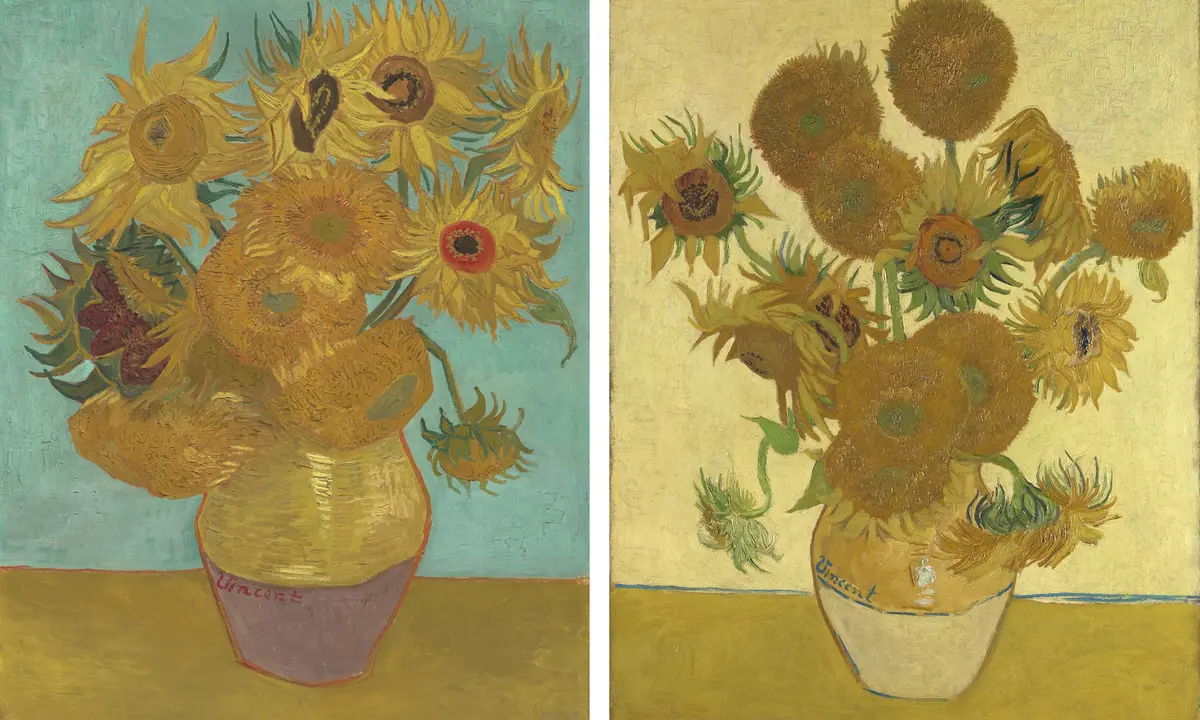
Philadelphia Reunites Two Van Gogh Sunflowers
Philadelphia has reunited its Sunflowers with London's National Gallery version, turning a rare loan into a fresh reading of Van Gogh's serial ambition.
Philadelphia Has Turned a Rare Loan Into a Real Art-Historical Event
The Philadelphia Museum of Art has opened Van Gogh's Sunflowers: A Symphony in Blue and Yellow, a compact display that reunites its turquoise-background Sunflowers with the National Gallery, London's yellow-background version. As The Art Newspaper reports, the London picture has never before crossed the Atlantic and has been lent abroad only a handful of times since entering the National Gallery in 1924. On the surface that sounds like a familiar museum story about prestige borrowing and institutional reciprocity. In practice it is more consequential. The reunion gives viewers a rare chance to see two key works in Van Gogh's sunflower cycle in direct conversation and to ask whether the artist imagined them not as isolated icons but as parts of a larger compositional project.
The timing matters. Philadelphia lent its own 1889 Sunflowers to the National Gallery for Van Gogh: Poets & Lovers in 2024, marking the first time that picture had traveled since the museum acquired it in 1963. London is now returning the favor, but the result is not simply a diplomatic swap between major museums. It is a high-value act of scholarship performed in public. By bringing the paintings together under the subtitle Van Gogh himself used, a "symphony in blue and yellow," Philadelphia is asking visitors to look beyond brand recognition and toward sequence, display logic and the restless experimentation behind one of modern art's most overfamiliar images.
The Exhibition Reframes a Canonical Image as a Serial Problem
Most museumgoers know Sunflowers as a singular masterpiece, a painting that sits in the mind the way a logo does. The Philadelphia show disrupts that lazy familiarity. The Art Newspaper recounts how Van Gogh initially envisioned a much larger sunflower scheme, telling Theo that he hoped to create "a dozen or so panels." That plan never materialized, but the surviving works preserve the trace of a serial ambition. When the turquoise and yellow versions are seen side by side, the question shifts from which one is more famous to what work the pair may have been meant to do together. Color, background temperature, bouquet density and painterly pressure begin to look like active decisions in a sequence rather than cosmetic variations on a fixed theme.
This is where the show earns its keep. Small focused exhibitions can feel like opportunistic repackaging, especially when built around one star loan and one work already on site. Philadelphia avoids that trap by making comparison the substance rather than the excuse. The display invites viewers to consider the relation between the August 1888 paintings and the January 1889 copies, and to follow how Van Gogh reimagined the status of the pictures after his collaboration with Gauguin collapsed. That kind of close looking is harder to stage in a large survey, where masterpieces often function as compulsory stops. Here the two paintings do not compete for attention. They create a structured visual argument.
The Real Question Is How Van Gogh Wanted the Sunflowers To Behave
One of the strongest threads in the story is not the loan itself but the curatorial proposition it enables. According to Martin Bailey's reporting, the reunion underscores Van Gogh's changing ideas about how the Sunflowers were meant to be presented. The pair may have operated as adjoining panels in a larger decorative and emotional scheme. Later Van Gogh seems to have imagined them as wings to a triptych centered on La Berceuse, Augustine Roulin holding the rope of a cradle. That possibility was vividly explored in London in 2024, where the two Sunflowers flanked the Boston version of La Berceuse. The current Philadelphia show omits the central painting, but it keeps the triptych hypothesis alive through the catalogue and through the force of comparison itself.
This matters because it restores contingency to a body of work that has been flattened by repetition. Van Gogh's fame encourages viewers to experience the paintings as finished answers. The exhibition pushes back, presenting them instead as elements in a developing thought about color, companionship, decoration and emotional address. That is also what makes the show more than a trophy exercise. Loans between major museums can easily become prestige theater. Here the loan opens a real interpretive question, and one rooted in the artist's own letters rather than curatorial overreach. The Philadelphia museum is using institutional capital to produce a better reading environment, which is the most defensible use of masterpiece borrowing there is.
Philadelphia and London Both Gain From the Arrangement
The practical politics of the loan are worth noting. Masterpiece reciprocity is one of the ways museums consolidate relationships, and this exchange benefits both institutions. Philadelphia gets a once-in-a-generation event for its collection. London demonstrates that its crown-jewel picture can travel under tightly controlled conditions when the scholarly stakes justify it. In an era when museums often sound reluctant, risk-managed and overprotective, that willingness to lend stands out. The National Gallery's own presentation of the work has long treated the painting as one of its defining possessions. Sending it abroad for a tightly conceived show suggests confidence rather than mere generosity.
The Philadelphia side of the equation is equally revealing. The museum is not drowning the loan in spectacle or treating it as a temporary Instagram prop. Instead it is making a case for the depth of its own holding. The turquoise-background version is not secondary simply because the London picture is more famous. Indeed, the whole exhibition quietly insists that the Philadelphia painting becomes more compelling once it is no longer read as an isolated derivative copy. In that sense the museum is strengthening the status of its own collection through relation, not ownership. That is a sophisticated curatorial move and a useful reminder that major collections do not only compete. At their best they sharpen one another.
Why This Show Lands at the Right Moment
The current museum climate favors scale, immersion and crowd volume, yet some of the best exhibitions in 2026 have worked by narrowing the field and heightening the terms of attention. We saw a related effect in the National Gallery's own ambitious Poets & Lovers presentation last year, and we have seen it elsewhere when institutions resist the pressure to inflate every display into a total-environment event. Philadelphia's one-room format feels almost defiant in that context. It trusts that one strong argument, clearly staged, can beat a louder and more diluted proposition. That is a healthy instinct for museums to recover.
It also helps that the exhibition arrives during a season in which museums are once again competing to prove that they can still produce occasions worth traveling for. Our coverage of the Crystal Bridges expansion shows one route: build more space and scale up the institutional claim. Philadelphia takes the opposite route and wins by precision. It does not need dozens of loans or immersive technology to make its point. It needs two paintings, careful scholarship and enough confidence to let the encounter stay concentrated. That is a different kind of institutional ambition, and in some ways a more impressive one.
What Comes Next After the Reunion
The exhibition runs through 11 October, which gives scholars, repeat visitors and ordinary tourists time to test the curatorial thesis for themselves. The most valuable outcome may not be consensus about whether the pair was definitively intended as part of a triptych or larger sunflower ensemble. It may simply be the restoration of complexity to works that have been dulled by fame. When paintings become too canonical, they stop behaving like problems and start behaving like obligations. Philadelphia has reversed that condition, at least temporarily.
The conservation angle deepens that argument. Bailey notes that traces of yellow-orange paint were recently found along the edges of the Philadelphia canvas when conservator Teresa Lignelli removed tape in preparation for the display. Those traces may indicate a colorful original frame, which matters because framing is part of how the painting would have behaved as an object in space, not just an image on a wall. Small technical discoveries like that can sound minor in isolation, but here they reinforce the exhibition's central claim that the Sunflowers were conceived relationally. Philadelphia is not just borrowing a masterpiece. It is using conservation evidence to rebuild the conditions under which the paintings may once have spoken to each other.
The market dimension should not be ignored either, even if the show wisely refuses to foreground it. Van Gogh paintings are among the most overdetermined objects in modern art, weighed down by value, insurance logic and cultural overexposure. To create a setting in which those pressures recede long enough for formal comparison to matter is a curatorial accomplishment. The museum cannot erase the aura of rarity around the London loan, but it can redirect that aura toward attention rather than spectacle. That is exactly what this display does. It makes the paintings feel less like trophies than like active propositions, which is harder to pull off than most museums care to admit.
That is why this modest-looking reunion matters. It offers a rare object lesson in what museums can still do when they treat a masterpiece not as a mascot but as an unresolved thought. The loan will attract headlines because of scarcity and value. It deserves attention because it makes Van Gogh more difficult again, and therefore more alive. For a painter this overexposed, that is no small achievement. It is the difference between staging a hit and producing a reason to look hard.