Oldest Fragment of The Odyssey Goes on Display at the Met
A papyrus fragment dating to 285-250 BCE, containing three lines absent from the standard text, is now on view at the Metropolitan Museum of Art
What Happened
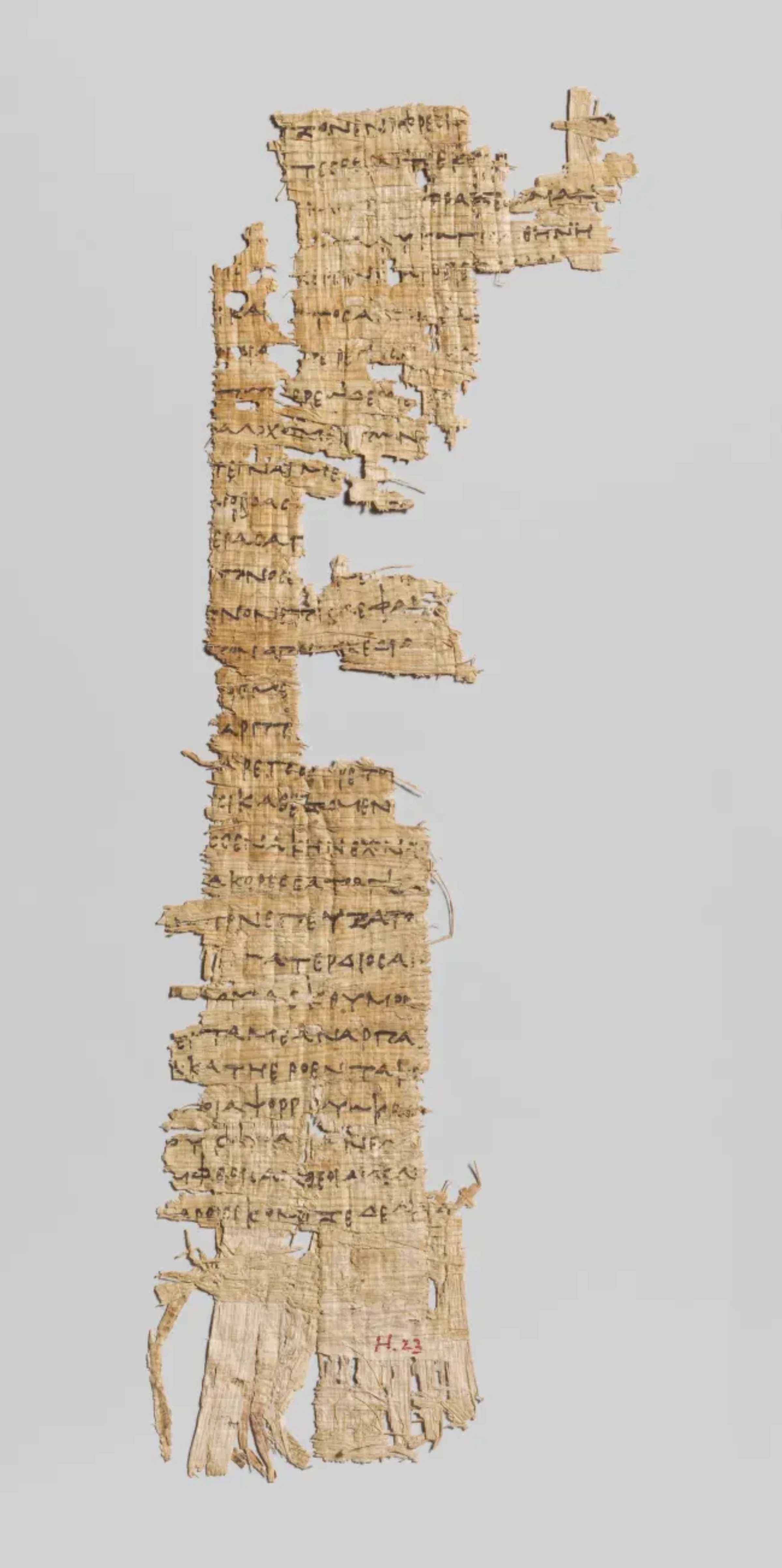
The oldest existing fragment of The Odyssey, Homer's epic poem that has shaped Western literature for nearly three millennia, has gone on display at the Metropolitan Museum of Art after a long hiatus from public view. The fragment, a Ptolemaic relic dating to around 285-250 BCE, was rendered with a stylus using charcoal and water on papyrus. It is on view in gallery 162 of the Met's Department of Greek and Roman Art, with both sides of the fragment visible to audiences. The announcement was covered by Artforum on August 18, 2026.
What makes this fragment extraordinary is not just its age. The text contains three lines that do not exist in today's standard version of The Odyssey. This variance points to the fluid, oral tradition from which the epic emerged, where bards recited different versions of the same story across generations before the text was fixed in written form. The fragment was gifted to the museum in 1909 by the Egypt Exploration Fund, which acquired it during archaeological work in Egypt, where the dry climate preserved papyrus materials that would have disintegrated in more humid environments.
The Oral Tradition Behind the Text
The Met's exhibition text makes a point that is often lost in popular understanding of Homer: The Odyssey was originally recited by bards in oral performances. Enthusiastic bards would occasionally embellish and have different versions of these stories, as Sean Hemingway, the lead curator in the Met's Department of Greek and Roman Art, explained in an Instagram video. This makes the first existing written scrap of The Odyssey all the more valuable, because it captures a moment when the oral tradition was transitioning into a fixed textual form. The three lines that do not appear in the standard text may represent a regional variant, a bard's improvisation, or a version that was later standardized out of the tradition.
The fragment's display at the Metropolitan Museum of Art is significant for scholars of Homeric poetry, papyrology, and ancient Egyptian textual culture. Ptolemaic Egypt was a period of intense scholarly activity centered on the Library of Alexandria, where Homeric texts were catalogued, edited, and standardized. This fragment likely dates to the same period when Alexandrian scholars were working to establish authoritative versions of Homer's epics, making it a witness to both the oral tradition that preceded standardization and the textual culture that emerged from it.
Odyssey Objects at the Met
The museum is also drawing attention to six other objects related to The Odyssey that can be found throughout the premises. The items include a terracotta plaque (ca. 460-450 BCE) that depicts one of the goddess Athena's final interventions on behalf of the incident-prone Odysseus, a terracotta bowl for mixing wine and water that shows Odysseus chasing after the goddess Circe, a fresco depicting Polyphemus and Galatea in a landscape, and a Trojan Horse scarab made of carnelian that dates back to around 500 BCE. Together, these objects trace the visual reception of The Odyssey across centuries, from archaic Greek vase painting to Roman fresco.
The decision to display the fragment alongside these other Odyssey-related objects reflects a curatorial strategy that treats the epic not just as literature but as a visual and material tradition. The Met's exhibitions program has increasingly integrated textual artifacts with visual ones, recognizing that ancient literature was experienced through images as much as through words. The terracotta plaque of Athena's intervention, for instance, would have been as familiar to a Greek audience as the text itself, serving as a visual shorthand for a story everyone knew.
The materiality of the fragment is itself worth close attention. The use of charcoal and water as a writing medium on papyrus was common in Ptolemaic Egypt, where papyrus was manufactured and traded across the Mediterranean. The stylus, rather than a reed pen, suggests a particular kind of scribal practice, one that prioritized speed and legibility over the calligraphic refinement associated with literary manuscripts. This is not a luxury object. It is a working text, possibly a scholar's copy, a student's exercise, or a record of an oral performance committed to papyrus for reference. The fact that it survives at all is due to the preservative properties of Egyptian burial conditions, where dry sand and sealed tombs kept papyrus intact for millennia. The Egypt Exploration Fund, which gifted the fragment to the Met in 1909, was a British organization that supported archaeological excavations in Egypt during the late 19th and early 20th centuries, a period when Egyptian antiquities were routinely exported to Western museums under arrangements that would be contested today.
Nolan's Odyssey and the Cultural Moment
Homer's Odyssey is back in the public's consciousness this summer with the release of Christopher Nolan's The Odyssey, a three-hour take on the hero's journey home that casts Matt Damon as a scaled-down patriarch humbled by the violence of war. The film has prompted a wave of popular interest in the original text, which the Met's exhibition is well positioned to capture. The fragment's return to public display is timely, though the museum has not explicitly connected the exhibition to the film's release.
The cultural moment matters because it determines who comes to see the fragment. Academic interest in Homeric papyrology is constant but niche. Popular interest driven by a blockbuster film brings a general audience to a case containing a small piece of papyrus with charcoal marks that, without context, look like little more than scratches. The Met's curatorial framing, which emphasizes the oral tradition and the variant lines, gives that general audience a reason to look closely. The fragment is not just old. It is evidence of a moment when one of the foundational texts of Western literature was still being shaped, still in flux, still multiple stories rather than one fixed narrative.
What Comes Next
The fragment has no scheduled end date for its current display, but the Met rotates objects in its permanent collection galleries regularly, and papyrus is particularly sensitive to light. The museum's conservation protocols mean the fragment will likely be rotated off view after a limited period to preserve it. For scholars, the fragment remains accessible for study through the Met's digital collection resources. For the public, the current display is a rare opportunity to see the earliest surviving physical evidence of a text that has been read, recited, adapted, and argued over for almost 3,000 years.
The Met's decision to foreground the fragment's variant lines, the three lines that do not exist in the standard text, is the most interesting curatorial choice. It reframes the fragment not as a relic of a fixed canonical text but as evidence of a living, changing tradition. That framing is more honest to how The Odyssey actually came down to us, through centuries of oral performance, scribal copying, and scholarly editing. The fragment on display is not The Odyssey. It is one version of it, frozen in charcoal and papyrus at a moment when the story was still being told in multiple forms.
The broader context of Homeric textual scholarship adds another layer to the fragment's significance. The standard text of The Odyssey that we read today is the result of centuries of editorial decisions, beginning with the Alexandrian scholars of the Ptolemaic period and continuing through the medieval manuscript tradition to modern critical editions. Each step in that process involved choices about which variants to include and which to discard. The three lines on the Met's fragment, absent from the standard text, represent one of the roads not taken, a version of the story that was available in the third century BCE but did not survive into the canonical text. Whether those lines were part of an older tradition that was later lost or an improvisation by a particular bard is impossible to determine, but the fragment gives us a rare glimpse of the textual pluralism that preceded standardization. Artforum's coverage notes that the fragment's public display comes after a long hiatus, suggesting that the Met has been waiting for the right moment to present it. The Nolan film has provided that moment, but the fragment's significance extends far beyond any single cultural event. The Met's decision to put it back on public view now, after years in storage, reflects a curatorial instinct to connect ancient material with contemporary cultural conversations. The fragment is not just a piece of Homeric text. It is a reminder that the canon was not always a canon, that the texts we treat as fixed and authoritative were once fluid and contested, and that what survives is often a matter of accident rather than design. In an era when questions of canon formation, textual authority, and cultural inheritance are being vigorously debated across the humanities, the fragment speaks to concerns that extend well beyond classical philology. It is a small piece of papyrus, but it raises large questions about how texts become texts, how stories become canonical, and how the accident of survival shapes what we think we know about the past.
The fragment also speaks to contemporary debates about cultural repatriation and the provenance of museum holdings. The Egypt Exploration Fund acquired the papyrus during a period when British archaeological missions operated in Egypt under colonial-era concessions, and the fragment's presence at the Met is a product of that history. While no repatriation claim has been made for this specific object, its display invites visitors to consider the circumstances under which ancient artifacts moved from their countries of origin to Western museums, a conversation that the Met has increasingly acknowledged in its gallery labels and programming.