Obama Presidential Center Opens as an Art-Filled Monument to Hope
The $850m Obama Presidential Center in Chicago debuts with monumental commissions by Maya Lin, Mark Bradford, and Njideka Akunyili Crosby
A Strategic Opening on Juneteenth
The Obama Presidential Center (OPC) officially opened its doors today, June 19, in Chicago's Hyde Park neighborhood. The decision to launch the $850 million complex on Juneteenth—a federal holiday commemorating the emancipation of enslaved African Americans—was both symbolic and strategic, anchoring the institution's identity in the struggle for civil rights and the pursuit of democratic progress. Designed by Tod Williams Billie Tsien Architects, the center is more than a museum; it is a 19.3-acre campus that blends narrative history with an expansive program of public art, aiming to reflect the "hope" that characterized Barack Obama's 2008 campaign and his subsequent presidency.
At the heart of the campus is a towering, granite-clad museum building that houses a sophisticated interplay of technology and art. The interior is designed to be a motivational journey, moving visitors through the personal and political history of the first Black president and first lady. The experience culminates in the Sky Room, an eight-storey tower where the architecture itself speaks. Huge cast-concrete letters on the façade quote Obama's 2015 speech in Selma, Alabama, transforming the building into a literal monument to the civil rights marches of the 1960s. For an in-depth look at the opening, see The Art Newspaper.
The strategic alignment of the opening with Juneteenth also serves to position the center as a site of ongoing liberation rather than a static mausoleum of political achievement. By grounding the site in the specific historical context of emancipation, the foundation attempts to link the achievements of the Obama administration to the broader, centuries-long arc of Black American struggle. This approach transforms the visitor's experience from a simple tour of presidential artifacts into a meditation on the nature of progress and the persistent gaps in the American promise of equality. The architecture, with its stark granite and expansive glass, reflects this duality: a sense of permanence and institutional weight balanced with the transparency and openness required of a democratic space.
Monumental Commissions and Site-Specific Works
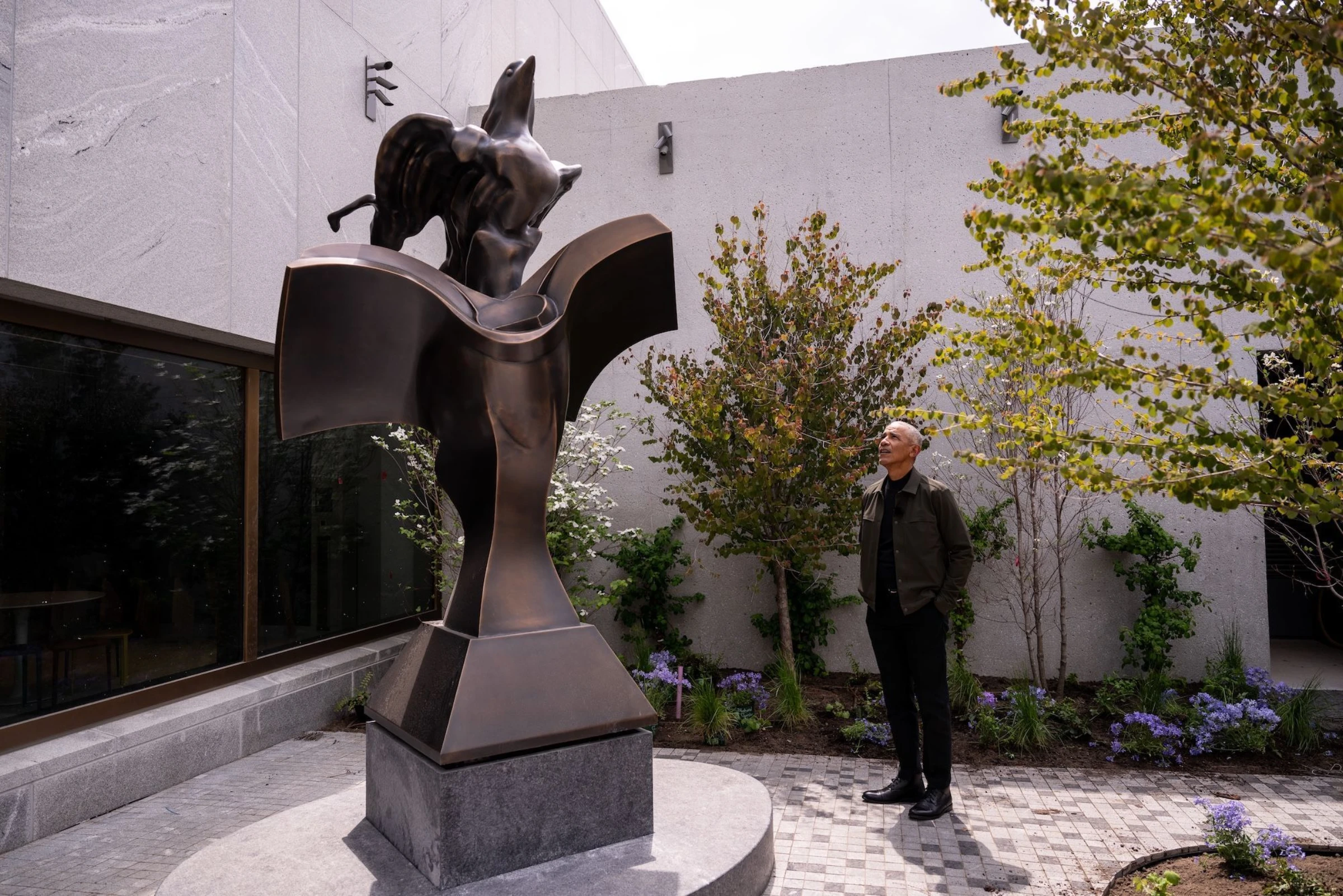
The OPC is notable for its unprecedented scale of artistic commission, featuring 28 site-specific works by 30 different artists. The foundation's goal, led by museum director Louise Bernard and curator Virginia Shore, was to embed art into the very fabric of the campus. One of the most significant recent reveals is the dual portrait of Barack and Michelle Obama by Njideka Akunyili Crosby, titled "The Obamas: Springing Forth." This work is a complex tapestry of archive materials, family ephemera, and painting, capturing the couple's journey in a way that transcends traditional presidential portraiture.
Other key installations include Mark Bradford's "City of the Big Shoulders," a 38-foot-tall textured map painting in the museum atrium, and a massive wall relief, "This Land, Shared Sky," created through a collaboration between Nick Cave and Marie Watt. Watt, a member of the Seneca Nation of Indians, incorporates tin jingles from ceremonial regalia, while Cave uses his signature beads and nets. This fusion of indigenous materials and contemporary sculpture creates a powerful dialogue about American identity and shared space. These works are not mere decorations but are integral to the site's mission of showcasing a diverse American experience. For more on these artists' trajectories, visit ARTnews.
The integration of these commissions requires a delicate balance between the ego of the individual artist and the narrative needs of the institution. In many presidential libraries, art is additive, placed in hallways as an afterthought. At the OPC, the art is foundational. For instance, the collaboration between Cave and Watt does not just occupy a wall; it defines the physical and spiritual entry point of the museum, forcing the visitor to acknowledge the contributions of indigenous and Black artists as the primary lenses through which the American experience is viewed. This shift in priority reflects a broader movement in museum curation toward what is known as "the decentering of the archive," where the living voice of the artist is given as much weight as the historical document.
The Architecture of Memory and Hope
The museum's curation balances the personal milestones of the Obamas with broader social movements. From the use of declassified FBI files in a text-based painting by Jenny Holzer to Idris Khan's "Sky of Hope," which transforms the ceiling of the Sky Room into a radiating expanse of hand-stamped words, the OPC uses avant-garde artistic strategies to communicate political ideas. The inclusion of Carrie Mae Weems' "The Cool Blue Wind and Freedom Riders" further links the center to the history of Black resistance and endurance in the United States.
Beyond the ticketed museum floors, the campus is designed as a public resource, with free access to gardens, plazas, a library, and an athletic facility. The landscape architecture is equally curated, featuring Maya Lin's "Seeing Through the Universe," a stone-and-water piece dedicated to Ann Dunham, the former president's mother. By making the surrounding park and gardens accessible to the public, the OPC attempts to avoid the feeling of an ivory tower, instead positioning itself as a civic hub for the south side of Chicago. The presence of Martin Puryear's "Bending the Arc," a 34-foot wood beam, serves as a final, elegant reminder of the slow, difficult process of progress. You can see the impact of this architectural vision on Artnet News.
The use of light and space within the center is also an intentional editorial choice. The Sky Room, in particular, uses the verticality of the building to create a sense of transcendence, drawing the visitor's gaze upward toward a simulated cosmos of words and hope. This architectural gesture is a physical manifestation of the "hope" theme, suggesting that the goals of the Obama administration were not just policy achievements but aspirational benchmarks for the entire nation. By intertwining the physical experience of the building with the emotional arc of the exhibition, the OPC attempts to create a visceral connection between the visitor and the ideals of the former president, moving beyond the dry delivery of historical facts.
Civic Legacy in a Polarized Era
The opening of the Obama Presidential Center comes at a time of profound political division in the United States. The juxtaposition of the center's message of unity and hope against the current backdrop of national tension is stark. As visitors walk through the gardens dedicated to figures like John Lewis and Fannie Lou Hamer, the institution asks whether the unity Obama preached in 2004 is still a viable goal for the country. The center's commitment to a "hopeful view of US history" is an intentional editorial choice, contrasting with the more critical, revisionist trends in many current American museums.
Ultimately, the OPC is an experiment in how a presidential library can function as a living art gallery and a site of active civic engagement. By partnering with artists like Julie Mehretu, whose work is visible on the north façade, the foundation is betting that art can bridge the gap between political biography and public inspiration. Whether it succeeds in this mission will depend on its ability to remain relevant to the residents of Chicago and the wider American public in an era where the definition of "hope" is increasingly contested.
The long-term success of the OPC will likely be measured by its impact on the Hyde Park community. The tension between a massive $850 million luxury campus and the socio-economic realities of the south side is a challenge that no amount of public art can fully resolve. However, by integrating high-caliber contemporary art with accessible public spaces, the center makes a bold claim: that beauty and intellectual rigor are not the exclusive domain of downtown galleries but are essential rights for every citizen. This commitment to "democratic beauty" is perhaps the center's most daring attempt to leave a lasting legacy, moving the presidential library from a place of memory to a place of active, artistic transformation.
Furthermore, the OPC serves as a critical case study in the viability of the "campus-museum" model in the 21st century. By diverting a significant portion of its budget into site-specific art and open green space, the foundation is challenging the traditional museum's role as a container for objects. Instead, the OPC is an environment, where the interaction between the landscape and the art creates a narrative that cannot be replicated in a gallery. This model of institutional growth, which prioritizes a symbiotic relationship with the surrounding urban fabric over the mere accumulation of artifacts, may well set a new standard for how presidential centers are conceived in the future, moving from monuments to active civic participants. It represents a shift from the static curation of the past toward a more fluid, ecologically aware form of institutional storytelling.