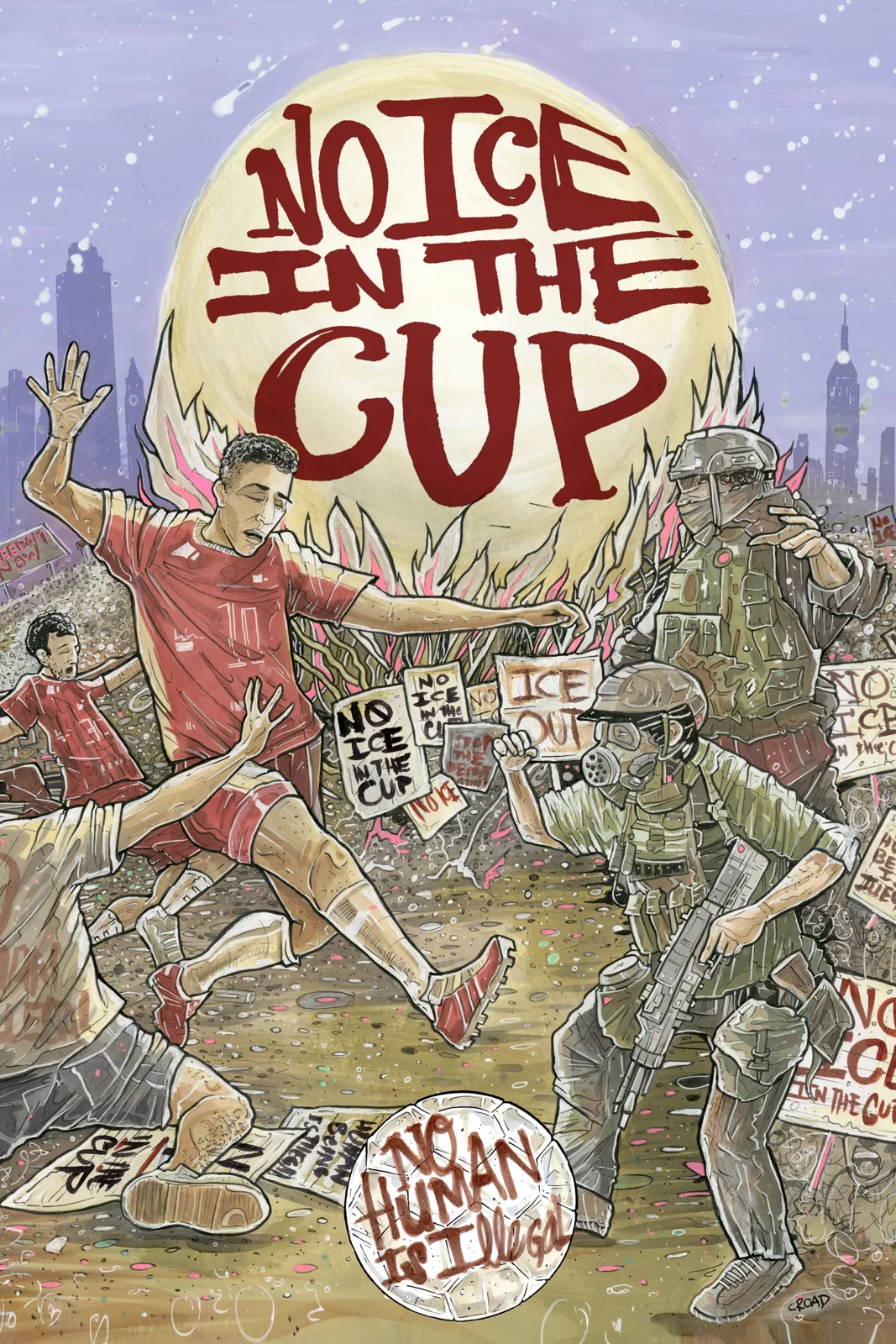
No ICE in the Cup Uses Protest Posters to Reframe World Cup America
A new campaign has enlisted artists from US host cities to argue that ICE presence would turn the 2026 World Cup from a civic celebration into a theater of fear.
The campaign understands that the World Cup image war has already started
The most interesting thing about No ICE in the Cup is that it refuses to treat culture as a soft accessory to politics. As The Art Newspaper reports, artists from ten of the eleven US host cities have produced posters denouncing any visible presence of Immigration and Customs Enforcement around the 2026 Fifa World Cup. The campaign, launched on 6 May by the Horizons Project and allied organizers, argues that a tournament sold as joyful international spectacle cannot be separated from the threat landscape surrounding immigrant communities in the United States. That argument is not abstract. The organizers explicitly call for ICE to stay out of stadiums, watch parties, small businesses, and the streets where fans gather.
That clarity is what gives the campaign force. Too much socially engaged art still behaves as though symbolism alone were enough, as if the artist’s role were to offer tasteful conscience while institutions or movements handle the risky parts elsewhere. No ICE in the Cup does something more direct. It turns poster design into movement infrastructure. The campaign site offers free downloads, invites people to remix and adapt the work, and positions art not as a commemorative byproduct but as a way to motivate action, train attention, and mark public space before the tournament begins. In practical terms, it is trying to shape what the World Cup looks and feels like long before the first whistle.
That is a smart reading of how mega-events now work. By the time a World Cup opens, the visual field around it has usually been colonized by sponsors, official branding, security messaging, and host-city boosterism. If dissent waits until opening week, it arrives late. A poster campaign gives opponents of aggressive immigration enforcement a chance to circulate an alternative civic image in advance, one grounded in care, solidarity, and the right to gather without intimidation. The art is therefore doing political scheduling as much as graphic work. It is trying to occupy memory before the state and the tournament’s commercial apparatus finish scripting the scene.
The strongest posters do not merely protest. They localize fear and belonging city by city
What makes the campaign more than a generic activist package is its insistence on local specificity. The Art Newspaper highlights works by Chris Stewart in Los Angeles, Hana Natsuhara in Seattle, Johann C. Muñoz-Tapasco in Miami, and Cristy Road Carrera in New York. Each poster uses a different graphic language and a different urban referent, but all are organized around the same demand: the tournament should not become another pretext for enforcement theater. That variation matters. National political messages are often strongest when they do not pretend every city experiences the same pressure in the same way.
Carrera’s New York poster is especially sharp because it literalizes the confrontation. Soccer players square off against heavily geared agents, turning the image into a tactical tableau rather than a vague mood of concern. Stewart’s Los Angeles contribution, by contrast, stages the violence as a tearing gesture, with a man in a Mexico jersey pulled at by unseen hands. Muñoz-Tapasco’s Miami image uses alligator iconography and a text-heavy format to translate regional vernacular into political warning. Natsuhara’s Seattle design folds the city’s coffee mythology into the campaign rather than pretending civic branding and civic danger exist in different universes. Together the posters suggest that belonging is always visualized somewhere specific, under local pressure.
That matters because the 2026 World Cup in the United States will not be experienced only inside stadiums. It will unfold across transit systems, restaurant strips, neighborhood parks, fan zones, and immigrant-owned businesses that are supposed to benefit from tournament traffic while also being exposed to heightened policing and surveillance. By commissioning artists rooted in host cities, the campaign is effectively building a map of where that contradiction lives. The posters are not illustrations of a prewritten political line. They are evidence that local cultural workers already understand the stakes of the tournament as a lived urban event.
The campaign’s own language reinforces that point. The homepage describes No ICE in the Cup as a national call to action demanding that the World Cup remain joyful, safe, and secure for all to enjoy, and says the coalition includes artists, organizers, lawyers, athletes, small businesses, labor unions, veterans groups, and faith communities. That cross-sector framing matters because it makes the posters legible as one tool inside a larger organizing field. The art is not being asked to solve policy by itself. It is being used to bind constituencies into a shared public narrative before official messaging hardens.
This is also a test of whether art can still function as organizing media in an age of security spectacle
The campaign arrives in a climate that gives its warning real weight. The Art Newspaper cites a Washington Post and University of Maryland poll finding that nearly two thirds of Americans oppose ICE presence at World Cup stadiums. It also notes a 23 April travel warning from more than 120 civil society groups, alongside public backlash over raids and occupations in US cities. Whatever one’s view of the campaign’s rhetoric, this is not a case of artists inventing a crisis to dramatize themselves. The posters are responding to a documented fear that global visitors and immigrant communities could encounter the tournament through the language of detention, scrutiny, and force.
What the organizers understand, and what many museums still do not, is that images are not politically secondary to that environment. Security is always staged visually. Tactical uniforms, barriers, street presence, signage, press images, drone shots, and official clips all work together to normalize a certain idea of order. A countercampaign therefore has to fight at the level of visual expectation as well as policy demand. If public space will be saturated with football iconography, the protest has to learn to inhabit football iconography too. No ICE in the Cup does exactly that by making soccer aesthetics itself a contested medium.
This is where the campaign sits in a longer history of poster culture, from antiwar graphics and migrant-rights organizing to feminist print workshops and ACT UP’s image tactics. Posters are cheap, reproducible, adaptable, and meant to circulate beyond the controlled wall. That makes them unusually suited to the distributed geography of a World Cup. A museum can preserve one. A movement can move with one. In 2026, when every corporate and state actor around a mega-event is investing in frictionless digital branding, the poster’s stubborn materiality looks like a strategic asset rather than a nostalgic holdover.
Readers who have followed our recent reporting on American institutions and national image management will recognize the overlap. Cultural politics in the United States is increasingly a fight over who gets to define public belonging under intensified pressure. The World Cup only magnifies that fight because it invites the country to perform hospitality for an international audience. No ICE in the Cup is saying, in effect, that hospitality backed by threat is not hospitality at all. That is a much more serious cultural claim than merely objecting to optics.
The campaign’s success will depend on whether it can move from circulation to collective use
For all its energy, the campaign now faces the hard part. A politically sharp poster is not automatically an effective one. It has to travel, appear in the right places, attach itself to local actions, and remain legible to people who are not already convinced. The campaign’s organizers seem aware of that. The website pairs artwork with calls to action, invitations to submit new work, and references to training programs for volunteer N.I.C.E. Brigades. That infrastructure matters because it gives the images a social afterlife. Without that, poster activism can become an online gallery of moral correctness admired by exactly the people who would have agreed anyway.
There is also a timing challenge. The closer the tournament gets, the more crowded the symbolic field will become. Municipal leaders, sponsors, and broadcasters will all push versions of civic joy tied to visitor spending and national prestige. A countercampaign has to stay nimble enough to respond without sounding repetitive. One advantage here is that No ICE in the Cup is not relying on a single master image. The city-by-city structure creates room for local adaptation, and the open invitation to remix the works suggests the organizers understand that visual movements need mutation, not just repetition.
The campaign could also become a useful test case for how artists work inside democratic coalitions rather than beside them. Too often the art world flatters itself for proximity to protest while leaving actual movement strategy to others. No ICE in the Cup looks different. The artists are contributing imagery that can be downloaded, printed, translated into merchandise or action materials, and inserted into organizing efforts on the ground. That is less glamorous than a museum commission, but more socially exacting. It asks whether artists are willing to make work that is accountable to use.
For now, the campaign deserves attention because it identifies the 2026 World Cup as a battle over atmosphere as much as policy. If the state wants fear to feel normal and unavoidable, artists and organizers are trying to make another atmosphere plausible: one where celebration, solidarity, and immigrant safety belong to the same picture. That is not guaranteed to win. But it is a serious reading of the political work images still do. In a summer when the world will be watching American host cities perform welcome, No ICE in the Cup has already started asking the sharper question of who exactly that welcome is for.