MFA Boston Reframes Liberty Through David Drake and Paul Revere
MFA Boston’s new American galleries place David Drake beside Paul Revere, forcing a sharper reading of liberty, exclusion, and the nation’s founding myths
MFA Boston Uses Two Vessels to Reopen the American Story
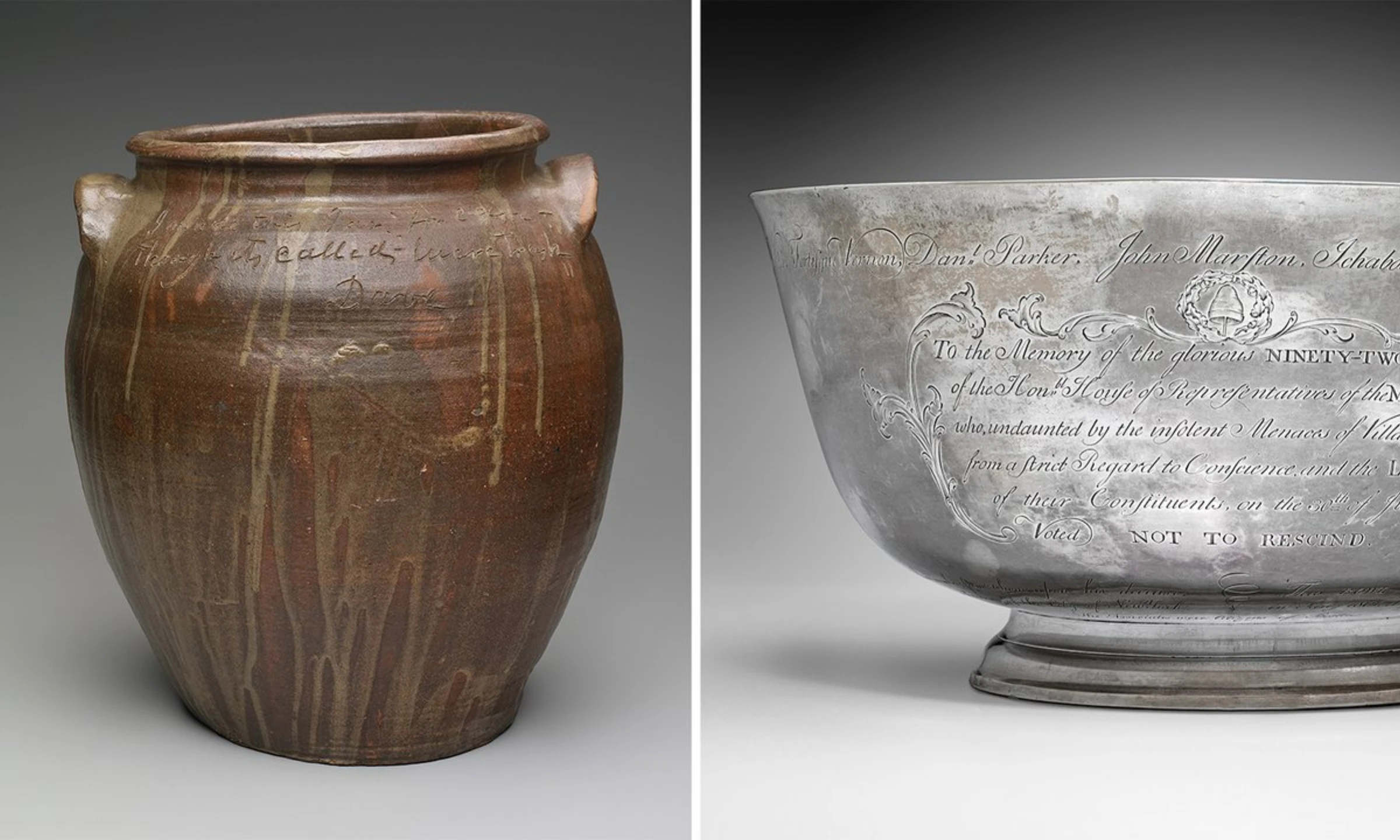
MFA Boston is reopening its early American galleries on 20 June with a pairing that cuts through the pieties that usually attach themselves to anniversary programming. Instead of offering visitors a settled story about the Revolution, the museum is placing Paul Revere’s 1768 Sons of Liberty Bowl beside an 1857 storage jar by David Drake, the enslaved South Carolina potter also known as Dave the Potter. The move, first reported by The Art Newspaper, is a curatorial argument disguised as an installation decision. It asks what happens when one object associated with patriotic dissent is made to answer another object shaped under slavery, literacy prohibition, and racial exclusion.
The juxtaposition matters because both works speak in language as much as form. Revere’s bowl commemorates Massachusetts legislators resisting British taxation. Drake’s jar bears one of the rhyming inscriptions that made his surviving vessels so singular in American art history. By bringing them into the same sightline, the museum is not merely broadening representation inside a canonical room. It is staging a conversation about who counted as a political subject in the eighteenth and nineteenth centuries, and who was denied that standing while the rhetoric of liberty expanded around them.
MFA Boston has framed the reinstallation as part of a broader rethink of its American galleries, its first major reset since 2010. On the museum’s own Art of the Americas program, the institution describes its holdings as a long arc rather than a sealed colonial chapter. The Drake-Revere pairing sharpens that claim. It suggests that the most honest way to mark the 250th anniversary cycle around the United States is not to decorate the founding narrative but to force its contradictions into the open.
Why David Drake Belongs in the Main Galleries, Not the Margins
For years, Drake’s jar sat in the museum’s folk and self-taught art gallery, a placement that carried its own hierarchy. Such classifications can preserve visibility while also keeping certain makers at a safe interpretive distance from national narratives. Drake has increasingly escaped that box in recent years. Scholars, museums, and collectors have treated his stoneware not as an aside to American art but as one of its central achievements: formally commanding, linguistically daring, and historically devastating. The fact that this particular jar was restituted to Drake’s heirs and re-acquired by the museum last autumn only heightens the sense that institutions are revisiting not just where his work belongs, but how it entered collections in the first place.
There is a deeper museum-historical point here. American galleries were long built around a familiar cast of silversmiths, portraitists, furniture makers, and patriotic icons whose works could be slotted into a triumphalist sequence. Drake destabilizes that sequence. He does not fit a neat category because his pots are at once utilitarian objects, literary artifacts, and records of survival under terror. His inscriptions signal authorship in a world that attempted to deny him precisely that. When the museum moves him into the main run of foundational American art, it acknowledges that the republic’s visual culture cannot be understood through elite white makers alone.
The museum has telegraphed this broader recalibration in other parts of the rehang, including the placement of Alan Michelson’s 2024 bust of George Washington, Hanödaga:yas (Town Destroyer): Reflect, near older patriotic imagery. That matters because it shows the museum is not isolating Drake as a one-off corrective. It is instead using the galleries to demonstrate that the nation’s image tradition has always been contested, revised, and shadowed by people excluded from the heroic script. A museum only gets credit for that ambition if the juxtapositions are legible. This one is.
The larger institutional shift is worth tracking against other collection stories this year. Museums have recently been under pressure not only to diversify labels but to rethink acquisitions, restitution, and interpretive hierarchy across entire departments. We touched a related pressure point in our guide to reading museum collection gifts, where the real story often sits in where an object is positioned, how it is framed, and what historical argument its placement is meant to serve. Boston’s rehang belongs to that broader institutional reckoning. The object shift is physical, but the deeper change is epistemic: the museum is telling visitors that the story of American art has been badly arranged for a long time.
What the Revere Bowl Can and Cannot Say About Liberty
Revere’s Sons of Liberty Bowl is one of the trophies of American museum culture, the kind of object that comes preloaded with civic reverence. Its engraving celebrates legislators who opposed imperial taxation and defended colonial rights. In the standard patriotic reading, it is an object of resistance, courage, and proto-democratic principle. None of that disappears in Boston’s new display, but it no longer gets to stand alone. Next to Drake, the bowl’s claim on liberty becomes narrower and less comfortable. The object speaks eloquently about political grievance inside the colonial elite. It says far less about those who remained outside the frame of freedom its makers defended.
That is what makes the pairing more than a diversity gesture. It does not flatten the two works into interchangeable symbols of American expression. Instead it lets the differences bite. Revere’s bowl belongs to an emerging revolutionary public sphere. Drake’s jar emerges from a slave society where literacy among enslaved people could be punished. To place them together is to ask whether the language of liberty in American material culture was aspirational, hypocritical, or structurally partial from the beginning. The likely answer is all three. The installation works because it does not tidy that up.
There is also a sonic intelligence to the decision. According to the report, visitors approaching the objects will hear recordings of their inscriptions. Museums love audio when they want to humanize collections, but in this case the effect could be sharper. The spoken words should make clear that these are not mute relics. They are authored interventions. Revere inscribes political solidarity. Drake inscribes wit, commerce, biblical cadence, and self-assertion. If the programming is handled well, visitors will not leave with the impression that the museum has solved America’s founding contradictions. They will leave hearing how those contradictions were voiced from radically unequal positions.
That matters because visitors tend to remember gallery argument through staging more than wall text. A juxtaposition that looks tidy but sounds unresolved can do more work than a hundred careful labels. If the museum allows the distance between the two inscriptions to remain audible, it will expose one of the central problems of American commemorative culture: the country still likes to praise liberty as a complete inheritance rather than a contested claim. Drake’s authorship interrupts that fantasy. His pot refuses the idea that freedom was ever evenly distributed, while Revere’s bowl preserves the language of liberty from inside a narrower political class. The pairing is valuable precisely because it does not let either object speak in isolation.
What This Rehang Signals for Museums in the 250th Anniversary Cycle
The timing is not accidental. As US institutions prepare programming around the 250th anniversary of independence, they are under pressure to avoid both empty celebration and stale culture-war choreography. The easy option is balance: one patriotic object, one corrective label, one gesture toward complexity, then move on. MFA Boston appears to be betting on something more substantive. By remaking the first room around argument rather than tribute, it is turning gallery sequencing into a public editorial act.
Other museums will be watching. Institutions with historic American collections are facing the same question: whether to preserve the old canon and append critical context, or to rebuild the canon through new adjacencies, acquisitions, and restitution histories. Boston’s answer is still cautious in one sense, because it works through existing master objects rather than by abandoning them. But it is braver than the average centennial-style rehang because it makes a treasured icon answer to someone history tried to exclude.
There is a practical institutional lesson here too. Rehangs are where museums reveal what they actually believe their collections mean. Acquisition announcements get headlines, but gallery sequencing determines public memory day after day. If this installation succeeds with visitors, other museums may discover that audiences are more capable of handling contradiction than development offices and trustees usually assume. The fear that complexity drives people away has often been overstated. In many cases, flat triumphalism is what deadens attention. Strong institutions do not merely display masterpieces. They arrange them so that history argues with itself in plain view.
The next test is whether the museum follows through across the rest of the galleries and not only in a headline-ready pairing. Visitors can judge that through the museum’s broader programming and gallery materials once the reinstallation opens. For now, the Drake-Revere confrontation already offers a model for how museums might handle the nation’s founding anniversary without lapsing into nostalgia. It insists that the story of American liberty only becomes intelligible when the objects left outside the old frame are allowed to speak back from the center.