The Met’s Neue Galerie Merger Will Reshape How New York Treats Private Museum Legacies
The Met’s planned 2028 merger with Neue Galerie secures a private collection’s future while raising harder questions about legacy, governance, and public trust.
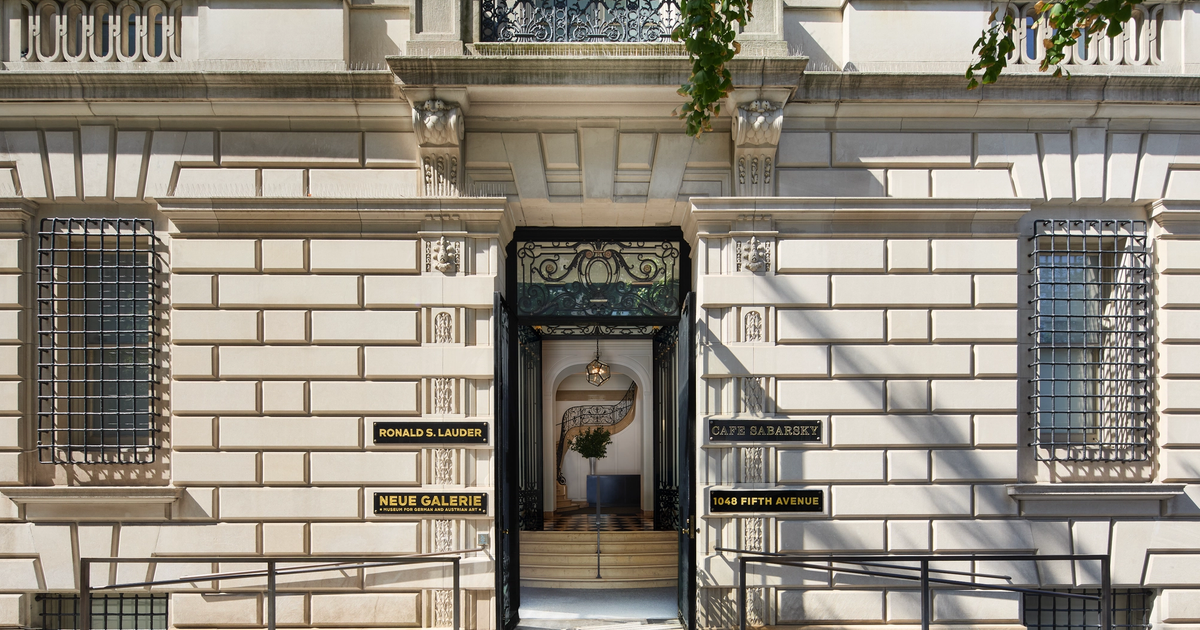
The planned 2028 merger between the Metropolitan Museum of Art and Neue Galerie lands as one of the most consequential museum governance stories in New York this year. As The Art Newspaper reported, Ronald S. Lauder’s institution will be folded into the Met while retaining its building, collection identity, programming profile, and Café Sabarsky. On paper, that sounds like a continuity play. In practice, it is a major transfer of cultural power from a focused private museum into the city’s encyclopedic flagship.
The basic facts are already striking. Neue Galerie, founded in 2001 and devoted to early 20th century German and Austrian art and design, will merge with the Met in 2028 after a renovation period and a 25th anniversary season. Ronald Lauder and Aerin Lauder Zinterhofer are also donating works from their personal collection, including paintings by Gustav Klimt, Otto Dix, George Grosz, and Christian Schad. The building will become the Met Ronald S. Lauder Neue Galerie, and a joint advisory board chaired by Lauder will guide the transition. That is not a small annexation. It is the absorption of a fully formed curatorial identity into one of the world’s largest museums.
What matters is not only that the Met gets stronger in Austrian and German modernism. It is that New York gets a new model for how private museum founders can convert legacy into permanence. Rather than sustaining a standalone institution indefinitely, Lauder is choosing to hardwire his museum into a larger civic organism. That choice reduces succession risk, protects the collection against the volatility that can hit founder-driven museums after a patron’s exit, and gives the Met a concentrated area of strength that it could not build quickly on its own.
Why the merger makes strategic sense for both institutions
For Neue Galerie, the logic is obvious. Single-founder museums often look stable until the founder’s mortality, estate planning, and long-term endowment needs come into sharper view. A tight mission can be an advantage curatorially and a liability structurally. Governance becomes heavily tied to one family, one board culture, and one donor network. By merging into the Met, Neue Galerie gains the institutional depth, conservation infrastructure, fundraising machine, and staffing durability that a larger museum can offer. The collection’s future becomes less contingent on whether a boutique institution can keep reproducing founder-level support generation after generation.
For the Met, the upside is equally clear. The museum instantly deepens its holdings in Viennese modernism, German expressionism, and the broader world around artists such as Gustav Klimt, Egon Schiele, Oskar Kokoschka, and Josef Hoffmann. The Met has long excelled at being broad. What it occasionally lacks is the sharper atmospheric density that smaller specialist museums can produce. Neue Galerie offers precisely that: a coherent environment, a recognizable brand, and a collection that already comes with architectural and social memory attached.
The merger also reflects Max Hollein’s museum politics. Hollein understands that the contemporary mega-museum is no longer judged solely by acquisition totals or exhibition attendance. It is judged by whether it can consolidate ecosystems around itself. Folding an admired specialty museum into the Met strengthens the institution’s claim to be both encyclopedic and highly specific. That matters in a city where donors increasingly expect institutions to demonstrate not just prestige but staying power, curatorial seriousness, and long-term care capacity.
There is another pragmatic layer. The Met has the operational heft to preserve the rituals that made Neue Galerie beloved in the first place. Keeping the mansion setting, the programmed focus, and Café Sabarsky is not sentimental window dressing. It is how the Met avoids turning a dense cultural environment into a generic satellite. The smartest version of this merger keeps the scale and mood of Neue Galerie intact while backing it with the resources of a giant.
What New York gains and what it risks losing
New York gains security, but it risks flattening texture. The best private museums often feel different because they are allowed to be unapologetically narrow. They can turn a founder’s obsession into a public method. Neue Galerie has always been more than a storage site for blue-chip objects. Its identity depends on concentration: Vienna around 1900, German and Austrian modernism, the interplay of painting, design, architecture, and decorative arts. Visitors experience it as a total environment rather than a department.
That is why the preservation language around the merger matters. If the Met treats Neue Galerie as a branded container for masterpieces, the result will be thinner than what exists now. If it treats the museum as a fully authored curatorial world, the merger could become a model for how specialist institutions survive without dissolving. The difference is subtle but decisive. A private museum legacy is not only its object list. It is also its scale of looking, its pace, its room logic, and its unapologetic focus.
There is also the question of donor power. Lauder is not simply making a gift and stepping away. He will chair the advisory board guiding the merger, and the renamed institution will permanently bear his name. That is standard in American philanthropy, but it is worth saying plainly: the public museum sector increasingly grows through arrangements in which private wealth shapes the terms of institutional expansion. Sometimes that produces extraordinary public benefit. Sometimes it narrows the space for more democratic cultural planning.
The Met will need to show that this is not a vanity annex but a public-facing act of stewardship. It should publish a clear roadmap for governance, staffing, curatorial autonomy, conservation planning, and access. It should also explain how the merged institution will relate to the rest of the museum’s European holdings. Without that transparency, the merger will read less like a civic achievement and more like a donor succession plan executed at elite scale.
The merger points to a broader shift in museum legacy planning
The deeper story is that founder-led museums are entering a maturity phase. Across the United States and Europe, institutions built around a single collector’s vision are facing hard questions about continuity. Can they remain independent? Should they? Is the best outcome perpetual autonomy, or a negotiated handoff into a larger structure that can preserve the collection more reliably? The Neue Galerie case suggests that more founders may decide legacy is better protected through merger than through heroic independence.
That shift could have real consequences for the museum map. Some small institutions will double down on their singularity. Others may seek federation, shared governance, or integration with universities and major civic museums. A merger like this one gives cover to the latter path by making it look dignified rather than defensive. Lauder is not closing shop after a crisis. He is choosing consolidation from a position of strength. That distinction matters because it changes the optics for everyone watching.
It also changes expectations for encyclopedic museums. The Met is not merely collecting art; it is collecting institutional forms. That has benefits, but it raises governance responsibilities too. The museum must prove it can absorb a smaller body without erasing what made that body matter. If it succeeds, the result could be a rare win: a private museum’s atmosphere preserved inside a public museum’s infrastructure. If it fails, the city will lose one of its few spaces where style, scholarship, and setting locked together with unusual intensity.
For now, the merger deserves to be read as both generous and strategic. It secures a collection, elevates the Met, and offers a plausible answer to a problem many founder museums avoid discussing until it is too late. But it also reminds us that museums are built not only through curatorial vision but through structures of inheritance. When those structures change, the art stays in place while the meaning of its custody changes with it. That is the real significance of the Met-Neue Galerie deal, and it is why the story will matter long after the press release language has faded.
There is also a labor and management dimension that museums often skip in merger coverage. When institutions integrate, reporting lines, budgets, registrar practices, and exhibition planning calendars all change. If the Met wants the merger to function as stewardship rather than prestige capture, it will have to protect specialist expertise inside its own bureaucracy. That means retaining curators, conservators, and educators who understand why the Neue Galerie format works, not just the market value of the objects entering the fold.
The public should also watch what happens to interpretation. A merged institution has an opportunity to create richer lines between the Neue Galerie collection and related holdings elsewhere in the Met, from decorative arts to European painting and design history. If those links are made intelligently, visitors could gain a more layered picture of fin-de-siècle culture than either museum could offer alone. If the links are handled lazily, the merger will merely amplify brand scale. artworld.today recently argued something similar in its coverage of France’s museum-governance reckoning after the Louvre heist: strong institutions are defined less by grandeur than by whether their structures can honor the responsibilities they inherit.