Minanbé: Undisturbed Mayan City Found in Mexico
A joint Slovenian-Mexican team has uncovered 'Minanbé,' a Mayan city hidden for over 1,000 years in the Calakmul Biosphere Reserve
The Unveiling of Minanbé
Deep within the impenetrable greenery of the Calakmul Biosphere Reserve in Campeche, Mexico, a joint Slovenian-Mexican archaeological team has achieved a discovery of staggering proportions: an undisturbed Mayan city that has remained hidden from the world for over a millennium. Named "Minanbé"—a Maya Yucatec phrase meaning "there is no road"—the city's discovery is a testament to both the resilience of ancient urban planning and the effectiveness of modern archaeological technology. For over a thousand years, the city was swallowed by the jungle, its plazas and temples obscured by vegetation that acted as a natural fortress, preserving the site in an almost pristine state and offering a rare, unfiltered glimpse into the zenith of Mayan civilization
The discovery of Minanbé is particularly significant because it was found "intact." Most Mayan sites discovered in recent decades have suffered from centuries of looting or the degradation caused by human encroachment. Minanbé, however, owes its survival to its extreme isolation. The very lack of roads that gave the city its name served as its primary protection. This means that the spatial arrangement of the city, the placement of its ceremonial centers, and the contents of its structures remain exactly as they were when the city was abandoned, providing archaeologists with an unprecedented baseline for studying Mayan urbanism.
The preservation of such a site is a statistical anomaly. Usually, the humid, acidic soil of the jungle destroys organic materials and the elements erode the limestone of the pyramids. But at Minanbé, the density of the forest canopy may have actually served as a protective shield against extreme weather, creating a microclimate that stalled the decay of the architecture. This allows researchers to study not just the stones, but the relationship between the built environment and the encroaching jungle in real-time.
Archaeology in the Age of LiDAR
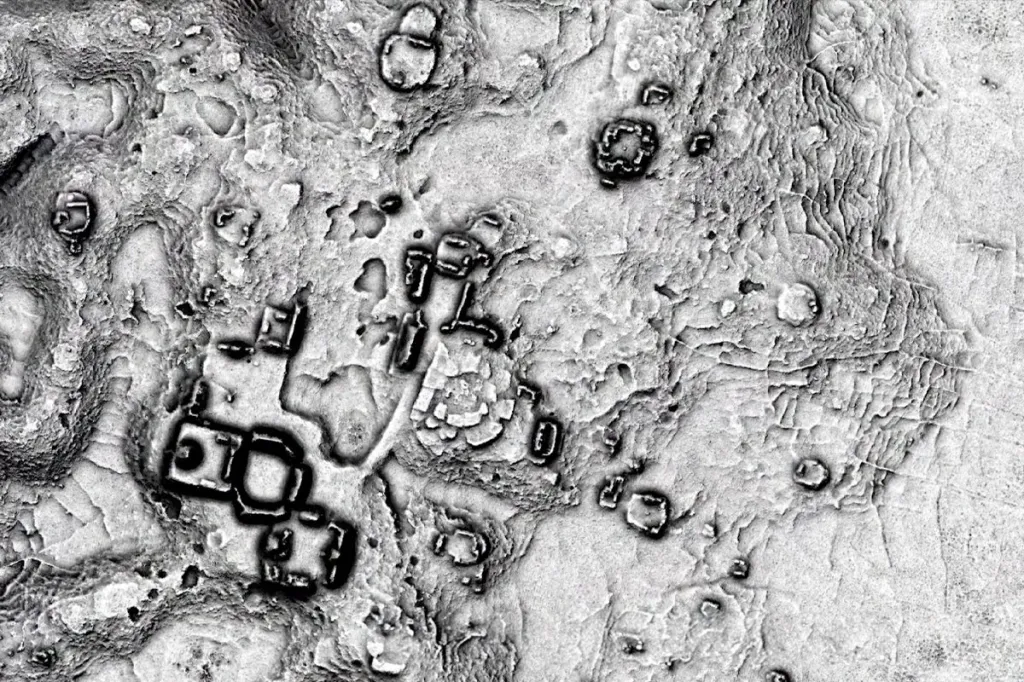
While the team's physical discovery was the climax, the path to Minanbé was likely paved by the revolution in LiDAR (Light Detection and Ranging) technology. In recent years, the use of aerial laser scanning has transformed the jungles of Mexico and Guatemala from opaque walls of green into transparent maps of ancient architecture. LiDAR allows researchers to strip away the canopy digitally, revealing the geometric signatures of pyramids, causeways, and reservoirs that are invisible from the ground. The discovery of Minanbé follows a broader trend of "megacity" discoveries in the region, suggesting that the Mayan population was far denser and their political networks more complex than previously believed.
The strategic location of Minanbé within the Calakmul Biosphere Reserve suggests it may have played a critical role in the regional power dynamics of the Classic period. Calakmul was one of the great "superstates" of the Maya world, often locked in a centuries-long conflict with the city of Tikal. Minanbé likely served as a satellite center or a strategic outpost, managing resources or controlling trade routes through the jungle. By analyzing the city's architecture and the distribution of its elite residences versus commoner dwellings, the Slovenian-Mexican team hopes to reconstruct the social hierarchy and economic function of a city that existed entirely off the map for ten centuries highlighting the ongoing need for the protection of these newly revealed sites from modern threats
This discovery also forces a re-evaluation of the Mayan 'road' system. The Maya were famous for their sacbeob—white limestone roads that connected cities. The fact that Minanbé is named 'the place where there is no road' suggests it may have been a clandestine site, a religious retreat, or a city designed for stealth. This challenges the assumption that all Mayan urban centers were integrated into a rigid, visible network of trade and transit, suggesting a more nuanced and possibly subversive approach to urban planning.
The Challenge of Conservation and Access
Now that Minanbé has been revealed, the archaeological team faces the classic dilemma of discovery: how to study a site without destroying it. The very isolation that preserved the city now makes it a logistical nightmare for conservation. Bringing equipment, personnel, and supplies into the heart of the Calakmul reserve requires a delicate balance between scientific necessity and environmental protection. There is also the immediate threat of "huaqueros"—looters who follow archaeological news to find and steal artifacts. The "intact" nature of Minanbé makes it a prime target for those seeking to sell Mayan jade, ceramics, and obsidian on the black market.
The Mexican government and the Slovenian partners are currently developing a security and conservation plan that prioritizes the site's integrity over tourist access. Unlike the heavily commercialized ruins of Chichén Itzá, there is a growing movement to keep sites like Minanbé as "research-only" zones. This approach acknowledges that some of the most valuable data is found not in the monuments themselves, but in the organic remains and soil layers that would be destroyed by the footfall of thousands of visitors. The goal is to create a digital twin of the city through high-resolution scanning, allowing the world to experience Minanbé in virtual reality while the physical ruins remain undisturbed in the jungle.
This shift toward 'virtual tourism' is not just a convenience but an ethical necessity. The carbon footprint of transporting thousands of tourists to a remote biosphere reserve would destroy the very environment the researchers are trying to study. By decoupling the experience of the site from the physical presence of the visitor, Mexico is setting a new global standard for the preservation of archaeological heritage in the 21st century, prioritizing the survival of the ruins over the profit of the tour industry.
What Minanbé Tells Us About the Mayan Collapse
The most enduring mystery of the Mayan civilization is the cause of its collapse in the Southern Lowlands. For years, theories have ranged from prolonged drought and environmental degradation to incessant warfare and systemic political failure. Because Minanbé was hidden and undisturbed, it provides a unique data set for testing these theories. If the city shows signs of a gradual decline—such as the repurposing of grand plazas into agricultural plots— it supports the theory of environmental stress. If it shows signs of sudden abandonment or violent destruction, it points toward the warfare model.
The discovery of Minanbé suggests that the "collapse" was not a la single event but a fragmented process that varied by region. Some cities may have thrived long after others fell, adapting their social structures to survive in a changing climate. By studying the final layers of occupation at Minanbé, researchers can determine exactly when the la "roadless city" finally fell silent. This discovery is not just about finding ruins; it is about recovering the lost narrative of a la people who mastered astronomy, mathematics, and urban planning in one of the most challenging environments on Earth, only to vanish into the green veil of the la Campeche jungle reinforcing the deep historical complexity of the Mexican landscape
Ultimately, Minanbé is a reminder of the limits of our knowledge. For a thousand years, this city existed as a ghost, a silent witness to the rise and fall of empires. Its sudden reappearance is a humbling event that reminds us that the earth still holds secrets that defy our current maps. As the team continues to excavate, the 'roadless city' may finally provide the roadmap we need to understand the true nature of the Mayan collapse and the enduring legacy of their civilization.
The discovery of Minanbé also brings to light the intersection of ancient urbanism and modern ecology. The way the city was integrated into the rainforest—using the canopy as both a resource and a shield—suggests a sophisticated understanding of sustainable urban living that may have lessons for contemporary architecture. As we face a global climate crisis, the study of how the Maya managed water and food in a remote jungle environment is no longer just an archaeological curiosity, but a potential blueprint for future survival. The 'roadless city' is thus a bridge between a lost past and an uncertain future, proving that the most valuable lessons often come from the places we forgot to look.
Finally, the discovery of Minanbé emphasizes the importance of international collaboration in archaeology. The partnership between Slovenian and Mexican researchers demonstrates that the most significant breakthroughs often happen when diverse academic perspectives and technical capabilities converge. By combining European laser-mapping expertise with Mexican field experience and deep cultural knowledge, the team was able to locate a city that had escaped detection for a millennium. This model of shared discovery and shared stewardship is the only way forward in an era where the remaining undisturbed sites must be protected from the twin threats of looting and commercial exploitation.