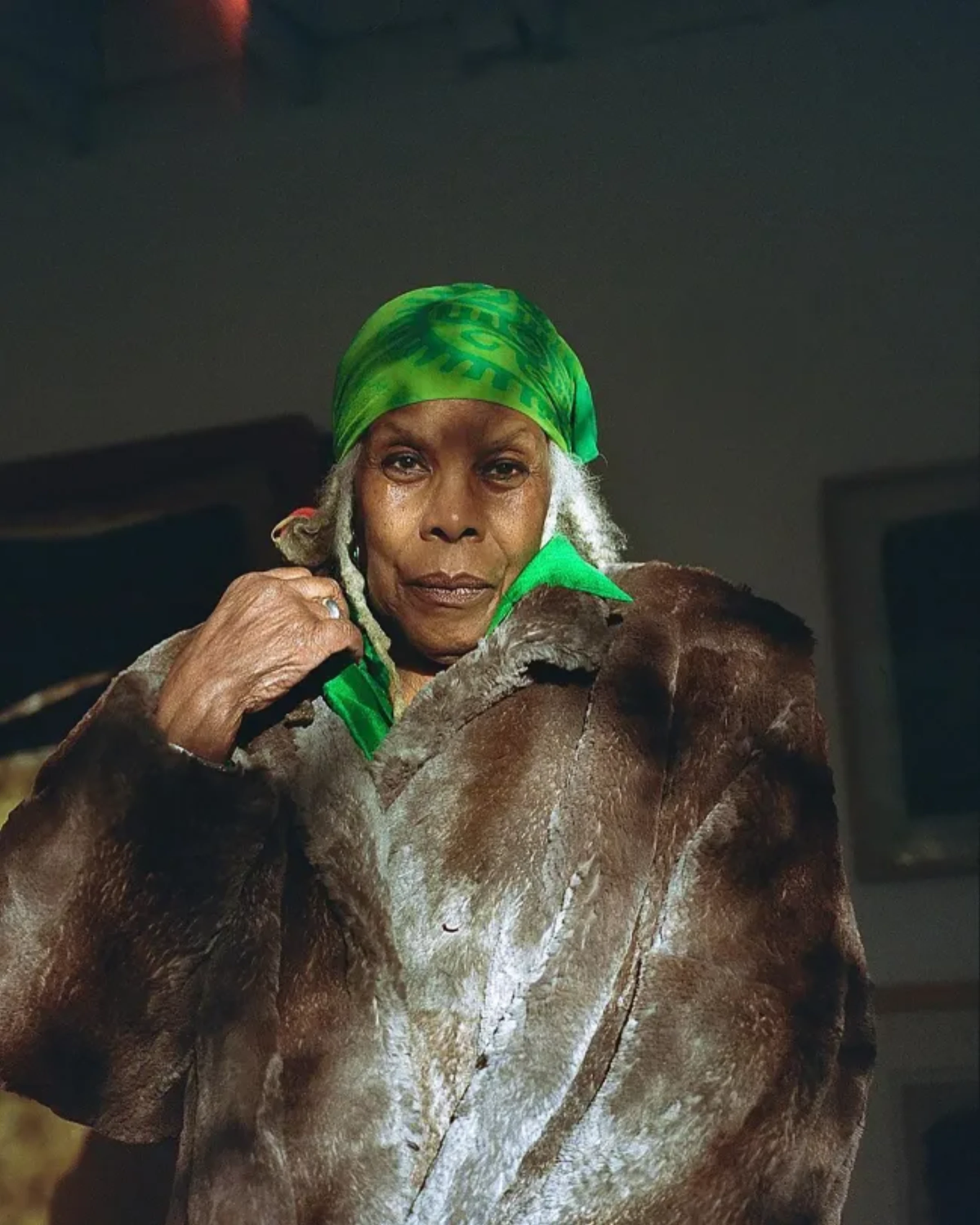
Mary Lovelace O'Neal Dies at 84
Mary Lovelace O'Neal, who fused abstraction, Black political history and unruly material force, has died at 84 after a late-career critical ascent
Mary Lovelace O'Neal leaves behind a body of work that refused clean categories
Mary Lovelace O'Neal, who died on May 10 in Mérida, Mexico, at eighty-four, spent six decades making paintings that were too physical for easy theory and too intellectually exacting for the market's usual identity labels. Artforum's obituary gets the basic outline right: she was long treated as an artist's artist before a belated wave of institutional and commercial recognition caught up with the scale of her achievement. But that phrase can also understate the problem she posed. Lovelace O'Neal's work did not wait to be discovered. It sat in plain view for decades, demanding that critics, curators and collectors update their language for what postwar abstraction could look like when Black life, feminist refusal and painterly intelligence were not filed into separate compartments.
She was not a neglected artist because the work was minor. She was neglected because the work made too many existing categories look flimsy. Her lampblack paintings, for instance, are not easily reduced to either monochrome severity or autobiographical statement. They absorb both, and then complicate both with touch, abrasion, atmosphere and an insistence on pleasure. When Lovelace O'Neal said she did not categorize her work or give it a new name, she was not being coy. She was refusing the taxonomic impulse through which art history often tries to make difficult practices easier to market and teach.
From Howard to Columbia, she built a language of form under political pressure
Born in Jackson, Mississippi, on February 10, 1942, Lovelace O'Neal came of age in a context where art and political action were never entirely separate. At Howard University, where she studied under David Driskell, she was active in the civil rights movement and helped found the Non-Violent Action Group. Artforum notes that she traveled to Mississippi with Stokely Carmichael to support voter registration drives and labor protests. That matters not because it offers a credential in activism, but because it clarifies the pressure surrounding her later commitment to abstraction. For Black artists of her generation, form was never innocent terrain. To paint abstractly was often to be asked, by friends and institutions alike, whether one was refusing politics, refusing legibility or refusing responsibility.
Lovelace O'Neal answered by refusing the terms of the question. At the Skowhegan School of Painting and Sculpture in 1963 she discovered lampblack, the pigment that would become one of the signatures of her practice. Later, in New York and at Columbia, she pushed that material into a language that was velvety, scorched and unstable all at once. She applied it to unstretched canvas with her hands or chalkboard erasers, then cut through its density with acrylic, pastel or oil. The surfaces do not perform purity. They behave like arguments between atmosphere and insistence.
Those arguments were sharpened by competing demands. Artforum recalls Lovelace O'Neal's account of being criticized by friends in the Black Arts Movement for not foregrounding explicit activist narratives, while professors at Columbia pushed her toward a more doctrinaire Minimalism. She was squeezed from both sides by people who wanted abstraction to be tidier than she did. Her response was to build a practice that could be read through Black political history without becoming illustrative, and through formalist discourse without becoming obedient. That balancing act was not moderation. It was a form of combat.
It also explains why her work feels so contemporary now. Much current criticism claims to welcome complexity, but artists are still routinely rewarded for being immediately legible inside institutional narratives about race, gender or medium. Lovelace O'Neal's paintings never offered that convenience. They ask the viewer to keep several histories active at once, then deny the relief of a simple synthesis. That difficulty is part of their generosity. They make more thought possible, not less.
The lampblack paintings and later series made unruliness into method
Her best-known works are powerful partly because they never present material innovation as neutral technique. The lampblack series used darkness not as a symbol to decode but as a tactile condition to move through. In one register, the paintings speak to the history of abstraction after Ad Reinhardt and post-Minimal painting. In another, they answer the social demand that Black artists either narrate trauma directly or stay decoratively formal. Lovelace O'Neal refused both traps. The paintings are sensuous, hostile, witty and difficult. They make blackness feel like matter, pressure and velocity, not merely theme.
That refusal carried into later bodies of work. After moving to the Bay Area in the 1970s, she began the wildly titled "Whales Fucking" series, which Artforum describes through the artist's own deadpan explanation of seeing whales surge through the water off the San Francisco coast. The title is funny, but the paintings are not jokes. They transform massive displacement, erotic force and liquid movement into sweeping forms that refuse embarrassment. Another major series, "Panthers in My Father's Palace," drew from a 1984 trip to Morocco and from the artist's relationship to memory, geography and familial authority. Across both series, she kept proving that grandeur and irreverence do not cancel each other out.
That is one reason younger painters found her so compelling. Lovelace O'Neal never performed the solemnity that often gets mistaken for seriousness in abstraction. Her works could be lush, abrasive and intellectually barbed at once. They also made room for contradiction without asking permission. She could be in dialogue with the Black Arts Movement, Minimalism, Bay Area experimentation and global modernist histories while still making pictures that looked unmistakably like hers. That is rarer than the art world likes to admit.
The late-career institutional embrace was welcome, but it was also an indictment
In recent years the institutions finally arrived. Artforum notes a 2020 mini-retrospective at Mnuchin Gallery, major 2024 exhibitions at Marianne Boesky and the San Francisco Museum of Modern Art, participation in the 2024 Whitney Biennial and inclusion in the 2025 Centre Pompidou exhibition "Paris Noir." The Virginia Museum of Fine Arts is currently showing "Blacker Than a Hundred Midnights Down in a Cypress Swamp" through August 6. All of that recognition mattered, and none of it was early.
The art world likes a redemption arc because it flatters institutions for eventually noticing what they once ignored. Lovelace O'Neal's late-career acclaim should be read less as redemption than as evidence of how long mainstream narratives of American postwar painting remained structurally narrow. Her work did not become important in 2020 or 2024. It became harder to exclude. That distinction matters because market enthusiasm can too easily recast historical neglect as a solved problem. A few major shows do not erase the decades in which she was peripheral to the very histories she helped complicate and enlarge.
Her teaching career sharpens that point. In 1985 she became the first Black woman to receive tenure in the art department at UC Berkeley, after teaching there since 1979, and later chaired the department. That is not a minor institutional footnote. It means Lovelace O'Neal shaped generations of artists while the broader art market still struggled to place her. She occupied the paradoxical role too many major artists know: central in pedagogy, peripheral in canon formation until the canon had no choice but to catch up.
Her presence in public collections makes that lag even harder to excuse. Artforum lists holdings at the de Young, the Art Institute of Chicago, the Brooklyn Museum, the National Gallery of Art and the Smithsonian, among others. Museums were willing to own the work before they were fully willing to organize the histories that would place it at the center of postwar American painting. That gap between acquisition and interpretation is where a great deal of artistic marginalization actually lives.
What her death means for American painting now
Lovelace O'Neal leaves a body of work that makes current debates about identity, abstraction and institution-building look both overdue and insufficient. She showed that abstraction can carry Black historical pressure without surrendering its formal autonomy, and that political seriousness does not require the deadening literalism often demanded of artists from marginalized histories. She also exposed the timidity of critical habits that want artists to stand still inside the categories built for them. Her best paintings keep moving past those boundaries even after the language around them changes.
The next phase of her legacy will depend on whether museums and scholars are willing to do more than memorialize her belatedly. The challenge is to rewrite the histories in which she was treated as adjacent rather than essential. That means placing her not in a separate compensatory lane but within the main arguments about postwar American painting, Black modernism, feminist material practice and West Coast experimentation. Anything less would repeat, in softer tones, the same sidelining that defined so much of her career.
Lovelace O'Neal once described being unruly as her nature. That line now reads less like autobiography than like an instruction. Her paintings remain unruly because they do not let viewers settle for recognition as a substitute for understanding. They ask for a more demanding kind of looking, one that accepts sensual excess, historical contradiction and formal force without trying to tame them into a neat lesson. The institutions are finally paying attention. The harder task is to prove they understand what they were late to see.