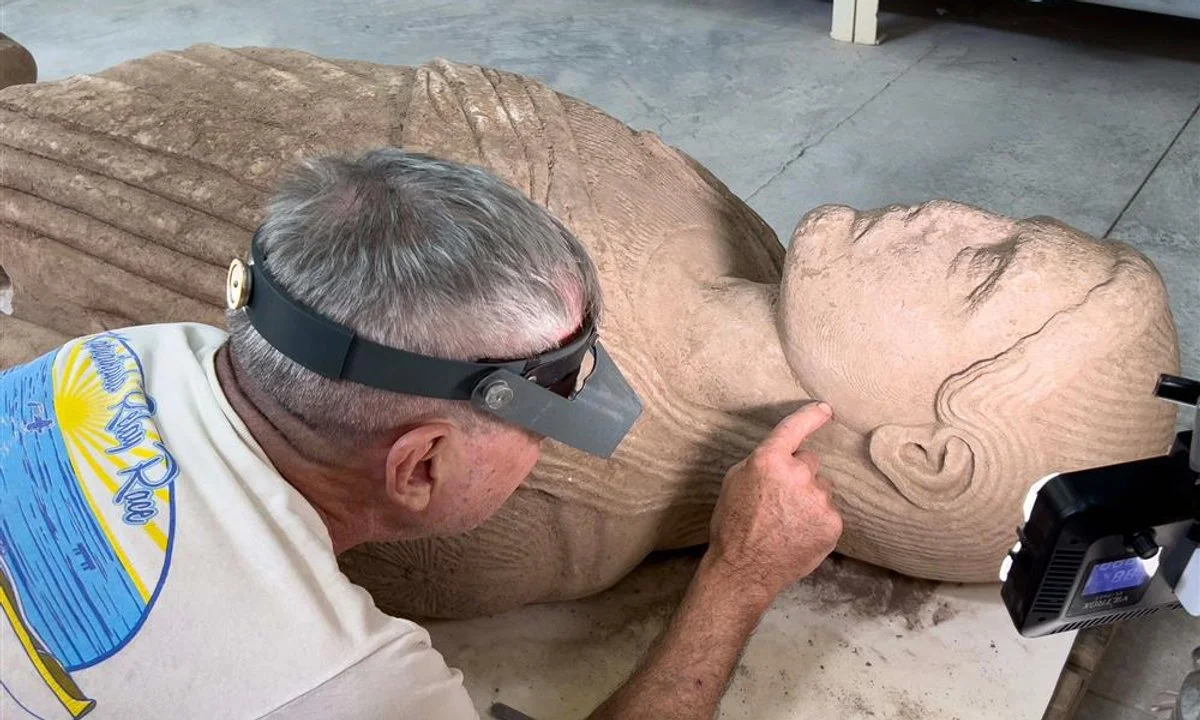
Colossal Lydian Statue Unearthed at Sardis
A seven-foot statue of a young man holding fruit emerged from a Roman paving stone at the UNESCO site of Sardis, baffling archaeologists
A Statue Buried in the Pavement
Archaeologists at the ancient city of Sardis in western Turkey have unearthed a colossal statue dating to the first half of the fifth century BC, a period that marks the transition between the Archaic and Classical eras of Greek art. The figure, depicting a young man holding fruit, was discovered in two pieces but once stood approximately seven feet tall, according to a statement from Turkey's Ministry of Culture and Tourism. The statue's preservation is remarkable: it survived because it was repurposed as a paving stone on a Roman-era colonnaded street, buried face-down beneath centuries of foot traffic. The reuse of older monuments as building material was common in the ancient world, but the survival of a statue of this scale and quality in such a context is exceptional.
The discovery was announced on August 4, 2026, and immediately drew attention from specialists in ancient sculpture. The statue was found at Sardis, the capital of the Lydian civilization, which was inscribed as a UNESCO World Heritage site in 2025. Sardis was one of the great cities of the ancient Mediterranean, known for its wealth, its invention of coinage, and its position at the crossroads between the Greek world and the Near East. The city's strategic location in the Hermus Valley made it a hub of trade and cultural exchange, and its archaeological record reflects layers of Lydian, Persian, Greek, Roman, and Byzantine occupation.
The Lydian Puzzle
What makes the statue extraordinary is its stylistic inconsistency. The figure's upright stance and long flowing hair are characteristic of sixth-century BC sculptural traditions, while the carving of the face and hands, including visible veins and a turned neck, reflect the more naturalistic techniques of the early fifth century BC. The garment combination, a Greek-style outer cloak worn over a tunic-like lighter garment with horizontal lines, has no parallel in known sculptures from Greece or Anatolia from this period. The ministry statement suggests the work sheds light on the "clothing traditions and visual language of Lydia," a culture that remains poorly understood despite its historical importance.
Nicholas Cahill, the field director of the Sardis Expedition, told The Art Newspaper: "I'm always struck by how little we know about the Lydians. There is only one major Lydian site, and that's Sardis. We're still almost in the infancy of our studies of ancient Lydia, despite working at Sardis for more than 70 years. And we have never been fortunate enough to find such a monumental sculpture. Indeed these things come up very rarely worldwide."
Cahill's assessment suggests the sculptor was aware of developments in Greek and Italian art but deliberately chose to portray the subject in a manner rooted in ancestral Lydian tradition. This points to a distinctly local artistic culture that absorbed and adapted Greek forms rather than simply imitating them, a finding that complicates the conventional narrative of Greek cultural dominance in the eastern Mediterranean during the Classical period. The statue may represent a Lydian elite figure, perhaps a priest or a member of the ruling family, depicted in a style that asserted local identity within the framework of Persian imperial rule.
Sardis and the Crossroads of Empire
Sardis was the capital of the Lydian kingdom until its defeat by the Persian king Cyrus the Great in 546 BC, after which it became the administrative center of the western province of the Achaemenid Persian Empire. The statue dates from this period of Persian rule, when Sardis was a cosmopolitan hub where Greek, Persian, and local Lydian cultures intersected. The blending of styles visible in the statue may reflect the complex social dynamics of a city that was simultaneously a seat of imperial power and a center of indigenous artistic production.
The archaeologist Hector Williams, who has worked at the site over multiple decades, described the statue as "one of the most unusual pieces of sculpture to emerge from excavations in western Turkey in the last decades" and predicted that specialists in Greek sculpture will scrutinize it closely. The statue's combination of archaic and classical features, along with its unprecedented garment configuration, raises fundamental questions about how artistic innovation spread through the ancient Mediterranean and how local identities persisted under imperial rule. Williams emphasized the layered history of Sardis itself, noting its significance across Lydian, Persian, Greek, Roman, and early Christian periods.
A Second Discovery at Aspendos
The Sardis find was followed by a second major announcement on August 6: 1,800-year-old marble sculptures of Asklepios, the Greek god of medicine, and his son Telesphoros were discovered at another UNESCO site, the ancient city of Aspendos, known for its remarkably preserved Roman theater. Turkey's Minister of Culture and Tourism Mehmet Nuri Ersoy praised the "intricate craftsmanship" of the Roman-period works, which depict the healing deities in a grouping that, as Ersoy noted, "serves as a powerful symbol that holistically conveys the healing process, spanning from the treatment of an illness to the individual's complete recovery."
The two discoveries within days of each other underscore Turkey's continuing importance as a repository of classical antiquity. The country's archaeological sites, from Ephesus to Troy to Sardis, have yielded some of the most significant finds of the past century, even as cultural heritage faces threats from urban development, looting, and political tensions over archaeological funding. The Sardis statue, with its hybrid Lydian-Persian-Greek style, is a reminder that the story of ancient art is not a simple progression from one dominant culture to the next, but a web of influences, adaptations, and deliberate local choices that resist easy categorization.
The Significance of Lydian Art
The discovery also raises questions about what has been lost. Sardis has been continuously occupied for over three millennia, and the archaeological record is fragmented by centuries of rebuilding, looting, and erosion. The fact that a statue of this quality was preserved only because it was used as a paving stone suggests that other Lydian monuments may have been similarly recycled into later structures, their identities erased by practical necessity. The Sardis Expedition has been excavating the site since 1958, and while the team has uncovered monumental architecture, inscriptions, and domestic quarters, monumental sculpture of this caliber has eluded them until now. The absence of comparable finds may reflect not a lack of Lydian sculptural production but rather the destructive effects of centuries of reuse and reconstruction.
The Lydians themselves remain one of the most poorly understood civilizations of the ancient Near East, despite their historical significance. Herodotus devoted considerable attention to Lydia in his Histories, particularly to the reign of Croesus, whose wealth became proverbial. But archaeological evidence for specifically Lydian cultural production, as distinct from the Greek and Persian cultures that surrounded and succeeded it, has always been thin. The colossal statue from Sardis is therefore not just a single remarkable find but a window into an entire artistic tradition that has been largely invisible to modern scholarship.
What Comes Next
The statue will undergo further study and conservation, and specialists in Classical sculpture await its full publication. For the field of Lydian studies, which Cahill describes as still in its infancy despite seven decades of excavation, the find opens new questions about the sophistication and distinctiveness of Lydian artistic production. The Sardis Expedition, a joint project of Harvard and Cornell universities, has operated at the site since 1958, and the colossal statue suggests that the ground still holds surprises capable of rewriting what we know about one of antiquity's most enigmatic civilizations. The full study and publication of the statue will likely take years, but even preliminary analysis has already challenged assumptions about the cultural hierarchy of the ancient Mediterranean world. For Turkey, the discovery adds another chapter to a remarkably rich archaeological record that continues to reshape understanding of the ancient world.
The Sardis site has produced evidence of continuous human settlement from the Bronze Age through the Ottoman period, making it one of the longest-occupied archaeological sites in the Mediterranean. Each layer of occupation has left its mark on the stratigraphy, and the colossal statue was found in a context that spans the Lydian, Persian, and Roman periods. Understanding this context is essential for interpreting the statue, as it was not found in its original setting but in a secondary use that reflects the practical priorities of a later era. The reuse of monuments as building material was a common practice in the ancient Mediterranean, but it is unusual for a statue of this quality to survive the process intact.
The statue also highlights the role of international archaeological collaboration in producing knowledge about the ancient world. The Sardis Expedition has been a joint project of Harvard and Cornell universities for nearly seven decades, and its longevity has allowed for the kind of sustained, systematic excavation that produces discoveries like the colossal statue. Short-term excavation projects, by contrast, rarely uncover material of this significance because they lack the deep contextual knowledge that comes from decades of work at a single site. The Sardis team understands the stratigraphy, the ceramic sequences, and the architectural history of the site in a way that no short-term project can match, and this expertise is what made it possible to recognize the significance of the statue and its context immediately.