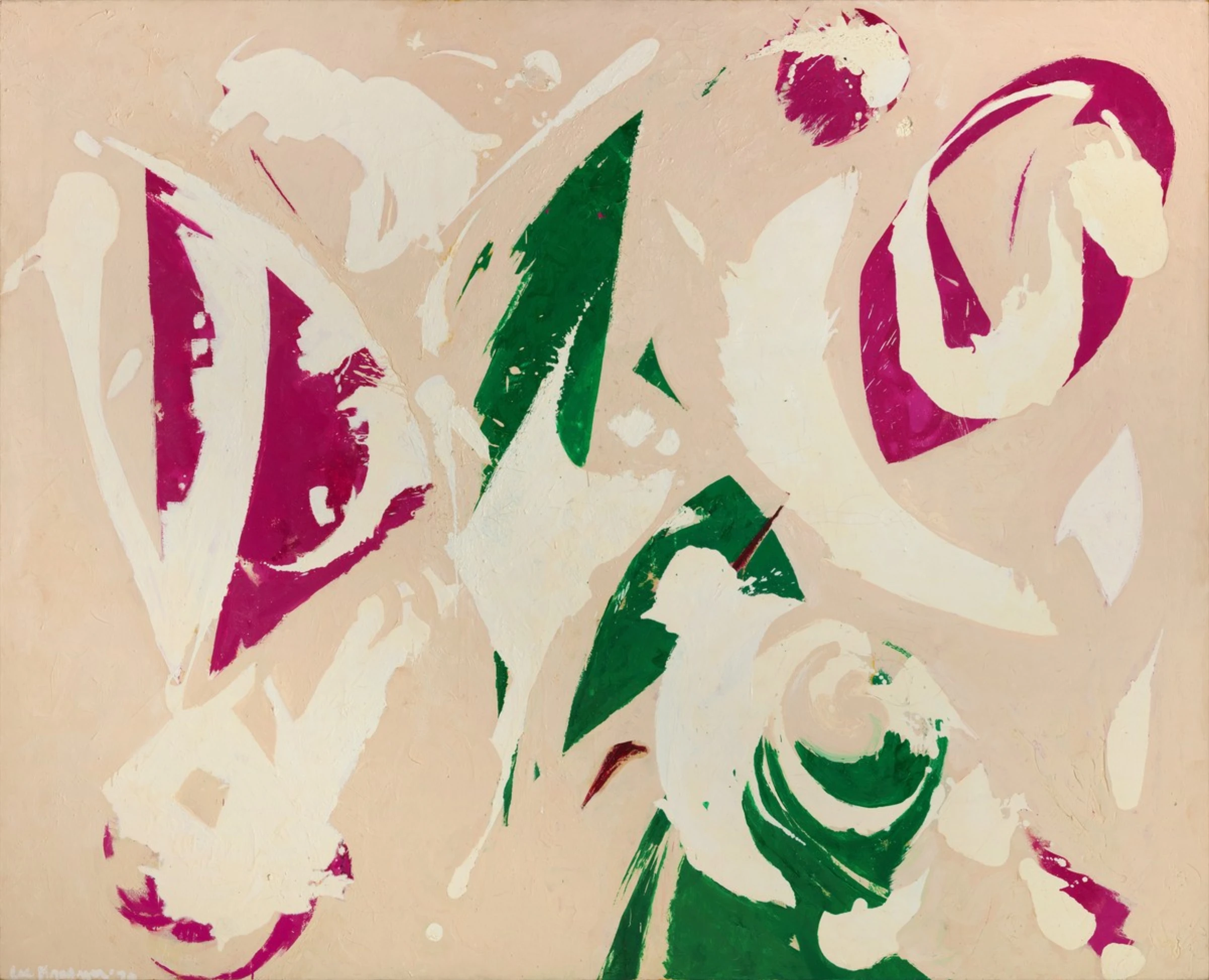
Lee Krasner Gets a Paris Platform Before Art Basel Week
Gagosian and Olney Gleason are positioning Lee Krasner in Paris just before Art Basel Paris, turning canon repair into a high-visibility autumn wager
Lee Krasner Arrives in Paris at a Strategic Moment
ARTnews treated the announcement of a Lee Krasner exhibition in Paris as a market calendar item, but the timing deserves a harder read. Gagosian and Olney Gleason will open the show on 19 October at Gagosian's Rue de Ponthieu space, just before the 2026 edition of Art Basel Paris. That places Krasner not in a quiet scholarly season but inside one of the most concentrated weeks of global art traffic. Dealers, advisers, curators, collectors, and museum trustees will already be in the city. A postwar painter whose reputation has historically been filtered through male peers is being positioned in front of the precise audience that helps rewrite hierarchies in real time.
The raw facts are simple. The Metropolitan Museum of Art has already announced a Lee Krasner and Jackson Pollock exhibition opening 4 October in New York. Two weeks later, Paris gets its own Krasner-focused presentation. That sequencing is not accidental. It creates an autumn corridor in which Krasner can be seen first through an institutional duet with Pollock and then through a dealer-backed solo frame of her own. The second step matters. It implies that the market no longer needs Krasner merely as part of a heroic couple narrative. It wants her as an independent anchor for a major Paris season.
Why Gagosian and Olney Gleason Want Krasner Now
Krasner has never lacked importance, but importance and positioning are different things. For decades, the standard telling of postwar American art treated her as a foundational painter who was somehow always adjacent to the central story rather than fully installed inside it. Museums and scholars have worked against that distortion for years, yet commercial scale often lags behind critical correction. A Gagosian exhibition changes the temperature because Gagosian remains expert at converting art historical seriousness into public inevitability. Once a painter enters that machine at the right moment, the question becomes less whether she matters and more who failed to recognise it earlier.
Olney Gleason's involvement sharpens the signal. The gallery has built a reputation for handling estates and artist legacies with a level of research and archival attention that can complement, rather than merely imitate, mega-gallery reach. Pairing that work with Gagosian's international audience suggests a two-track strategy: scholarship for credibility, scale for consequence. The result is not just another booth-adjacent event timed to a fair week. It is an attempt to reframe Krasner's place in the market and in the postwar canon at once.
The location matters too. Paris in October is no longer simply a satellite to London and New York. It has become a battleground where galleries, auction houses, museums, and fairs compete to claim intellectual and commercial leadership for the season. A Krasner show in that environment is a pointed act of programming. It says that redistributive canon work can still function as prestige programming, and that a woman artist long treated as supplementary can become a headline proposition without apology.
How Paris Fair Week Turns Scholarship Into Theater
Fair weeks encourage a particular kind of distortion. They compress attention, reward instantly legible gestures, and tempt galleries to stage exhibitions that photograph well but say little. Krasner is not a natural fit for empty spectacle, which is exactly why this exhibition could matter. If the show is handled seriously, it allows Gagosian to claim more than floor traffic. It can claim judgment. The fair-week audience arriving in Paris will include people already primed to compare priorities across the city. A strong Krasner presentation could stand out precisely because it resists novelty for novelty's sake.
There is a lesson here about the politics of programming around major fairs. Not every ambitious gallery show mounted during Art Basel Paris week is truly about art history. Many are about client management, social choreography, and strategic noise. Krasner offers a harder proposition. She requires a gallery to explain why this work, this moment, and this city belong together. If Gagosian succeeds, it will demonstrate that canonical repair can still drive attention when it is paired with conviction instead of tokenism.
The Paris show also throws useful pressure onto the Met exhibition. Institutional surveys often promise revision but risk smoothing an artist back into familiar comparative structures. A solo commercial exhibition opening days later keeps the conversation unsettled. It lets viewers test whether Krasner reads differently when she is not placed in a dyad. That difference is exactly where art historical rehabilitation either becomes real or collapses into public relations language.
Krasner and the Ongoing Repricing of Postwar Narratives
The broader stakes extend well beyond one gallery season. Postwar market narratives are still being repriced as institutions and collectors confront how badly women artists were structurally under-recognised. Some corrections have been speculative and shallow. Others have produced enduring changes in collecting priorities, museum displays, and monographic scholarship. Krasner sits at a crucial junction because her case is both obvious and unfinished. Everyone serious already agrees she matters. The question is whether the ecosystem is ready to let that consensus alter exhibition calendars, acquisition strategies, and valuation logic in a durable way.
That is where Gagosian's involvement cuts both ways. The gallery has the power to intensify attention and move works into stronger collections. It also has every incentive to shape the story for market effect. Those aims are not mutually exclusive, but they should not be confused. A dealer-backed correction is still a correction mediated by inventory, audience management, and prestige competition. Readers who want a wider frame should compare this move with other institutional recalibrations we have tracked, including how museums use planning documents to convert values into priorities in our guide to reading strategic plans. In both cases, the real test is whether rhetoric changes resource allocation.
Krasner's Paris moment therefore deserves both enthusiasm and skepticism. It is encouraging that she is being foregrounded at such a visible point in the season. It is also fair to ask what kinds of works will be shown, how the exhibition will narrate her development, and whether the presentation risks flattening her into a market-corrected emblem. Great postwar painters should not have to arrive as moral lessons. They should arrive as artists whose work can still trouble the categories built around them.
What to Watch in October
When October arrives, the most revealing comparison may not be between Paris and New York as cities but between formats. How does Krasner read inside a museum argument shaped partly by Pollock, and how does she read in a gallery exhibition that has no reason to share the frame? Which works travel, which periods get emphasized, and how much formal risk survives the pressure of fair-week spectatorship will tell us whether this is a serious intervention or an elegantly timed inevitability play.
Watch also for the secondary effects. If the show lands, more galleries and institutions will push harder on women artists whose reputations have long been verbally secure but operationally underused. If it disappoints, the problem will not be Krasner. It will be the familiar art-world habit of mistaking overdue recognition for finished thinking. Paris has given the galleries an excellent stage. Now they have to prove they have something sharper than timing.
One more thing to watch is how aggressively the galleries distinguish Krasner from the sentimental language that often surrounds overdue recognition. The strongest version of this exhibition would not ask viewers to admire her because she was neglected. It would ask them to contend with a painter whose formal intelligence, scale, and volatility can reorganize the room on their own terms. That may sound obvious, but too many rehabilitation narratives still smother artists in righteousness. If Paris gives Krasner the space to look difficult, ambitious, and unresolved rather than merely deserving, then the show will have done real work for her legacy and not just for her market.
There is also a city-level competition embedded in the announcement. Paris wants to keep proving that its October season can carry museum-grade substance alongside fair-week commerce. A Krasner exhibition helps the city stage that argument because it sits between scholarship and spectacle without collapsing into either. If the show attracts collectors, curators, and critics who would otherwise move through the week on autopilot, it will confirm that the most effective autumn programming now involves placing historically urgent artists where high-velocity audiences have no excuse to ignore them.
The implication for collectors is straightforward. They are being invited to treat art historical attention and market timing as mutually reinforcing rather than contradictory. That invitation may produce deeper looking, or it may simply accelerate a repricing everyone already sees coming. The outcome depends on whether the show can generate interpretation equal to its positioning. Paris will provide the traffic. The galleries still have to provide the argument.
Either way, the announcement is a signal. Krasner is being placed at the center of an autumn week usually ruled by fairs, trophy consignments, and predictable names. That is worth noting. It suggests that canon repair now works not only as institutional homework but as a public-facing wager about what audiences with money and influence are prepared to look at seriously.