Christie's Tests the Market for a Grail Manuscript
A thirteenth-century Arthurian manuscript at Christie's turns medieval literature into a live market question about rarity, provenance, and spectacle
Christie's is selling myth, rarity, and manuscript history in one lot
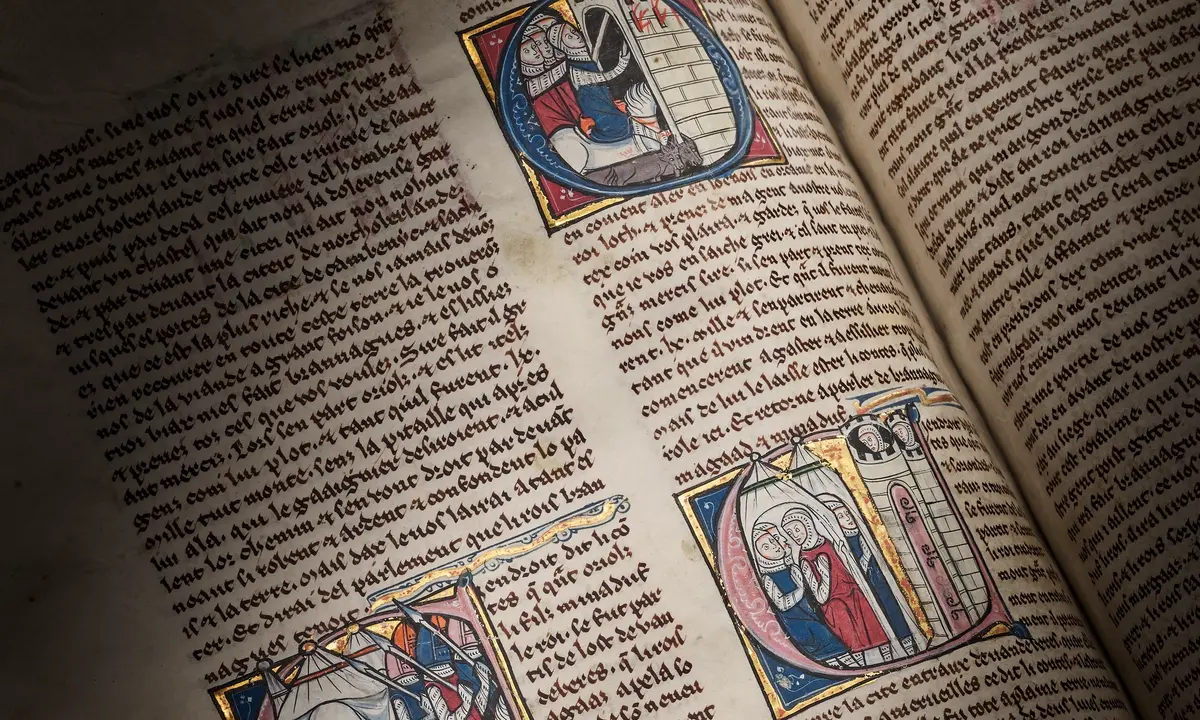
Christie's London will offer the Clermont-Tonnerre Grail on 8 July with an estimate of £1.5 million to £2 million, a figure that tells you the house believes the manuscript can operate as more than a specialist treasure. As The Art Newspaper reported, the late thirteenth-century volume contains material from the Old French Lancelot-Grail cycle, including the Holy Grail quest, Merlin narratives, and Arthurian adventures, and it carries 126 miniature illustrations. Christie's is not just bringing a medieval codex to market. It is staging the sale of one of Western culture's most durable narrative machines.
The manuscript's appeal begins with obvious ingredients: vellum, gold leaf, aristocratic provenance, visual richness, and the fact that King Arthur remains legible far beyond the world of manuscript collectors. But the more serious point is scarcity. Christie's describes the work as the earliest of only three known examples in private hands. In a field where top-end buyers often chase singularity rather than simple quality, that framing matters. The lot becomes attractive not only because it is beautiful, but because it occupies a very thin band of availability between institutional holdings and complete inaccessibility.
The object is compelling because its history is long, specific, and unusually legible
The manuscript is thought to have been produced in Metz between about 1290 and 1310 by the medieval artist known as the Master of the Liège Apocalypse. That attribution gives the lot more than generic antiquity. It anchors the object in a particular workshop tradition and a particular visual culture. According to the sale narrative summarized by ARTnews and The Art Newspaper, the manuscript later passed through the hands of Michel de Gronnais, Michel de Chaverson, the comte de Clermont-Tonnerre, Sir Thomas Phillipps, and industrialist Jean Lebaudy before entering a long-standing private collection.
That chain of ownership does two things at once. It reassures buyers who want documented pedigree, and it intensifies the aura of the object by showing how elite stewardship itself becomes part of the sale. Medieval books often arrive on the market wrapped in a story of survival, but survival alone is not enough. What collectors pay for is survival with names attached, preservation with documentary continuity, and scholarship that can be turned into competitive confidence at the bidding table.
There is also a literary point here that the market is happy to exploit. Arthurian material occupies a crossover zone between the rare-book trade and broader cultural memory. A collector does not need to be a medievalist to understand why Merlin, the Grail, and the Round Table remain catnip. Christie's gets to sell deep scholarship through instantly recognizable mythology. That is a profitable combination because it flatters both connoisseurship and fantasy.
The visual richness matters just as much as the text. This is not a scholar's manuscript whose importance becomes visible only after prolonged study. With 126 miniatures, the lot can perform immediately in preview rooms, catalogs, and media coverage. That is critical in an era when auction houses increasingly rely on cross-platform circulation to manufacture urgency. The manuscript must work for specialists who care about codicology and textual transmission, but it also has to work for wealthy generalists who respond first to image, aura, and narrative legibility. Medieval material rarely gets such a clean crossover opportunity.
Rare-book auctions now depend on spectacle almost as much as scholarship
The house's estimate may be conservative enough to attract competition, but it is also theatrical. Big estimates for medieval manuscripts work partly because they dramatize how little of this material ever circulates publicly. Auction houses know that rarity needs staging. Specialist commentary, close-up images, and language about Western cultural foundations all help turn a scholarly object into a broadly legible event. This is not cynical by definition. It is simply how the high end of the market now performs seriousness.
Christie's has become especially adept at framing historical objects in ways that feel event-like rather than dutiful. That strategy is familiar from marquee design sales, celebrity estates, and blue-chip contemporary consignments, but it is now central to rare books too. The manuscript is being sold not only as a medieval survivor but as a conversation piece for a collector class that wants historical legitimacy without sacrificing theatrical impact. In that sense, the sale reveals how auction marketing has flattened differences between categories. A Grail manuscript now has to compete in the same attention economy as a Basquiat or a T. rex skeleton.
Still, auction spectacle can blur real questions. How accessible should foundational literary material be when it moves deeper into private ownership? What obligations do wealthy buyers have toward lending, publication, or eventual institutional transfer? When Christie's presents the manuscript as a great survivor of noble and bibliophilic custody, it is also normalizing a system in which access remains contingent on private discretion. Museums, libraries, and scholars know that problem well, even if the sale catalog will not dwell on it for long.
There is a preservation dimension too. Manuscripts are not paintings that can be casually circulated through a home, a warehouse, and a fair booth without significant consequence. Climate control, handling expertise, conservation monitoring, and scholarly documentation all matter. Institutions usually provide that framework more transparently than private ownership does, though of course not perfectly. A buyer who treats the lot as a status totem rather than a custodial commitment would be purchasing a piece of cultural memory under conditions that the public cannot easily inspect. That imbalance is built into the trade, but it becomes harder to ignore when the object in question is a core witness to literary history rather than a luxury collectible with a shorter civic horizon.
Readers who followed our recent coverage of the Beyeler Cézanne claim will notice a familiar pressure point. Provenance is never just a credential. It is a way of deciding which histories become market assets and which histories become ethical scrutiny. In this case the provenance looks like a selling strength, but the broader lesson remains: ownership histories do cultural work long before the hammer falls.
What the July sale will really measure
The result on 8 July will not only indicate appetite for medieval manuscripts. It will measure whether buyers still respond strongly to objects that can bridge scholarship, image, narrative, and status without needing the liquidity profile of contemporary art. If bidding is aggressive, Christie's will have proof that deep-history material can still command attention in a market crowded by trophy paintings, design objects, and celebrity estates.
It will also show whether the top end of the market still values collecting as a form of historical self-fashioning. Buying a manuscript like this is not only about possession. It is about claiming a relationship to civilizational memory and making that claim legible to peers. That impulse has always animated bibliophilic collecting, but it now operates inside a much noisier luxury environment. The buyer will not just be purchasing vellum, paint, and text. They will be purchasing a role in the continuing public performance of stewardship, erudition, and exclusivity.
There is a lesson here for institutions too. Libraries and museums cannot compete with private wealth on every trophy lot, but they can compete in another way: by making the case that scholarship, conservation, and public access are forms of value the market alone cannot supply. If a manuscript like this disappears into private hands for decades, that loss is not simply sentimental. It affects teaching, reproduction, exhibition, and the general public's ability to encounter foundational material outside a catalog entry. The sale dramatizes the gap between ownership and custodianship with unusual clarity.
If bidding is soft, the explanation will not necessarily be that the manuscript lacks importance. It may mean the buyer pool for this level of rare book has narrowed, or that institutions cannot compete easily when private collectors sense a once-in-a-generation chance. Either way, the sale matters because it will expose how much room remains in the upper market for premodern material that is culturally famous yet structurally niche.
For now, the Clermont-Tonnerre Grail looks like the kind of lot auction houses dream about: undeniably rare, narratively irresistible, and just academic enough to make wealth feel studious. The danger is not that the object lacks value. It is that the market knows exactly how to convert cultural inheritance into a premium experience. On 8 July, we will see how much that experience is worth.
What makes the lot fascinating is that both outcomes can be true at once. A manuscript can be genuinely important and still be packaged through all the techniques of contemporary luxury sales. That tension is not a side issue. It is the central drama of how rare cultural material circulates now. Christie's is asking bidders to value literature, image, history, and exclusivity in one motion. Whether the room answers enthusiastically or cautiously, the result will tell us something important about how today's market prices the medieval past when it is offered as a singular collectible present.
That is why the sale deserves attention beyond the niche world of manuscript specialists. It condenses several broader art-market habits into one object: the use of scholarship as status insulation, the conversion of rarity into event culture, and the persistent belief that private ownership can stand in for public custodianship. The Clermont-Tonnerre Grail may sell because it is magnificent. It may also sell because it allows a buyer to perform taste at the level of civilization itself. Auction houses understand that distinction very well, even when they prefer not to say it out loud.