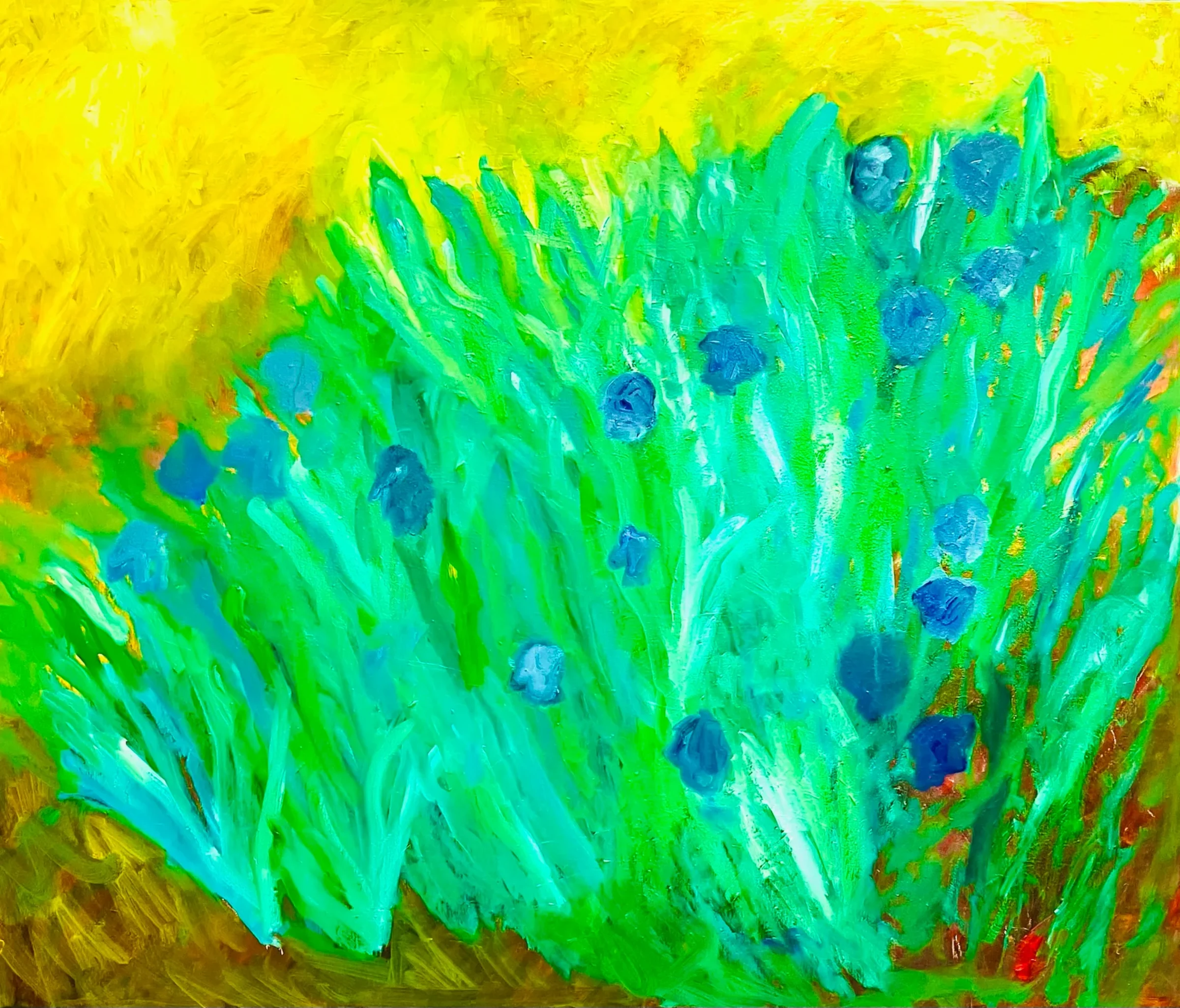
John D Edwards, Painter Who Turned Cancer Into Art, Dies at 74
The British artist worked with Hodgkin and Caulfield at Waddington Gallery before cancer redirected his practice toward healing and community art
Early Career and the Waddington Years
John David Edwards, who has died from heart disease aged 74, was a painter and sculptor who exhibited widely as John D Edwards and inspired community arts projects across Britain. Born in Hillingdon, he was the son of Edward (Ted) Edwards, a physicist and director at GEC, and Joan (nee Bird), who worked in the firm's library. He was educated at Abbotsfield school for boys and graduated from the Central School of Arts (1971-74) after foundation studies at Harrow School of Art. His training placed him in the British art education system at a moment when painting was being fundamentally rethought, and his early work reflected both the technical rigor of traditional training and the openness to new approaches that characterized London art schools in the early 1970s. The Central School, now part of University of the Arts London, was known for its emphasis on studio practice and its refusal to enforce rigid distinctions between fine and applied art, an approach that shaped Edwards's own flexibility across painting, sculpture, and community work.
In 1975 Edwards began working with artists and galleries in London, most notably the Waddington gallery, where he worked alongside major figures including Jim Dine, John Hoyland, Patrick Caulfield, and Howard Hodgkin. The Waddington was one of London's most important commercial galleries in the 1970s and 1980s, representing a generation of British painters who were negotiating the legacy of abstraction and figuration in distinctly British terms. Edwards's time there placed him in direct contact with the leading British and international artists of the period, and the influence of colleagues like Hodgkin, whose sensuous color and complex surfaces redefined British painting in the late 20th century, is visible in Edwards's own approach to paint and subject matter. Working at Waddington was not merely a job but an education, and the relationships Edwards formed there sustained him throughout his career.
He became an established figure in the artistic community with an initial one-man show at the Odette Gilbert Gallery and had exhibitions in London, New York, Chicago, and Tokyo. This early international reach was notable for a British painter of his generation and placed Edwards in a conversation that extended beyond the London scene. His work from this period, which included paintings like Tourist Class and Cruising at Midnight, showed a painter comfortable with both figuration and abstraction, able to move between observational drawing and more constructed compositions without losing a distinctive voice. The titles themselves suggest a painter interested in the social world around him, in travel and observation, rather than one locked into purely formal concerns.
Cancer and the Turn Toward Healing
Edwards's early success was severely impacted when, in 1996, he began treatment for cancer. The therapy was difficult and its side effects were significant, but he continued to work throughout, producing paintings that he later described as a fundamental part of his healing and physical and mental recovery. These paintings, made during and after treatment, became a distinct body of work that stood apart from his earlier production. They were more direct, more personal, and more willing to confront the experience of illness without sentimentality or evasion. The studio became not just a place of work but a site of recovery, where the physical act of painting served as both distraction and confrontation. Edwards discovered that the discipline of showing up to the easel, of mixing paint and applying it to canvas, provided a structure that medical treatment alone could not offer.
These paintings became the basis for his book How Cancer Saved My Life (2007), an honest and darkly funny account of using studio practice as a tool for survival. The title itself signals Edwards's refusal to treat illness as tragedy. The book argues that cancer, by forcing him to strip away everything that was not essential, gave him a clarity about his work and his life that he had not previously achieved. Sir Peter Blake, one of Britain's most respected living artists and a friend of Edwards, wrote the foreword, describing the paintings as courageous and full of humour and wit. Blake's endorsement placed Edwards's cancer-era work in a context that went beyond therapeutic expression into serious painting. The book and its associated talks became Edwards's primary public identity for the next decade, reaching audiences far beyond the art world.
Edwards was subsequently invited by hospitals and cancer charities throughout the UK to talk about the book and about externalising the experience of illness through art. He became a figure not just in the art world but in the broader conversation about creativity and recovery, speaking to audiences who had no prior interest in contemporary art but found in his story something they could use. His approach was not inspirational platitudes but practical demonstration: here is what I made, here is how I made it, here is what it did for me. This directness gave his talks a weight that more polished presentations might have lacked. He spoke the language of the studio, not the lecture hall, and that language turned out to be exactly the one that people in medical crisis needed to hear.
Studio Practice and Community Work
In 1991 Edwards married Susie Fairgrieve, whom he met when they both worked at Waddington. They established a home in Gloucestershire but divorced a year later. Edwards returned to his studio above the AB Fine Art Foundry in Poplar, east London, where he also assisted with the casting of Barry Flanagan's enormous hare sculptures. Flanagan's hares, cast in bronze at monumental scale, became one of the most recognizable public art projects in Britain in the 1980s and 1990s, appearing in plazas, parks, and gallery courtyards across the country. Edwards's role in their production connected him to a strand of British sculpture that was playful, physical, and unapologetically accessible, qualities that would later inform his own community work. The technical knowledge he gained at the foundry, understanding how bronze behaves at different temperatures and scales, gave him a material competence that supplemented his painting practice.
On medical advice, in 2008 Edwards relocated to a studio that his sister Marion owned in Ipswich. There he began a number of community projects, most notably The Never Ending Mural, an initiative that brought people from business, arts groups, playgroups, and schools together to create a community-owned mural to enhance the revitalisation of Ipswich Wet Dock and promote wider involvement in the arts. The project was characteristic of Edwards's later years, in which personal artistic practice and community engagement were inseparable. The mural was not a one-off event but an ongoing process, designed to keep growing and changing as new participants contributed to it. He gave immense personal support to people living with cancer and to others recovering from life-threatening addiction, offering what the Guardian obituary describes as a generosity of spirit that matched his practical help. In Ipswich, Edwards became a figure whose studio was not a private retreat but a community resource, open to anyone who needed it. The Never Ending Mural was emblematic of his belief that art should not be confined to galleries and that the act of making could be as therapeutic as the finished work itself. He also developed partnerships with local health organizations, bringing art workshops into clinical settings and demonstrating that the benefits he had experienced in his own studio could be extended to others facing their own crises.
A Life Recorded for the Archive
In March 2020 Edwards was invited to document his life and work for Artists' Lives at the British Library, an initiative run by National Life Stories in association with the Tate Archive and the Henry Moore Institute. The Artists' Lives project records extended oral history interviews with British artists, creating primary source material for future researchers. The interviews are not brief summaries but deep, multi-session conversations that cover an artist's entire career, technique, influences, and the cultural context in which they worked. Edwards's inclusion places him in a collection that includes some of the most significant British artists of the past century, a recognition of a career that, while disrupted by illness, never stopped. The recording was made just before the pandemic, a timing that now seems fortunate given what followed.
John D Edwards died from heart disease on August 16, 2026, at the age of 74. He is survived by his civil partner, whose brother provided the obituary text published in the Guardian. His death closes a career that spanned commercial gallery success, cancer survival, community art, and archive-grade documentation. The paintings he made during cancer treatment, the community mural in Ipswich, the book that changed how hospitals and charities talked about creativity and recovery, and the British Library recording together form a body of work that speaks to the value of persistence in the face of what would have stopped many artists entirely. His website maintains a record of his paintings and sculptures for those who want to see the work itself, and the British Library recording ensures that his voice, not just his art, will be available to future generations.