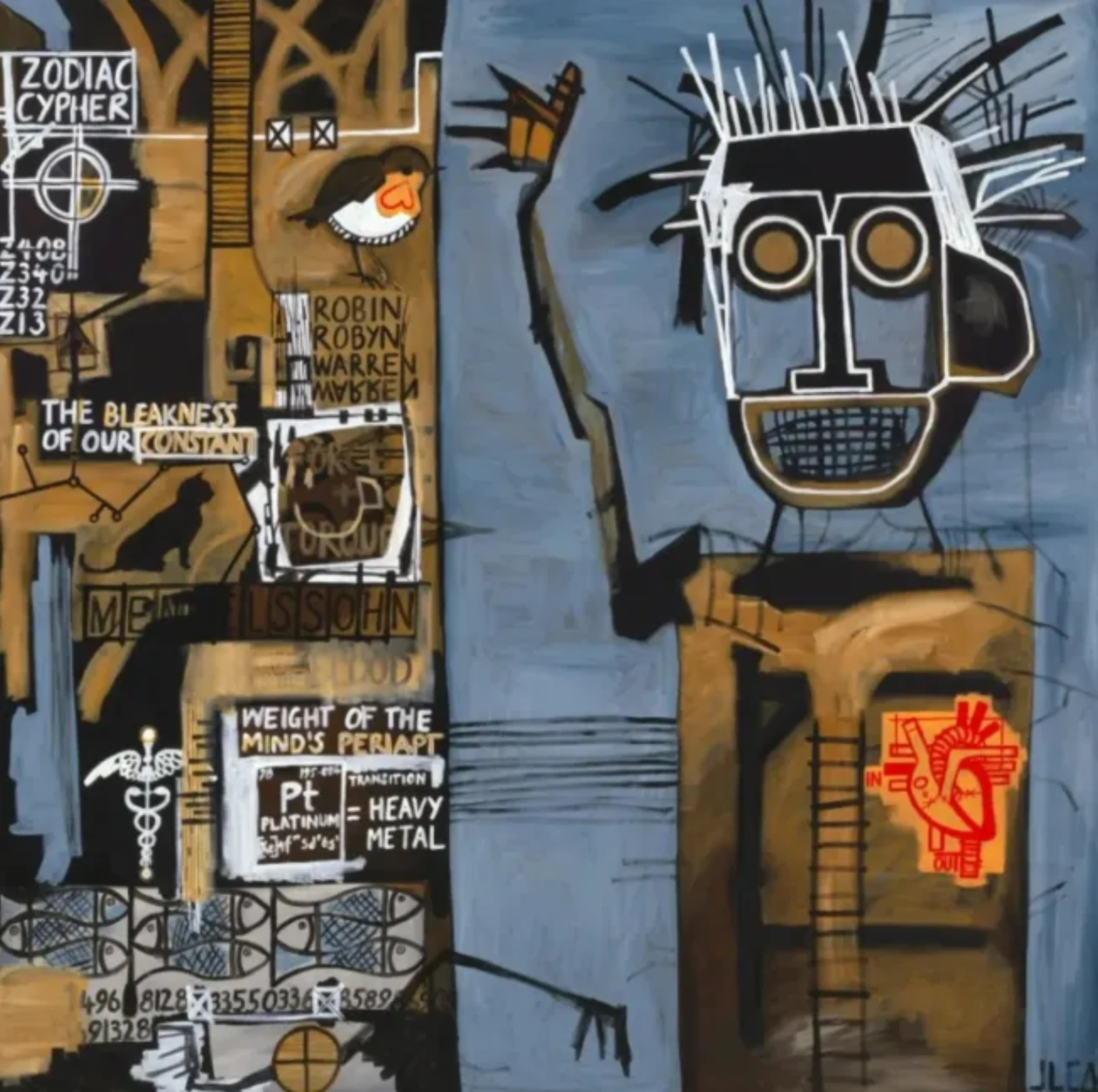
Australian Artist Jane Allan Accused of Plagiarizing Basquiat
Prizewinning artist Jane Allan faces allegations of mimicking works by Jean-Michel Basquiat and Nicholas Harding in canvases that won prestigious Australian awards
The Scandal of the Mimic
The Australian art world is currently grappling with a scandal of authenticity and intellectual property involving Jane Allan, an artist whose success has been tainted by allegations of blatant plagiarism. Allan is accused of mimicking the works of the iconic New York neo-expressionist Jean-Michel Basquiat and the British-born Australian artist Nicholas Harding in two separate paintings that won prestigious awards. The controversy brings to the forefront the precarious line between "artistic influence" and "direct copying," and the failure of institutional vetting processes in the high-stakes world of art prizes as prize committees face scrutiny over their due diligence
The first alarm was raised over Allan' la canvas 'Seaside Explorers,' which won the AU$20,000 Doyles Art Award for landscape painting in 2025. Philip Bacon, a prominent Brisbane art dealer representing Nicholas Harding's estate, identified the work as a "blatant copy" of Harding's 2011 piece 'Two Estuary Figures.' According to Bacon, the only significant difference was the scale. The fact that the work won a prize suggests that the judges failed to recognize a minor work by Harding, allowing Allan to present a derivative piece as an original vision. This failure underscores the danger of "siloed" expertise, where judges may be experts in a general category but lack the specific granular knowledge of an artist's entire oeuvre.
This event reveals a systemic gap in the way art prizes are adjudicated. In many cases, judges are asked to evaluate works based on immediate aesthetic impact and a brief artist's statement, without the support of comprehensive image-database cross-referencing. The result is a vulnerability to artists who possess the technical skill to copy and the audacity to claim originality. When a work is a 'blatant copy' and still wins, it isn't just a failure of the artist's ethics, but a failure of the institution's rigor.
The Basquiat Influence and Institutional Failure
The scandal deepened when the National Portrait Gallery in Canberra, Australia, reviewed Allan' la 'Weight of the Mind's Periapt.' The work was a finalist for the Darling portrait prize in 2022 and had received the $2,000 Art Handler's award. Upon closer inspection, the gallery admitted the work was "clearly influenced" by Jean-Michel Basquiat's 1982 'Untitled (Two Heads on Gold).' The similarities in composition, style, and content were too stark to ignore, suggesting that Allan had not merely studied Basquiat's aesthetic but had actively reconstructed a specific composition to lend her work a veneer of neo-expressionist authority.
The National Portrait Gallery's admission is particularly damaging because it confirms that the institution noticed the similarities at the time of submission but allowed the work to proceed. While the gallery maintains that it requires artists to declare their work as original, the decision to award a prize to a work that was "clearly influenced" by a global icon like Basquiat indicates a systemic lapse in judgment. This suggests a culture of complacency where "influence" is used as a euphemism for plagiarism, provided the resulting work is aesthetically pleasing or fits a certain institutional narrative reflecting a wider crisis of authenticity in the contemporary art market
The use of the term 'clearly influenced' by the gallery is a revealing linguistic choice. It attempts to soften the blow of what is effectively an admission of plagiarism. In the world of high art, 'influence' is a respectable tradition of dialogue. However, when a composition is mirrored so closely that it becomes a duplicate, the dialogue ends and a theft begins. By refusing to use the word 'plagiarism,' the institution protects its own reputation while failing the artists whose work was appropriated.
The Ethics of Influence vs. Plagiarism
In the arts, influence is the currency of progress. Every artist stands on the shoulders of their predecessors. However, the distance between influence and plagiarism is measured by the amount of critical and creative transformation the artist applies to the source material. When an artist replicates the composition and stylistic lappets of a work like 'Two Estuary Figures' and presents it as an original landscape, they are not engaging in a dialogue with the history of art; they are committing a fraud of identity. Jennifer Doyle, co-founder of the Doyles prize, captured this sentiment by questioning why an artist with the technical skill to copy so accurately wouldn't use that skill to create something of their own.
The impact of this plagiarism is felt most acutely by the estates of the original artists. Nicholas Harding's estate noted that the incident is a "reminder of the importance of due diligence, provenance and respect for artists' intellectual property." In the case of Basquiat, whose work has become some of the most valuable and recognized in the world, the plagiarism is not just an offense against the artist but an attempt to capitalize on a global brand. By mimicking Basquiat's visual language, the artist attempted to hijack the cultural capital and historical weight associated with the neo-expressionist movement.
This case raises a fundamental question about the la nature of 'originality' in the contemporary era. In a world of infinite digital reproduction and shared visual libraries, is the idea of a 'unique' work still viable? The answer, in this case, is yes. The fraud is not in the la act of looking at another artist' la work, but in the la act of presenting a copy as a new invention. The ethical breach is not aesthetic, but moral: it is a lie told to the judges, the public, and the history of the medium.
The Future of Prize Validation
This scandal will likely lead to a tightening of the rules for art competitions across Australia and beyond. The era of trusting an artist's "declaration of originality" is over. We are entering a period where digital forensics and reverse-image searching will become standard tools for prize juries. The failure of the Doyles Art Award and the National Portrait Gallery to catch these copies is a wake-up call for the industry to move beyond a surface-level evaluation of works.
Ultimately, the Jane Allan case is a cautionary tale about the dangers of technical skill without conceptual integrity. The ability to mimic a style is a craft, but the ability to synthesize influences into a new, honest vision is art. As the art world continues to grapple with the ease of replication in the digital age, the demand for genuine originality will only increase. For Allan, the cost of this shortcut has been the loss of professional credibility and the potential for legal action from estates that are increasingly vigilant about the protection of their intellectual property as the market for authentic masterpieces continues to soar
The ripple effects of this scandal will be felt in the way artists now document their process. There is now a higher premium on 'proof of work'—sketches, iterations, and conceptual notes that prove an artwork evolved from an original idea. The era of the 'miraculous' finished canvas, presented without context, is coming to an end, replaced by a demand for a transparent chain of creative evolution. For the Australian art market, this is a necessary, if painful, correction.
This case also highlights the vulnerability of 'regional' prizes. In the Doyles Art Award, the lack of a global search was a critical failure. If the judges had simply used a reverse-image search on the submitted works, the plagiarism would have been caught immediately. This indicates a disconnect between the technical capabilities of the 21st century and the traditional habits of the art establishment. The Jane Allan scandal is a reminder that in a world of global digital visibility, there is no such thing as a 'hidden' source, and any attempt to deceive the public will eventually be unearthed by the very tools that the art world uses to curate its archives.
The final implication for the broader market is the increased scrutiny of 'discovery' stories. For years, the art market has thrived on the discovery of 'lost' works or 'hidden' geniuses. This case proves that the line between a discovery and a fabrication is often just a matter of who is doing the research. As the tools of verification become more accessible, the market must move away from blind faith in provenance and toward a rigorous, scientific verification of every significant work. The cost of failure is no longer just a financial loss, but a total collapse of institutional trust.