Independent 20th Century Scales Up at the Breuer
Independent 20th Century will bring 56 exhibitors and more than 130 artists to Sotheby’s Breuer building, betting that canon revision now needs a bigger stage
Independent is turning the Breuer into a statement about scale
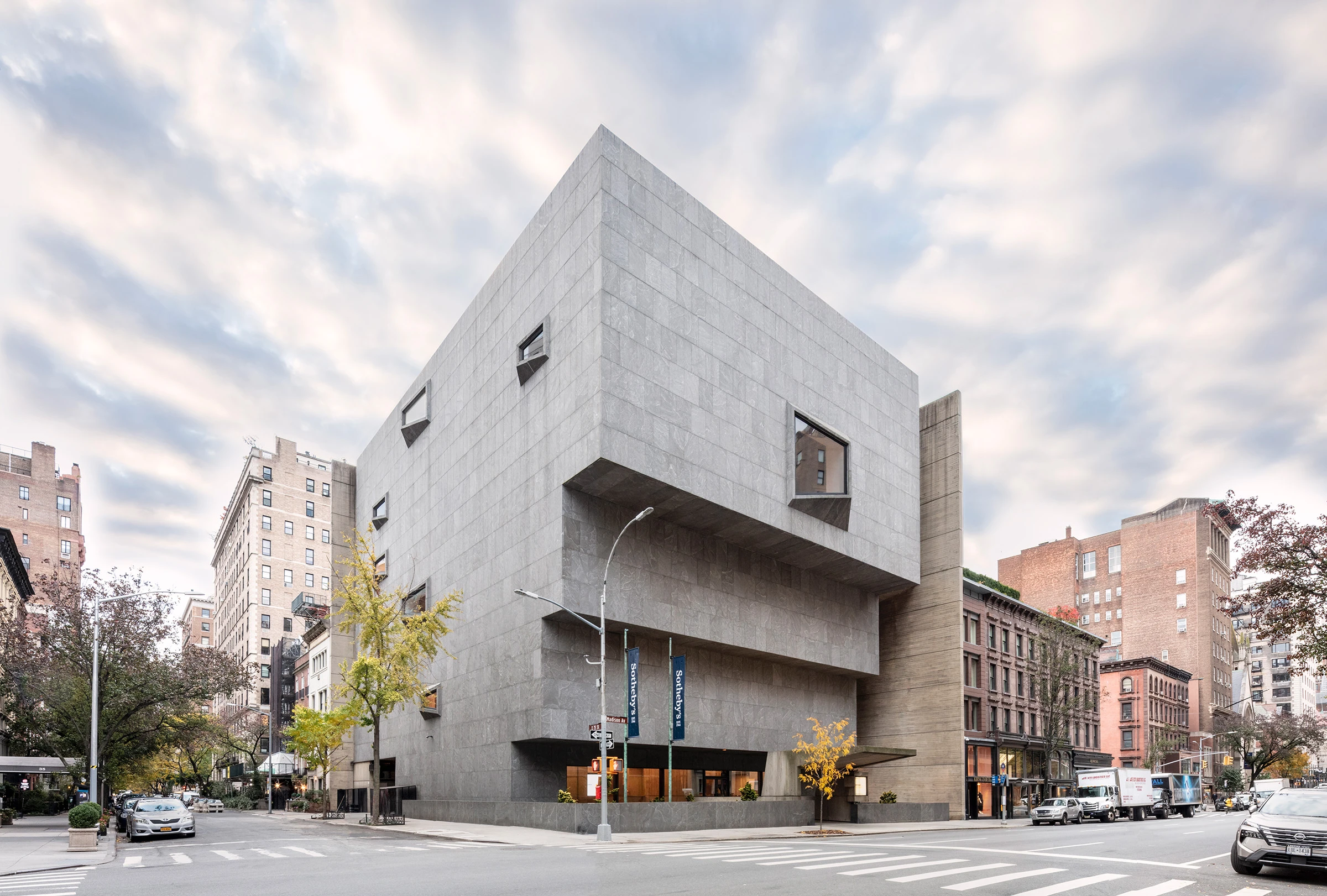
Independent 20th Century is no longer presenting itself as a nimble side conversation to the main fair circuit. With its fifth edition, the fair will occupy Sotheby's Breuer building from September 24 to 27 and expand to fifty-six exhibitors showing work by more than 130 artists, according to Artforum's announcement. That makes this the largest edition of the fair so far, and the venue shift matters as much as the exhibitor count. The Breuer is not neutral real estate. It is a building weighted with institutional memory, market prestige, and a very public argument about who gets to control 20th-century art history in New York.
Sotheby's presents its new headquarters at 945 Madison Avenue as both a public-facing cultural destination and a commercial base for its global business. Independent is taking that frame and using it to enlarge its own claim. The fair's pitch has always been that the 20th century can be reread through artists and galleries left outside the usual textbook version of modernism. By moving into the Breuer building and nearly doubling its sense of scale, Independent is saying that revisionist scholarship no longer belongs on the margins or in a boutique annex.
That is the strategic logic underneath the headline. A fair dedicated to reordering the canon can either remain a tasteful niche event or try to become infrastructure. This edition suggests the latter. More exhibitors, more artists, and a venue with instant symbolic capital create conditions for a bigger audience, more ambitious installations, and a stronger bridge between scholarship and sales. They also raise the pressure. Once a fair claims this much institutional real estate, it has to prove that the argument is more than branding.
What the exhibitor list says about the fair's curatorial politics
The exhibitor line-up described by Artforum shows Independent trying to balance historical validation with purposeful correction. Luxembourg + Co will bring Wassily Kandinsky, Paul Klee, and Sue Fuller. Mariane Ibrahim plans Lorraine O'Grady and Jose Gamarra. Berry Campbell's presentation of women associated with Stable Gallery groups figures such as Elaine de Kooning, Perle Fine, Joan Mitchell, and Yvonne Thomas. The effect is not simply diversity as decoration. It is a deliberate placement of under-read or insufficiently connected practices alongside names that art history already treats as secure.
That balance is where Independent has often been sharpest. It understands that fair visitors need recognizable anchors, but it also knows that the market habit of rediscovery can become shallow if every booth performs the same correction. The best sections of this year's list appear to avoid that trap by staging arguments across lineages, not just by reviving one neglected artist at a time. The fair's own growth gives those arguments more room to breathe. Live programming, performances, and a fuller event structure make it harder to reduce the edition to a spreadsheet of inventory.
Still, there is a built-in tension. Revisionist fairs can drift into a comfortable formula in which the language of canon expansion masks ordinary market sorting. The roster will need to show whether galleries are really rethinking the 20th century or simply packaging familiar names into more contemporary-sounding narratives. That is why Independent's success will not be measured only by attendance or sales. It will be measured by whether booths produce new relationships between works, histories, and publics rather than a softer form of blue-chip reassurance.
Why the Breuer venue changes the terms of the fair
The Breuer building intensifies that scrutiny because it already carries a chain of institutional afterlives. Before Sotheby's took over, the building housed the Whitney Museum of American Art, then the Met Breuer, and later the Frick Collection during its renovation period. Each occupant used the architecture to project seriousness and cultural authority. Independent now enters that sequence with a commercial fair whose stated purpose is to disrupt received understandings of the 20th century. That juxtaposition is not a contradiction. It is the point.
The building allows Independent to do something many fairs struggle to do: make space feel like an argument. Marcel Breuer's architecture still carries the atmosphere of museum judgment, even when sales are happening inside it. For exhibitors, that can sharpen presentation quality and demand more disciplined booth-making. For visitors, it alters the pace of looking. A fair staged in a site associated with public culture invites comparison with exhibitions, collections, and institutional canons rather than only with transactional market bustle.
There is also a competitive angle. New York fair week is crowded with events that promise discovery, but few can attach themselves to a building with this level of recognition. Independent's multi-year partnership with Sotheby's, noted by Artforum, is therefore about more than convenience. It gives the fair access to a venue that compresses institutional aura and auction-house muscle into one address. That combination could broaden the collector base while also amplifying curatorial ambition.
What this means for the September market calendar
The enlarged Independent 20th Century edition arrives at a moment when the market is re-evaluating scale across the board. Some galleries are pulling back from fairs that no longer justify their costs, while others are becoming more selective about where they spend. In that environment, a fair that can offer sharper identity, better architecture, and a targeted audience gains an advantage. Independent has long benefited from feeling edited rather than bloated. The question now is whether it can keep that editorial pressure intact while expanding.
For collectors, the fair may become one of the more efficient places to gauge which segments of 20th-century art are still being actively rewritten and which rediscoveries have already hardened into standard fare. For curators, it offers a compressed view of how commercial galleries are re-framing the century through women artists, diasporic histories, experimental photography, design-adjacent practices, and postwar abstraction outside the usual European-American chain. That makes it useful even for people not planning to buy.
Independent's September edition should also be read alongside artworld.today's earlier coverage of the fair's trajectory, including our prior report on the Breuer move. The latest announcement confirms that the venue was not just a glamorous headline but the basis for a larger operational wager. Independent wants a bigger share of how New York narrates 20th-century art in public. This fall will show whether it can turn that ambition into a fair that feels genuinely necessary rather than merely well placed.
The fair's expanded performance and events program could also matter more than the exhibitor statistics suggest. A lot of fairs bolt talks and performances onto the margins as goodwill gestures. Independent has a chance to make them structurally relevant, especially in a venue where historical and contemporary readings can be staged in close proximity. If that happens, the edition could function less like a temporary shopping district and more like a compressed curatorial platform, one where sales, scholarship, and public programming actually inform one another.
There is a market risk in that ambition. Once a fair advertises its role in revising the canon, collectors and institutions can legitimately expect a higher standard of rigor. Token rediscoveries, predictable solo-booth branding, or thin thematic framing will look weaker in the Breuer than they might in a more anonymous setting. The building encourages comparison with museum argument, and museum argument is harder to fake. Independent is therefore accepting a useful burden: the space itself demands that the fair's rhetoric about 20th-century revision be backed by presentation quality and intellectual structure.
Another reason this matters is timing. September fairs increasingly shape the tone of the autumn market before the heavier year-end machinery starts rolling. A strong Independent edition can influence what curators write about, what collectors chase, and how galleries position artists for the rest of the season. In that sense, the fair is not just reflecting taste but actively helping sequence it. The Breuer move magnifies that power because the location encourages visitors to read what they see through institutional memory as much as through price signals.
If Independent succeeds this year, other fairs will study the formula closely: fewer generic growth claims, more architectural identity, and a sharper relationship between the exhibitor list and a historical thesis. If it misfires, the lesson will cut the other way and remind the trade that scale can blur the very editorial edge that made a fair useful in the first place. Either outcome will tell us something real about how much room the market still has for events that try to shape art history instead of merely hosting it.
There is a reason so many people in the trade will watch this edition closely even if they never attend. Independent is effectively running an experiment on whether a fair can scale without surrendering its editorial intelligence. The Breuer gives it a powerful stage, but stages can expose weakness as quickly as they amplify confidence. If the fair manages to make the building feel activated rather than overfilled, and historically revisionist rather than merely market-savvy, it will strengthen the case for a different kind of fair leadership in New York. If not, the market will treat the expansion as another reminder that size tends to flatten nuance.