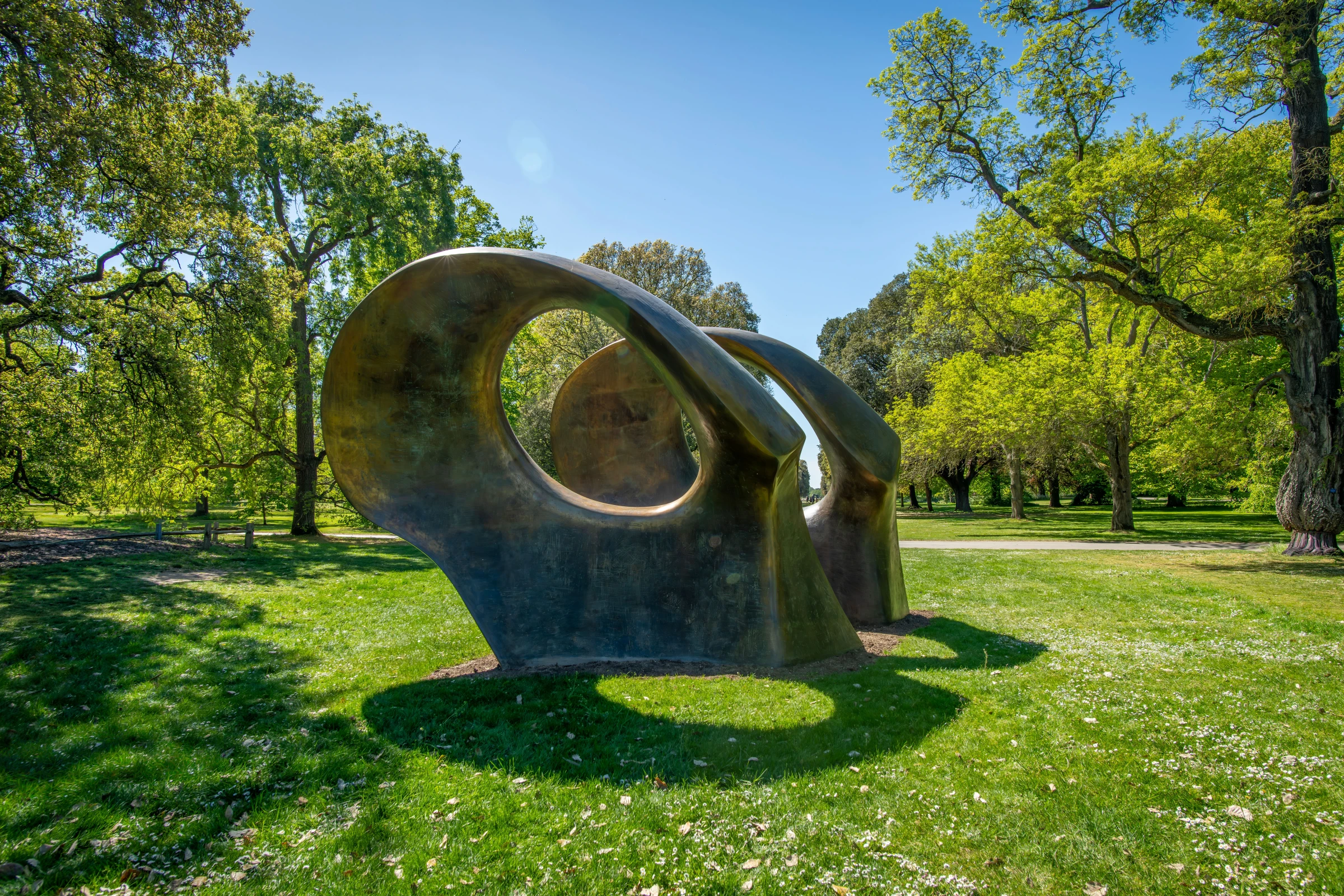
Henry Moore at Kew: When Bronze Meets Botany
Henry Moore at Kew Gardens: bronze sculpture in dialogue with living landscape, revealing tensions between artifice and nature
What Happened
Henry Moore: Monumental Nature, running at Kew Gardens through January 31, 2027, is being called one of the best arranged exhibitions of Moore's work you are likely to see. The setting makes the difference. Moore's great bronze forms are installed across the gardens, engaging in what amounts to an extended conversation with the surrounding trees, shrubs, and palm house flora. The review by art historian John-Paul Stonard describes the experience as wandering the stage of a grand drama, an epic conversation in which the protagonists are great bronze forms and the surrounding trees and shrubs, and palm house flora.
The exhibition includes major works like Totem Head (1968), Oval with Points (1968-70), and Hill Arches (1973), each placed to interact with specific specimens in the garden. The dark enclosed form of Totem Head stands against the giant enclosed crown of the Atlas cedar, as if it has emerged from the tree. The almost-touching interior spikes of Oval with Points echo the open, spindly, billowing branches of the verrucosa ash against which it is set. The conversations between sculpture and nature seem endless.
Moore and the Natural World
Inside the Shirley Sherwood Gallery, the exhibition presents Moore's Transformation Drawings from the 1930s, which turn stone and bone into living things, treating art as a form of reanimation. A sprawling elmwood Reclining Figure (1959-64) sits at the centre of the gallery, alongside rare hardwood specimens from Kew's collection and drawings of trees Moore made at Perry Green and Forte dei Marmi. The tree drawings are, as Stonard notes, the least satisfyingly Moore-like works on view. Faced with the greatest of rivals, the sculptural quality of a tree, Moore was forced to abandon all stylistic transformation.
The Reclining Figure also proves difficult to appreciate under gallery lighting, making clear that the real origin of Moore's sculpture is not so much the forms of nature but the softening effect of natural light and atmosphere. This is the central tension of the exhibition: Moore's work wants to be outdoors, in conversation with the landscape, but it does not fully belong to nature. It belongs to the history of sculpture, to the legacy of Moore's own foundation and studio practice, and to the transatlantic career that made his work famous.
The Transatlantic Story
One of Moore's grandest sculptures, Three Piece Sculpture: Vertebrae (1968-69), stands beside the ornamental lake in front of the Palm House at Kew. The smooth, bronze forms, interlocking in a beguiling organic puzzle, are displayed on a low plinth, like tokens in a game played by giants. But unlike almost all other sculptures in the show, it seems cut off from its surroundings. In sheer weight and brutality, Three Piece Sculpture: Vertebrae seems connected more with the commercial jet planes that cross overhead every 60 seconds on the flight path to Heathrow.
The work is a reminder that over two-thirds of Moore's works are in North America, and it was US collectors and architects who provided the money with which such costly sculptures could be fabricated and transported. Three Piece Sculpture: Vertebrae is one of these; the largest version cast was installed outside I.M. Pei's monumental brutalist City Hall in Dallas, Texas, where it was renamed Dallas Piece. Just a few months earlier, Moore's other late great work, Knife Edge Mirror Two Piece (1977), had been installed outside the National Gallery of Art in Washington, DC, also by Pei. These twinned sculptures are among the most important works of public sculpture anywhere. The Dallas Piece brilliantly energises the surrounding public space. Moore's multi-directional forms feel like a battery storing civic energy, making clear the public designation of the plaza on which it stands.
When Art Becomes Real Estate
As Mark Lamster reported in the Dallas Morning News, both Pei's building and the sculpture on the plaza are currently under threat from the Trumpist-dominated city council, who want to raze the building and replace it with a casino and an arena. The fate of the sculpture in this case is yet unknown. Perhaps it would turn into what the writer Tom Wolfe called curb flash, Moore's sculptures doing little else but enhancing real estate value.
The background reminder at Kew of Moore's transatlantic career might make us rethink the idea of a simple, or direct, relationship between sculptures and the natural world. Being inspired by nature is not the same thing as being of nature. The great bronze brutalist forms, in all their mystery and the genius of their fabrication, seem more a reminder of the impossibility of returning to natural innocence. In Moore's day it might have seemed, as he once put it, that nature is inexhaustible, but we now know that it is not.
What Comes Next
The exhibition runs through January 31, 2027, giving visitors months to see the sculptures across multiple seasons, each one changing the conversation between bronze and botany. The fate of the Dallas Piece remains uncertain, a parallel story that hangs over the Kew exhibition like a shadow. If the Dallas city council proceeds with demolition, one of the most significant public sculpture installations in the United States will be lost or displaced. The situation echoes broader tensions between public art and civic policy that have intensified across American cities, where sculptures by major 20th-century artists are increasingly treated as decorative assets rather than cultural landmarks. Moore himself was acutely aware of this tension. He once remarked that nature is inexhaustible, a statement that now reads as both an article of faith and a warning. The Kew exhibition, for all its beauty, cannot separate itself from the conditions that make monumental sculpture possible: money, infrastructure, civic will, and the willingness to treat art as something more than real estate enhancement. The show also implicitly asks whether outdoor sculpture exhibitions, which have become increasingly common at botanical gardens, estates, and public parks across Europe and North America, represent a genuine curatorial innovation or simply a marketing strategy designed to draw visitors during off-peak seasons. Kew's answer, at least, is that the setting transforms the work. Whether that transformation deepens or dilutes Moore's achievement is a question every visitor will answer differently, depending on whether they come to the gardens for the sculpture, the botany, or the conversation between the two.
For Moore's legacy, the Kew exhibition makes a convincing case that his work belongs outdoors, in dialogue with living things. But it also makes a more unsettling argument: that the relationship between sculpture and nature is never simple, never innocent, and always mediated by the commercial and institutional forces that make monumental art possible. The exhibition's greatest achievement is not showing how Moore's work harmonizes with nature, but revealing how it does not. That tension is what makes Monumental Nature worth the visit, and what makes it more than a garden stroll with sculpture. It is a show about the limits of nature as an artistic category, and about how the bronze in the garden is always also the bronze in the marketplace.
The indoor component at the Shirley Sherwood Gallery adds another dimension to the exhibition's argument. Moore's Transformation Drawings from the 1930s, which turn stone and bone into living things, reveal a sculptor who saw animation everywhere in natural materials. The drawings show Moore processing the world through the lens of metamorphosis, treating bones, stones, and roots as provisional forms that could become something else. This is not the same as saying Moore was a natural artist. It is saying he was an artist who used nature as raw material, which is a different and more honest claim. The sprawling elmwood Reclining Figure from 1959-64 reinforces this point. Carved from a single elm trunk, the figure is undeniably organic in its material, but its forms are sculptural ideas, not imitations of nature. The gallery setting, with its controlled lighting and climate, strips away the outdoor atmosphere that softens Moore's bronze work and exposes the formal intelligence underneath. The Art Newspaper's review suggests that the gallery presentation is the least satisfying part of the exhibition, which is itself an argument for seeing Moore outdoors, where natural light does the work that gallery lighting cannot.
The exhibition also raises questions about what happens to Moore's work when the natural environments it was made for are themselves under threat. Kew Gardens is a managed landscape, a curated collection of plants from around the world, not a wild ecosystem. The trees that frame Moore's sculptures are themselves cultural artifacts, specimens chosen and maintained by generations of botanists. The conversation between sculpture and nature at Kew is staged, not found, and that staging is part of what makes it compelling. It is a curated conversation between two kinds of cultural production, sculpture and horticulture, each with its own history of human intervention. The exhibition's title, Monumental Nature, is deliberately double-edged. Nature is monumental, but it is also monumented, curated, framed, and put on display. Moore's sculptures participate in that framing, and the show's intelligence lies in letting that tension surface rather than resolving it.