Free Video Game Recreates Michael Heizer's Monumental City
Free video game replicates Michael Heizer's 1.5-mile land art sculpture City in Nevada, questioning who gets access to monumental art
What Happened
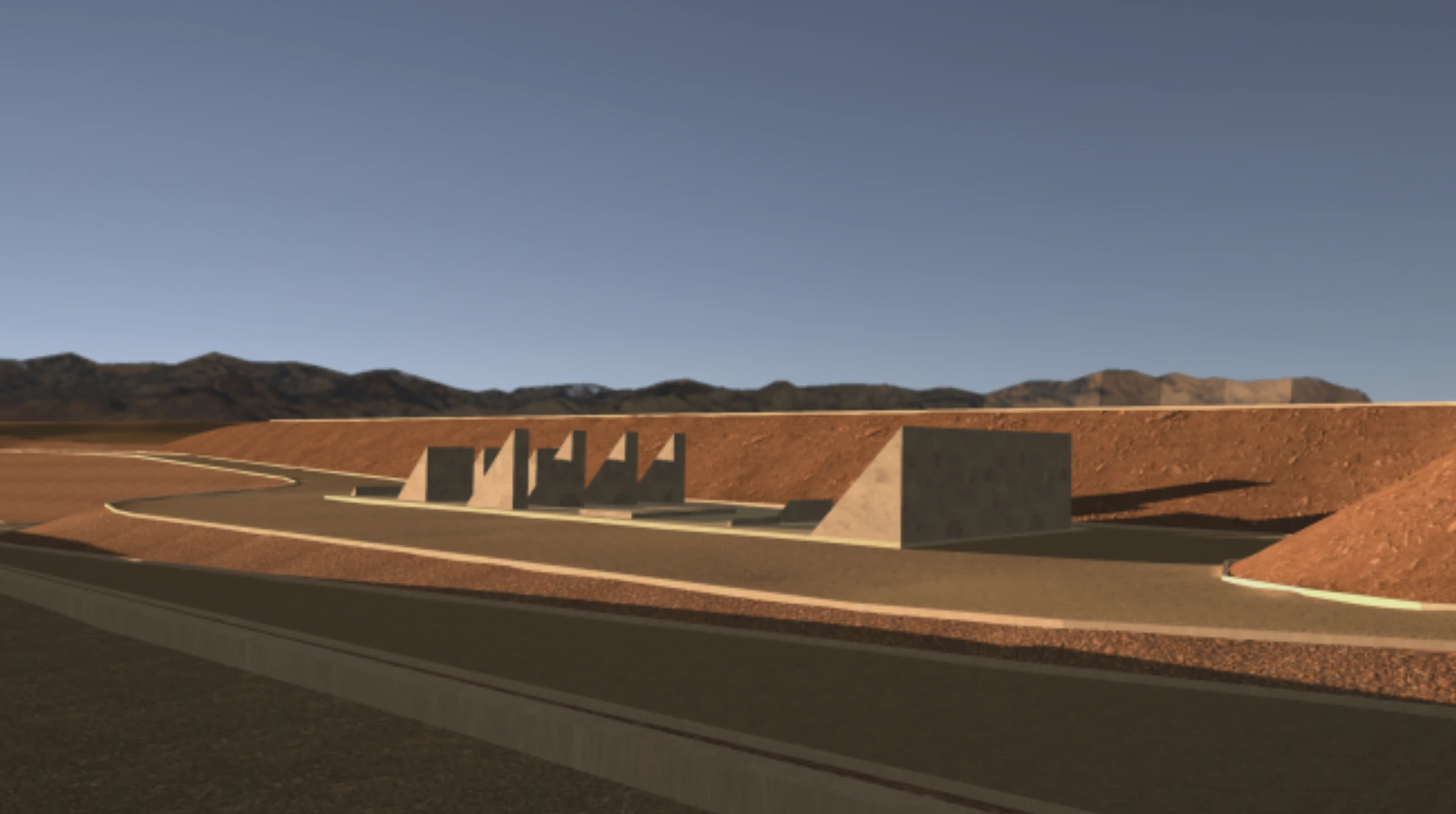
Digital artist Lily Belmira has created a free video game that recreates the environment of Michael Heizer's monumental land art sculpture City, 1970 to 2022, in the Nevada desert. Belmira, who is based in Tulsa, Oklahoma, wrote on her blog that she saw the act of creating the game as a way to undermine the sculpture's exclusivity and bring it to a wider audience.
City is one of the largest works of art in the world, stretching for 1.5 miles and taking over fifty years to complete. Heizer finally finished it in 2022, and it opened to the public that year. Visits cost up to $150 per person, with only six people allowed to enter the sculpture on any particular day for a fixed period of three hours. The extreme restrictions on access have made City one of the most exclusive art viewing experiences in the world, and one of the most debated. The scarcity of access has spawned a cottage industry of blog posts, social media threads, and art criticism grappling with whether an artwork that almost no one can see truly functions as public art.
To build the game, Belmira used publicly available LIDAR data about City and combined it with Google Maps satellite imagery to generate the digital model. The game begins at a wooden fence, past which players encounter a virtual version of Heizer's City. The shapes Heizer carved out of the earth seem both primordial and futuristic, evoking his fascination with Mesoamerican architecture. Players can peer over the sculpture's steep cliffs and drop down into its cavernous valleys at their leisure, without the time and cost constraints of visiting the actual sculpture in person.
The Question of Access
Belmira's project raises fundamental questions about who gets to experience monumental art. In her blog post, she acknowledged that upon studying City closely to make the game, she found it to be beautiful, but questioned the neoliberal undertones and disregard for Indigenous land dispossession in Heizer's work, given how few people are allowed to see it and how much effort was put into landmarking it even before completion.
She critiqued Heizer's sculpture as a bourgeois scar on the earth that holds a settler colonial stance toward nature, concluding that bringing it to a wider audience might allow his art to mean something to someone. The critique is sharpened by the fact that City sits on land that was protected through a federal land designation issued by former US President Barack Obama in 2015, creating the Basin and Range National Monument specifically to safeguard the area surrounding Heizer's sculpture. The use of federal protection for a single artist's work has been a point of contention among environmentalists and Indigenous rights advocates who argue that public land should serve broader public interests.
The tension between an artist's desire to control how their work is experienced and the public's interest in accessing significant cultural artifacts is not new, but Belmira's intervention represents a distinctly 21st-century approach to resolving it. Rather than petitioning for greater access or organizing protests, she used publicly available data to create an alternative experience that anyone with a computer can explore for free. The game exists in a legal gray area that highlights the unresolved tensions between artistic control and public access in the digital age, raising questions that will only become more pressing as 3D scanning and digital reproduction technologies continue to advance.
Land Art and Digital Reproduction
City's extreme access restrictions stand in contrast to other major land art works. Robert Smithson's Spiral Jetty in Utah's Great Salt Lake, maintained by the Dia Art Foundation, is visible to anyone willing to drive to the site, though its visibility depends on water levels. Walter De Maria's Lightning Field in New Mexico, also maintained by Dia, requires reservations but has a more accessible visitation policy. James Turrell's still-unfinished Roden Crater in Arizona, perhaps the most comparable in terms of exclusivity, has begun offering limited public access through a reservation system with steep fees that have drawn their own criticism.
The digital replication of land art through video games, virtual reality, and other interactive media represents an emerging frontier in how audiences engage with works that were designed for in-person experience. Heizer himself has been protective of City's image, carefully controlling photography and media access. Belmira's game, built from public data, exists in a legal gray area that highlights the unresolved tensions between artistic control and public access in the digital age. Similar projects have emerged around other restricted cultural sites, from digital reconstructions of endangered heritage in conflict zones to virtual tours of inaccessible archaeological sites, suggesting that the demand for digital access to physical places is a broad cultural phenomenon.
What Comes Next
Belmira told ARTnews via email that the project emerged out of a genuine interest in showing City to more people. Whether Heizer or the Triple Aught Foundation, which manages visits to City, will respond to the game remains to be seen, but the project has already sparked conversation about the democratization of art through digital tools. The game has been downloaded thousands of times since its release, suggesting that the appetite for digital access to exclusive artworks is substantial.
The game also raises questions about the future of land art preservation and access. As LIDAR data, satellite imagery, and 3D modeling tools become more accessible, the barriers to creating digital replicas of remote or restricted artworks diminish. Artists and institutions that have built their models around exclusivity and controlled access may need to reckon with a world where digital alternatives exist whether they approve of them or not. For now, Belmira's game stands as both an artwork in its own right and a pointed critique of the systems that keep art locked away from the public, a digital provocation that asks whether the most exclusive artwork in America should remain so.
The broader implications of Belmira's project extend beyond City to the entire model of land art as a practice. The movement's foundational artists, including Heizer, Smithson, De Maria, and Judd, created works that were explicitly resistant to reproduction, commodification, and mass consumption. Their insistence on in-person experience was, in part, a rejection of the photographic circulation that had come to define contemporary art by the 1960s. But the digital tools available in 2026 present a challenge that the movement's founders did not anticipate. When anyone can create a navigable 3D model from public data, the claim that a work can only be experienced on site becomes harder to sustain, even if the digital experience remains fundamentally different from the physical one.
For Triple Aught Foundation, which manages visits to City, Belmira's game presents both a challenge and an opportunity. The foundation has worked to balance Heizer's desire for exclusivity with the public interest in accessing the work, and the game may increase demand for in-person visits rather than substituting for them. Studies of virtual museum experiences have shown that digital engagement often motivates physical visits, suggesting that Belmira's game could serve as an unintended marketing tool for City itself. Whether that outcome would satisfy the artist's intentions or undermine them is a question that Heizer, who has carefully controlled access to his work for decades, will have to consider. The conversation about who gets to see art, and on what terms, is no longer confined to the physical world.
The legal dimensions of Belmira's project are as complex as the artistic ones. Copyright law provides limited protection for the appearance of land art, particularly works that are visible from public airspace and have been documented in publicly available satellite imagery. LIDAR data, which is collected by government agencies and made available for public use, further complicates claims of proprietary control over the digital representation of physical sites. Heizer and the Triple Aught Foundation could potentially pursue claims based on the right of publicity or the Visual Artists Rights Act (VARA), which protects the integrity of artworks from distortion or modification, but applying these frameworks to a video game that recreates the environment of a land art site would require novel legal arguments that no court has yet addressed.
The game also exists within a growing movement of artists using digital tools to challenge exclusivity in the art world. From open-source 3D scans of museum collections to virtual reality experiences that replicate gallery spaces, digital artists are increasingly creating alternative modes of access that bypass the traditional gatekeepers of the art world. Belmira's project is distinctive in its focus on a single, physically remote work that was designed to resist exactly the kind of democratization she has achieved. The tension between Heizer's vision of an artwork that demands pilgrimage and Belmira's creation of a digital shortcut encapsulates a broader debate about the future of art in an age when any physical site can be digitally reconstructed from public data. That debate will only intensify as the tools for digital reproduction become more sophisticated and more widely available to anyone with a computer and an internet connection.