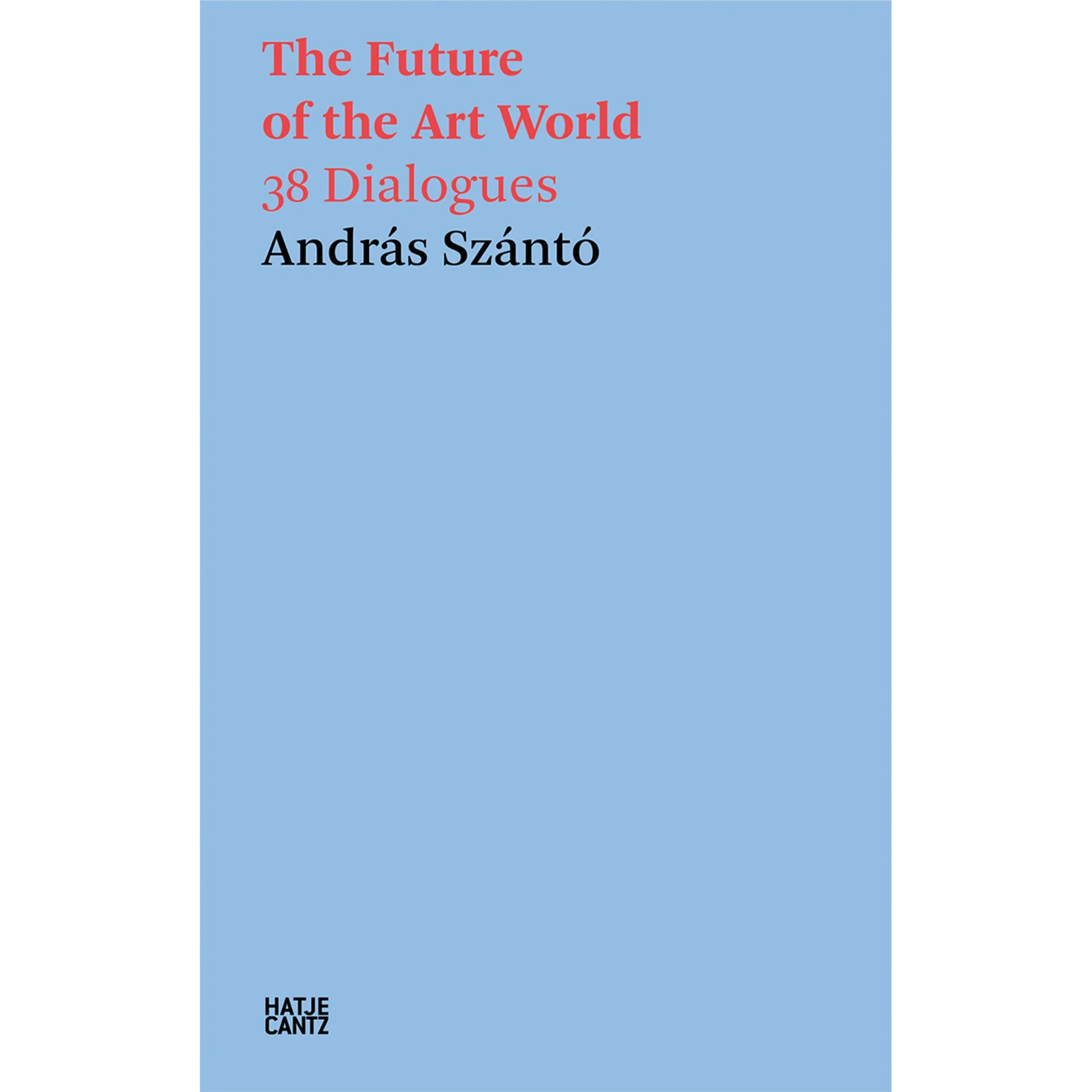
András Szántó's New Dialogue Book Maps a Fragmented Art-World Future
The final volume in András Szántó's museum-focused trilogy compiles 38 conversations that frame the next decade as a struggle over networks, institutions, and cultural legitimacy.
When a field cannot agree on whether it is growing, plateauing, or breaking apart, the most useful editorial format is often the interview volume. With The Future of the Art World: 38 Dialogues, cultural strategist András Szántó extends his ongoing effort to document institutional thinking while the ground is still moving. The book, published by Hatje Cantz, follows his earlier museum-director and museum-architect dialogue collections and widens the aperture to include artists, dealers, collectors, researchers, and policy-facing operators.
The premise is not prediction theater. It is network diagnosis. Instead of forcing one synthetic thesis, Szántó assembles contradiction as data. Gallerists, scientists, artists, and cultural diplomats do not share a single story about what the art world is becoming, and the book's value lies in preserving those asymmetries rather than smoothing them out. In an ecosystem that often mistakes confidence for clarity, that choice feels disciplined.
The cast matters. Voices referenced around the volume include figures connected to global fair infrastructure, collecting circuits, institutional leadership, and emerging digital culture. The roster ranges from market professionals to artists such as William Kentridge, and from systems-oriented thinkers to public cultural actors. This breadth mirrors the way power actually works now: no single institution governs legitimacy on its own, and no single market metric captures influence.
One recurring argument concerns value formation. Network scientist Albert-László Barabási's framing, cited in the coverage, is blunt: artistic value is not an intrinsic measurement but a relational outcome inside institutions, histories, and social graphs. For collectors and curators, this is less theoretical than operational. It explains why similarly strong works travel differently depending on where they are shown, who frames them, and what narrative architecture surrounds them.
Another pressure point is the gap between institutional time and digital time. Voices in the book highlight a durable mismatch: museums and legacy organizations still move in multi-year cycles, while contemporary attention economies reprice relevance in weeks. The concern is not that museums should imitate platforms, but that cultural institutions can no longer treat digital publics as a secondary communication layer. They are now part of the audience's baseline cultural literacy.
The diplomatic dimension is equally significant. Conversations on cultural diplomacy and state-scale cultural investment, including perspectives from Qatar Museums-adjacent leadership discourse, underline that culture remains one of the few arenas where geopolitical positioning and public imagination can still be negotiated in parallel. For institutions in Europe and North America, this is a reminder that competition is no longer only local and no longer only market-based.
For practical readers, the question is what to do with this multiplicity. The strongest use case is strategic planning. Boards, directors, and independent spaces can treat the dialogues as a stress-test library: which assumptions still hold, which are legacy myths, and where their own operating model is underexposed to technological, demographic, or financial shocks. The book's structure supports this use because chapters can be read non-linearly without losing coherence.
It is also a useful object for younger professionals entering the sector through hybrid roles where curatorial, communications, and commercial competencies increasingly overlap. In that landscape, binaries like market versus institution or scholarship versus audience development are less descriptive than they were ten years ago. Szántó's interview architecture reflects that hybridity better than manifesto-style writing tends to do.
The release lands at a moment when institutions are under pressure to prove relevance without eroding standards. That makes the volume timely for readers following how museums, fairs, and private actors are renegotiating authority. Those tracking this shift can pair it with institutional strategy outputs from organizations such as Art Basel and long-horizon programming documents from major museums, then read overlaps and gaps.
In the end, the book offers less a map than a field recording. That is a feature, not a flaw. The art world has entered an era where consensus is intermittent, and where the ability to model competing futures may matter more than backing a single forecast. Szántó's conclusion, leaning toward hope after hundreds of questions, is not naive optimism. It is a working method: keep asking better questions while institutions still have time to adjust.