Frieze Seoul Moves to Zaha Hadid's DDP for 2027
Frieze Seoul relocates from COEX to Zaha Hadid's landmark Dongdaemun Design Plaza for its 2027 edition as the convention center undergoes redevelopment
Frieze Seoul Announces Venue Change
The sixth edition of the Frieze Seoul international art fair will move for its 2027 iteration from the COEX exhibition center in Gangnam to the Dongdaemun Design Plaza (DDP), a cultural center in Seoul designed by Zaha Hadid Architects. The relocation comes as COEX undergoes a planned redevelopment project set to be completed in 2029, making a shift in setting necessary for the fair's continued operations, as reported by Artforum. The move represents a significant bet on Seoul's growing importance in the global art market and a willingness to adapt the fair's format to one of Asia's most architecturally distinctive buildings.
Frieze Seoul has staged its annual operations at COEX for all five of its editions since 2022. The move to DDP represents not just a logistical shift but a cultural one, placing the fair in closer proximity to Dongdaemun's fashion and design district rather than the corporate Gangnam area where COEX sits. The relocation aligns Frieze with a neighborhood known for creative energy and round-the-clock commerce, a fitting context for an art fair seeking to distinguish itself in an increasingly competitive Asian market.
The Dongdaemun Design Plaza
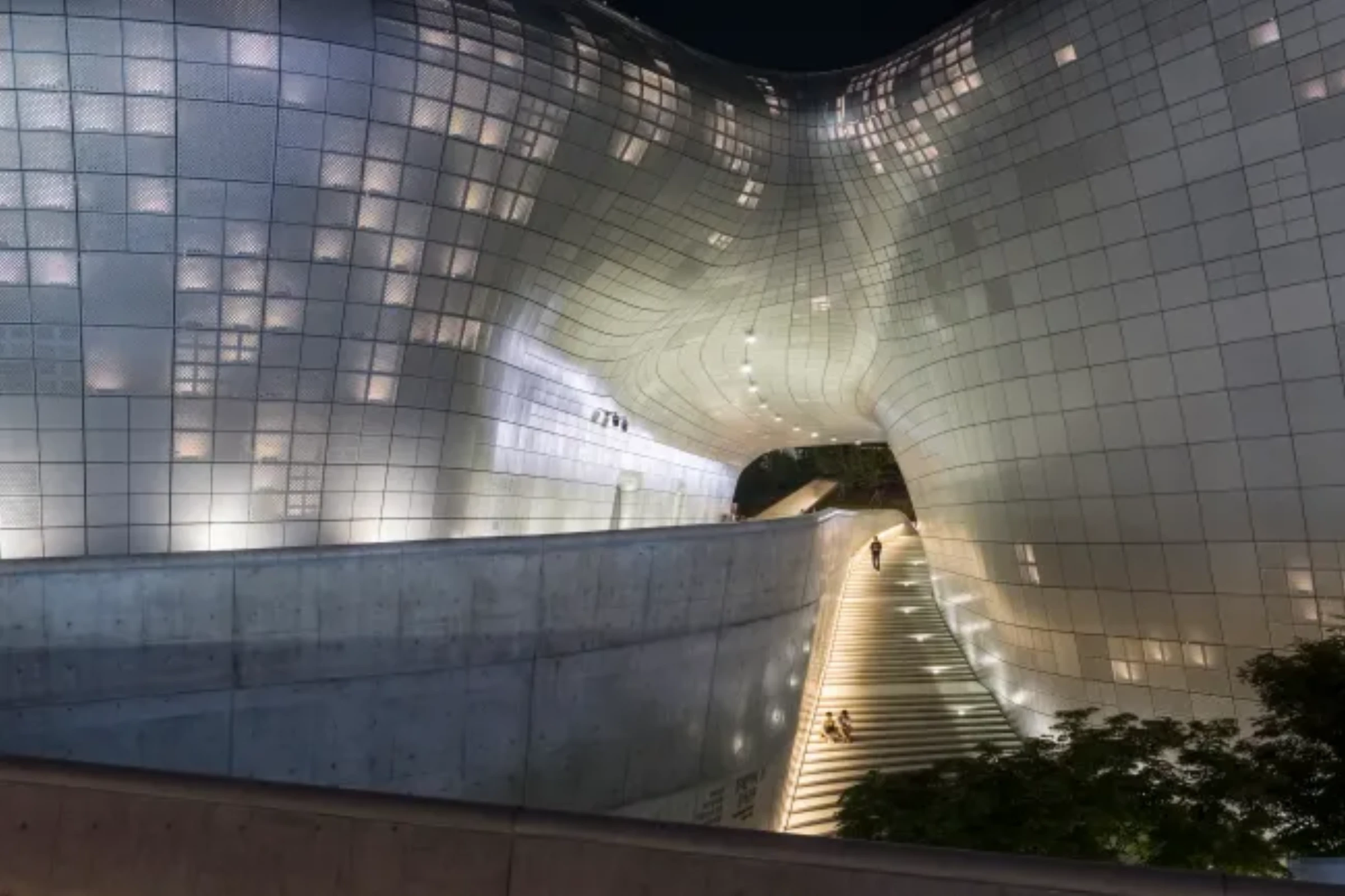
The DDP first opened to the public in 2014 as the result of a collaboration between Zaha Hadid Architects and Samoo Architects and Engineers. It stands as the world's largest three-dimensional freeform building and has welcomed over 126 million visitors since its inception. It was the first public building in Korea to be designed with the aid of BIM (Building Information Modeling) technology, which allowed the complex curvilinear forms to be engineered with precision.
Rendered in Hadid's signature curvilinear style, the plaza contains a museum and a multitude of exhibition spaces as well as a design center. These internal zones are linked through a series of interior and underground pathways that create a continuous flowing experience rather than the discrete gallery model of conventional exhibition halls. The building was constructed at the site of a former stadium and stands on the same site as one of the main entrances into South Korea's capital during the Chosun dynasty, creating a dialogue between historical and contemporary Seoul that aligns with Frieze's global brand identity.
What This Means for the Asian Art Market
Patrick Lee, the director of Frieze Seoul, framed the move as an opportunity for galleries to engage with a more concentrated and architecturally distinctive space. "DDP is an extraordinary setting and a landmark that Seoul has made its own," Lee said. "Its distinctive architecture and more concentrated footprint will create new possibilities for our galleries." The DDP's flowing interior spaces contrast sharply with the conventional booth-grid layout of COEX, potentially offering galleries new ways to present work and engage with collectors.
The fair will continue to take place in partnership with Kiaf SEOUL, South Korea's oldest international art fair. This year's Frieze Seoul, set to take place in September, will feature more than 125 galleries from thirty countries. In 2025, Frieze established Frieze House Seoul, a year-round exhibition presence in the Yaksu-dong neighborhood, signaling a long-term commitment to the Korean market that extends beyond the annual fair week.
Seoul's Growing Role in the Global Art Ecosystem
The venue change reflects Seoul's emergence as a major node in the global art market, rivaling Hong Kong for prominence in Asia. The Korean government has invested heavily in cultural infrastructure, and the city's gallery scene has expanded rapidly, with blue-chip spaces from New York and London opening Seoul outposts. Galleries including Perrotin, Lehmann Maupin, and David Zwirner have all established Seoul presences, drawn by the city's collector base and lower operating costs compared to Hong Kong.
The DDP itself has hosted numerous art and design exhibitions, building institutional experience that should smooth the transition for Frieze. The building's 126 million visitors since 2014 demonstrate its ability to handle massive foot traffic, a critical consideration for an art fair that draws international collectors, curators, and critics. Whether Hadid's unconventional spaces can accommodate the commercial demands of a major art fair, where galleries require clean walls, controlled lighting, and straightforward circulation patterns, remains the key question.
What Comes Next
Further details regarding the fair's 2027 edition have yet to be announced. The 2026 Frieze Seoul at COEX will proceed as planned in September, giving galleries and visitors one final year in the Gangnam location before the transition. Frieze will need to work closely with DDP management to adapt the building's flowing interiors for booth-based exhibition, potentially requiring custom partition systems and adapted lighting rigs designed for non-rectilinear spaces.
For Seoul, the move reinforces the city's ambition to be not just a market hub but a cultural destination where architecture and art intersect. The DDP edition could establish a new standard for how art fairs integrate with landmark architecture, moving beyond the convention-center model that has dominated the industry for decades. Other art fairs are already watching: Art Basel Hong Kong, which has faced its own challenges with political unrest and COVID restrictions, may feel increased pressure to innovate its format as Frieze Seoul raises the bar for architectural ambition in the Asian market.
The relocation also raises practical questions about logistics and capacity. COEX, despite its limitations, offered over 20,000 square meters of exhibition space and the infrastructure of a major convention center, including loading docks, climate control, and parking for thousands of visitors. The DDP's freeform interior, while visually stunning, presents challenges for booth construction, art handling, and visitor flow that Frieze will need to address through custom design solutions. The fair's ability to solve these problems will serve as a case study for other art events considering architecturally significant but unconventional venues. Climate control is another concern, as the DDP's open-plan interiors and large skylights could complicate the strict environmental conditions required for displaying sensitive artworks, particularly paintings on canvas and works on paper. Frieze may need to invest in custom booth enclosures with independent climate systems to ensure that galleries can maintain appropriate temperature and humidity levels for their inventory.
Korean galleries have generally welcomed the move, noting that the DDP's location in Dongdaemun places the fair closer to the creative industries that have driven Seoul's contemporary art scene. The neighborhood is home to numerous independent galleries, artist studios, and design studios that have emerged in recent years, creating a critical mass of cultural activity that Gangnam, with its corporate office towers and luxury retail, has never possessed. The move could create synergies between the fair and the local art ecosystem that were difficult to achieve at COEX, where the fair operated in relative isolation from the city's creative neighborhoods.
The fair may also need to reduce its overall footprint, as the DDP offers less total exhibition space than COEX, which could mean a more curated selection of galleries and a tighter fair experience that prioritizes quality over quantity. This contraction could actually benefit the fair's prestige, as a more selective roster tends to attract serious collectors who prefer focused presentations over sprawling booth crawls. Frieze has not yet announced how many galleries will participate in the 2027 edition, but industry observers expect the number to be smaller than the 125-plus galleries at COEX.
The economic implications extend beyond the fair itself. Hotels, restaurants, and cultural institutions across Dongdaemun stand to benefit from the influx of international collectors, curators, and critics who attend Frieze week. The Gangnam area has long been the primary beneficiary of art fair spending, but the shift to Dongdaemun could redistribute that economic activity across a different part of Seoul, potentially accelerating the neighborhood's emergence as a cultural destination in its own right.
The art world will be watching closely when Frieze Seoul opens at DDP in 2027, as the Artforum report suggests, to see whether Hadid's vision can serve commerce as effectively as it serves culture. If the DDP edition succeeds, it could reshape expectations for what an art fair venue can be, blurring the line between commercial event and cultural experience in ways that benefit both galleries and the public. The Dongdaemun Design Plaza has always been a building that asked what design could be. In 2027, it will ask the same question of the art market. The outcome will matter not just for Frieze and not just for Seoul, but for the entire architecture of the Asian art market, which is rapidly being reshaped by shifting geopolitics, changing collector demographics, and the emergence of new cultural venues across the region. If the DDP edition proves that an art fair can thrive in a landmark building rather than a convention center, it could trigger a wave of similar moves across Asia and beyond, as fairs seek to differentiate themselves in an increasingly crowded market. The era of the anonymous exhibition hall may be giving way to something more ambitious, and Frieze Seoul's 2027 edition could be where that shift becomes visible. The building that Zaha Hadid designed to push the boundaries of what architecture could be now faces a different test, one that will measure whether bold design can accommodate the commercial realities of the global art market. For Frieze, the stakes are nothing less than the fair's identity in Asia, and for Seoul, nothing less than its claim to be the city where art and architecture meet.