France Uses AI to Picture Heritage Climate Damage
French researchers are training AI on sites like Strasbourg Cathedral and Bibracte to forecast climate damage and make conservation risk politically visible.
This project matters because conservation data is being turned into a public argument
French researchers are developing an artificial intelligence model designed to predict how climate change will alter cultural heritage sites over decades, and the project is more consequential than the usual technology-for-culture headline. As The Art Newspaper reported, the initiative brings together conservation science, geoscience, engineering, heritage expertise, and multimodal AI to model what future deterioration may look like at specific sites. That sounds technical, but the ambition is political as much as scientific. Heritage institutions have struggled for years to describe climate damage in ways that move beyond vague warning. This project tries to replace abstraction with evidence a curator, mayor, donor, or resident can actually see.
The research centers on the problem of scale. Climate change is global, but damage to a wall painting, archaeological layer, or cathedral stone is local and stubbornly specific. A site has its own microclimate, its own exposure, and its own material weaknesses. Researchers at the Centre de recherche et de restauration des musées de France are therefore trying to train AI not merely on raw weather data but on the relationship between weather, material behavior, photographs, thermal imaging, and other signals. In other words, the tool is supposed to learn how climate stress becomes visible matter. That is exactly where many conservation plans currently fall short.
Strasbourg Cathedral and Bibracte make the project concrete
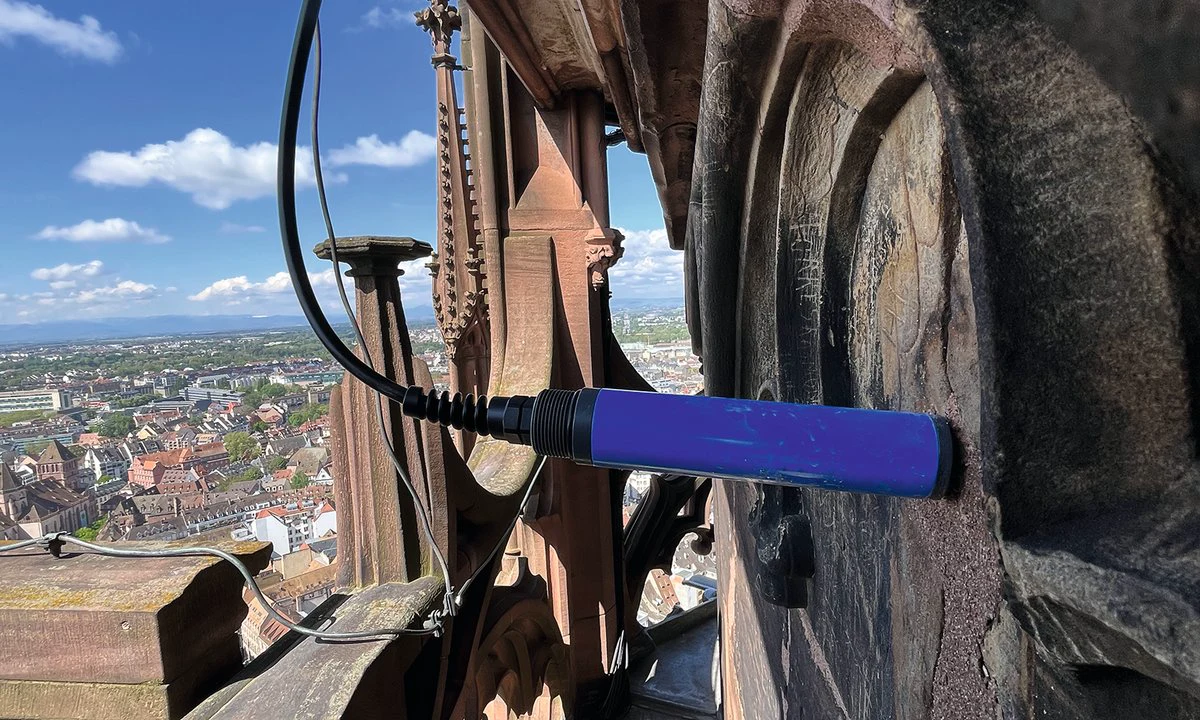
The current work focuses on sites chosen for their diversity of materials and conditions, including the sandstone base of Strasbourg Cathedral's spire and the archaeological site of Bibracte in Burgundy. Those case studies matter because they prevent the project from floating off into generic AI rhetoric. Strasbourg Cathedral is not simply a symbolic monument; it is a structure exposed to severe seasonal variation and long-term material vulnerability. Bibracte, meanwhile, forces the model to think across a very different heritage environment, where archaeological remains and landscape conditions complicate straightforward monitoring. Together they show that heritage climate risk is not one problem but many, distributed across object types and locations.
Both sites also point toward a broader French ambition to link national heritage stewardship with digital infrastructure. The Bibracte site and the institutions surrounding Strasbourg Cathedral already exist inside dense networks of research, tourism, state stewardship, and local identity. By adding predictive modeling, France is not simply digitizing records. It is trying to build a system in which future deterioration becomes forecastable, arguable, and therefore governable. That shift could change how restoration budgets are justified and when intervention is considered urgent rather than optional.
The real innovation is multimodal evidence, not the AI label by itself
One reason the project is worth taking seriously is that it does not reduce heritage assessment to one magical data stream. The team is working with photographs, audio, thermal infrared imaging, weather data, humidity, temperature, carbon dioxide measurements, and close analysis of cracks, fissures, and other forms of degradation. That is a stronger framing than the usual cultural-sector AI claim because heritage deterioration is not cleanly legible in a single format. Changes in light, angle, language, and observational habits all distort what a conservator thinks they are seeing. Teaching a system to correlate these inputs is hard, but it addresses an actual problem rather than inventing one.
That said, the project also exposes the mess underneath the AI boom. Standardization remains weak. Instruments gather environmental data in different ways, site photography varies, and descriptive taxonomies are rarely uniform enough for easy machine learning. The glamour word is AI, but the labor is classification, calibration, repeated measurement, and patient cleaning of inconsistent information. That is familiar to anyone in conservation. In practice, this kind of system will only be as good as the structures that discipline its data. The promise here is real, but it will not arrive through algorithmic charisma. It will arrive through institutional persistence.
France is quietly arguing that climate heritage policy needs better pictures
The most compelling line in the report comes from Ann Bourgès, who says the tool could show people what climate crisis is doing by visualizing how a wall might lose render or paint within a century. That is a very different proposition from simply reporting that temperatures are rising or storms are intensifying. Cultural heritage policy often stalls because long-term risk feels remote, technical, and hard to picture. If this system works, it could supply exactly the kind of image politics that conservation has lacked. Instead of telling officials that damage may worsen, conservators could show what worsening means in terms that are site-specific and hard to wave away.
The French Ministry of Culture has already been building digital heritage infrastructure through projects such as its national cultural platforms, and this initiative points toward a more interventionist use of that infrastructure. Open-source methodology, broader researcher access, and site-level predictive tools could allow smaller institutions to act earlier instead of waiting for visible crisis. That would be a serious gain. But it will also raise awkward questions about funding priorities. Once a tool can identify likely future damage in granular form, governments will find it harder to pretend they do not know where the next conservation emergency is forming.
There is a wider lesson here for the art world. Climate adaptation in culture is often discussed through architecture, insurance, or emergency response, with conservation science treated as a quieter downstream concern. This French project reverses that hierarchy. It suggests that the most powerful intervention may be epistemic: creating better ways to know damage before it becomes spectacular. Museums, archives, archaeological parks, and monument authorities across Europe will be watching closely, because the value of the project lies not only in what it predicts for France, but in whether it can help other institutions make climate risk legible enough to force action.
The implications extend beyond heritage science. Once predictive images enter public debate, they can alter insurance logic, maintenance schedules, regional planning, and even the rhetoric institutions use to raise money. A donor can ignore a generalized warning more easily than a visual model showing where stone, render, pigment, or archaeological surfaces are likely to fail over time. That is why this effort feels important. It does not treat data as a private technical resource for specialists alone. It treats evidence as something that can travel into politics. In that respect, the project belongs in the same larger conversation as our recent guide to reading museum policy shifts: institutional decisions become easier to decode when you can see what pressures are accumulating underneath them.
There is also an international governance angle. If France can show a workable open methodology, other ministries, cathedral authorities, archaeological parks, and museum systems will be pushed to decide whether they can still rely on slower, less legible forms of monitoring. That pressure could be productive, but it may also widen the gap between well-resourced heritage systems and those without comparable technical infrastructure. Open-source tools help, but they do not eliminate the need for trained staff, sustained measurement, and cross-disciplinary coordination. The next stage of this story will be less about whether AI can identify cracks and more about which institutions can afford to operationalize that knowledge.
For now, the most serious takeaway is refreshingly unspectacular. Heritage adaptation will not be won by slogans about resilience. It will be won by better evidence, better maintenance, and better arguments about time. France's experiment is promising because it understands that preservation depends on making long-term deterioration imaginable in the present tense. If the system can do that reliably, it will give conservators and site managers a stronger hand in every budget meeting where climate risk is still treated as tomorrow's problem.
The art world should pay attention because heritage often becomes the place where climate rhetoric is forced to meet physical evidence. Paint flakes, stone erodes, salt accumulates, timber swells, archaeological layers destabilize. Those processes do not care about institutional branding, and they rarely wait for ideal funding conditions. A predictive system that helps administrators decide earlier, argue harder, and document change more clearly could shift the tempo of conservation itself. That would make this project valuable even if the model remains imperfect. In preservation, a tool that makes deterioration more legible and actionable is already doing political work, because it narrows the space for delay, denial, and underfunded improvisation.
There is a second reason this matters for museums and site managers outside France. Once one public system demonstrates that climate vulnerability can be translated into site-level projections, it raises expectations everywhere else. Boards, ministries, and funders will start asking why comparable institutions cannot produce the same clarity. That may feel unfair to under-resourced organizations, but it is also how standards move. A methodology built around open access, cross-site comparison, and visual evidence could quickly become a benchmark for responsible stewardship. If that happens, France's experiment will not just document heritage risk. It will redefine what counts as adequate preparation for it.
That may sound like a technical upgrade, but it has editorial consequences too. Heritage stories are often covered only after catastrophe, when flood, fire, collapse, or visible cracking has already turned conservation into breaking news. Predictive systems could change that media rhythm by making slow deterioration legible before disaster supplies the headline. If institutions learn to communicate those projections well, the public conversation around preservation may become less reactive and more strategic. That would be a genuine shift in cultural politics, because it would make maintenance and foresight easier to defend against the perpetual bias toward emergency spending.