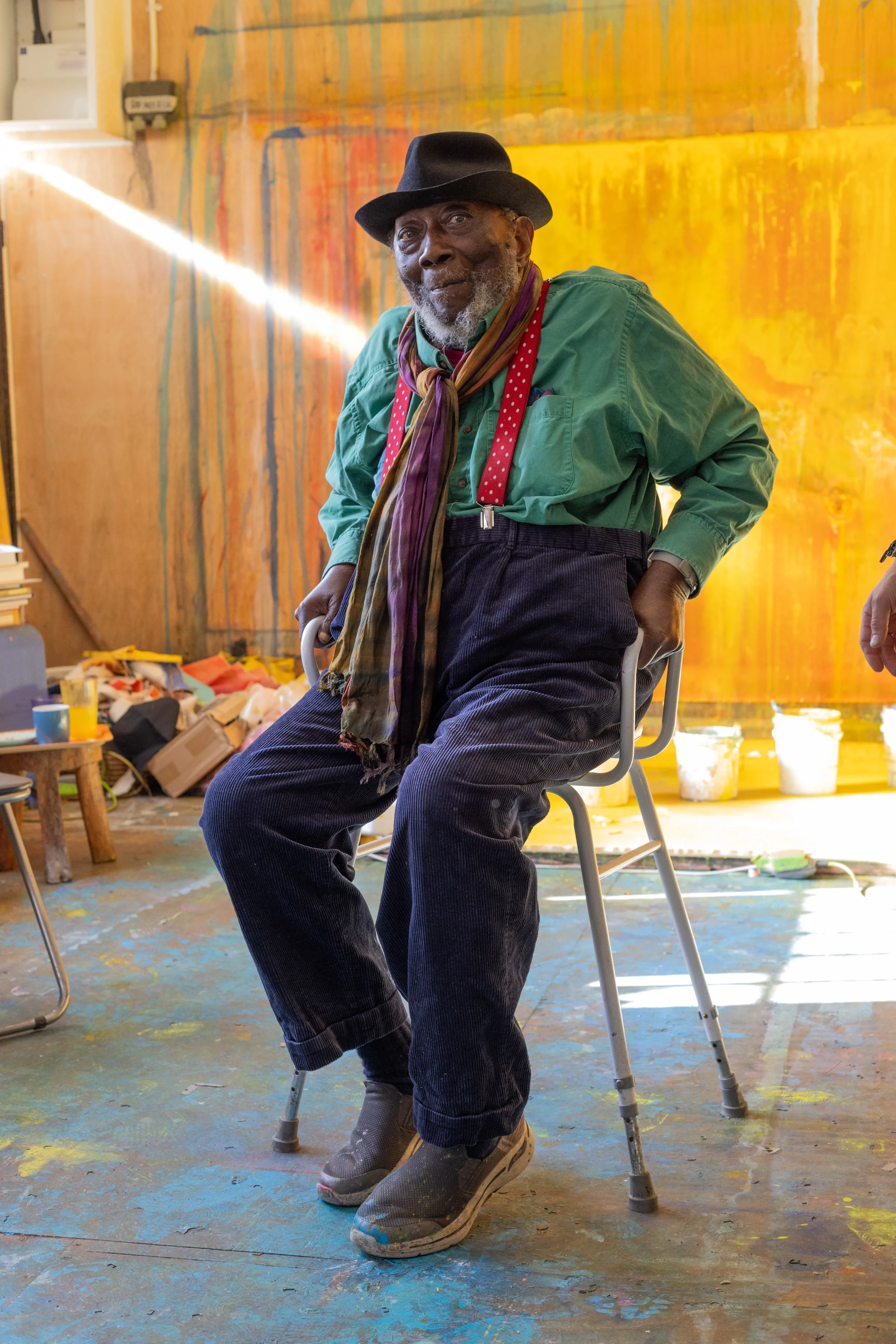
Frank Bowling Foundation to Launch in London
The Frank Bowling Foundation will launch with art, archives, bursaries, and London partners, making legacy control a public institutional question
The Frank Bowling Foundation is being built as a legacy structure with public obligations
The Frank Bowling Foundation will officially launch on 24 June, according to Artnet's industry roundup, with a mandate that goes beyond simple reputation management. The new educational charity will oversee public access to the work of Frank Bowling, receive a major gift of paintings, sculpture, works on paper, and personal archive material, and support scholarships and bursaries for London art schools while also backing the Whitechapel Gallery and the South London Gallery. That mix of archive control, educational spend, and institutional partnership is exactly what makes artist foundations worth watching. They are never just sentimental afterlives. They are governance machines that decide how an artist will be taught, stored, shown, and mobilized.
For Bowling, who has spent decades forcing British institutions to catch up with the scale of his achievement, the move feels overdue and strategic. His official biography traces a career from Guyana to the Royal College of Art, New York studios, major museum exhibitions, and a late flowering of broad public recognition that still came slower than it should have. A foundation changes the timeline. It creates a permanent body capable of turning recognition into infrastructure rather than letting it dissipate across temporary exhibitions and market enthusiasm.
The structure matters because Bowling's work is bigger than the market story around it
Too much writing on Bowling still treats him as a rediscovered master, as if the real drama were belated validation. That frame is useful only up to a point. The better question is what institutions do once they finally admit an artist's centrality. Foundations are one answer. They can stabilize archives, coordinate loans, support scholarship, and keep public access from being entirely subordinated to private demand. The UK Charity Commission listing already places the Frank Bowling Foundation inside a formal civic structure, complete with registered address and reporting obligations. That bureaucratic fact is not glamorous, but it is where cultural durability often begins.
Bowling's paintings demand that kind of durability. Their surfaces carry migration, abstraction, cartography, color, memory, and technical experiment without flattening any of those terms into slogan. A weak legacy structure could easily reduce the work to a single usable story: the overdue canonization of an underrecognized Black British painter. A stronger structure can do more. It can preserve the complexity of the work, fund scholarship that does not simply repeat the same redemption arc, and widen access so younger artists and students encounter Bowling as a living formal problem rather than a pious consensus figure.
The decision to link the foundation to scholarships and bursaries is especially smart. Artist foundations often talk about education while functioning mainly as archive managers or market stabilizers. Here the commitment, at least as announced, is materially directed toward art schools and partner institutions. If followed through seriously, that could matter more than another gala retrospective. Bowling's influence should not only appear in museum labels. It should show up in who gets resources to study, make work, and build their own careers in London.
That educational emphasis also answers a specific problem in British art history. Bowling has often been celebrated for resilience after the fact, once institutions finally catch up, rather than being treated as a formative presence within the education pipeline itself. A foundation can change that if it funds students, supports curricula, and keeps primary materials available to teachers and researchers. In other words, it can move Bowling from the category of artist you admire in hindsight to the category of artist you actually study while learning how contemporary painting, migration, and abstraction fit together.
It could also rebalance how Bowling is encountered geographically. Too much institutional framing still treats him as a figure who must be slotted into either British painting, Black Atlantic discourse, or a New York abstraction story, then held there. A foundation with serious archival and educational ambition can keep those histories in motion rather than forcing a single tidy label. That may sound abstract, but it affects everything from wall text and school syllabi to which works are loaned and which essays get commissioned first.
Artist foundations are now one of the main battlegrounds for canon formation
The launch also lands in a broader moment. Foundations have become one of the preferred vehicles for handling late-career and posthumous reputations, especially when artists' markets, archives, and educational ambitions all need coordination. The Bridget Riley Art Foundation offers another version of that model, pairing stewardship with educational and exhibition work. The difference is that every foundation encodes a distinct politics. Some are mainly defensive, built to authenticate, protect, and monetize. Others are expansive, using the artist's resources to shape a wider field. The Frank Bowling Foundation's first public description suggests it wants to be the latter, though descriptions are easy and long-term governance is harder.
That is where observers should stay alert. Foundations can broaden access while quietly narrowing interpretation. Once an archive is centralized, decisions about loans, publications, and critical emphasis become easier to coordinate. That can be productive, especially for preserving fragile materials. It can also create a smoother official story than the work deserves. Bowling's career is large enough to resist neatness, but institutions love neatness because it travels well. The foundation's success will depend on whether it protects complexity rather than merely branding it.
There is also a London-specific dimension. Whitechapel's history of bringing major art to working-class and migrant communities, set out on its own history page, makes it an apt partner for a project shaped by public access and educational ambition. South London Gallery, with its longstanding role in artists' careers and local programming, offers a different but complementary civic scale. If the Bowling foundation uses those relationships well, it could avoid the trap of becoming a closed prestige vehicle and instead operate as a live node inside the city's cultural ecosystem.
What to watch when the foundation goes live
The June 24 launch is only the headline. The real indicators will come after: who sits on the board, how the archive is catalogued, what scholarship opportunities are actually funded, which institutions receive support, and how accessible the collection becomes to researchers and the public. Announcing a foundation is easy. Building one that stays useful after the first press wave is not. Administrative clarity, publication strategy, and curatorial openness will matter more than celebratory rhetoric.
Loan policy will be another revealing test. A foundation serious about public access should not confine Bowling's work to prestige venues alone. It should be able to support museum and university presentations that widen the audience while protecting conservation standards. Publication strategy matters just as much. If the archive yields new catalogues, oral histories, or digitized materials, the foundation could become an engine for scholarship rather than a mere guardian of approved legend. Those choices will determine whether June 24 marks the start of a living institution or just a neat press line about legacy.
Just as important is whether the foundation develops a voice of its own rather than speaking only in institutional boilerplate. Bowling's art has never been polite. It is sensuous, argumentative, geographically restless, and materially unruly. A foundation that turns that body of work into generic cultural uplift will have missed the point. One that can keep the work's pressure intact while widening who gets to encounter it will have done something much harder, and much more necessary, than simply preserving a famous name.
Readers looking for a framework should revisit our guide on how to read late-career artist surveys. The same principle applies here: legacy institutions tell you which version of an artist's life is being made durable. A foundation can freeze a reputation or keep it productively unsettled. In Bowling's case, the best outcome would be a structure robust enough to support public learning, generous enough to widen access, and disciplined enough not to simplify a body of work that has always exceeded the categories imposed on it.
For now, the foundation looks promising because it pairs stewardship with obligation. It does not present Bowling's archive as a treasure to be guarded from the world, but as a resource to be activated through schools, scholarships, and institutional partnerships. That is the right instinct. The art world does not need more legacy embalming. It needs structures that keep difficult, major work in circulation without reducing it to brand heritage. If the Frank Bowling Foundation can do that, it will matter far beyond one artist's estate planning. It will become a model for how canon formation might still serve the public instead of merely the market.
The stakes are larger than one admirable launch. Artist foundations are quietly becoming some of the most important editors in the cultural field because they decide what is catalogued, what is teachable, what is loanable, and what remains visible when the market cycle moves on. Bowling deserves a structure capable of handling that responsibility without sanding down the force of the work. If this foundation manages that balance, it will not only honor his legacy. It will reshape how future generations encounter it.