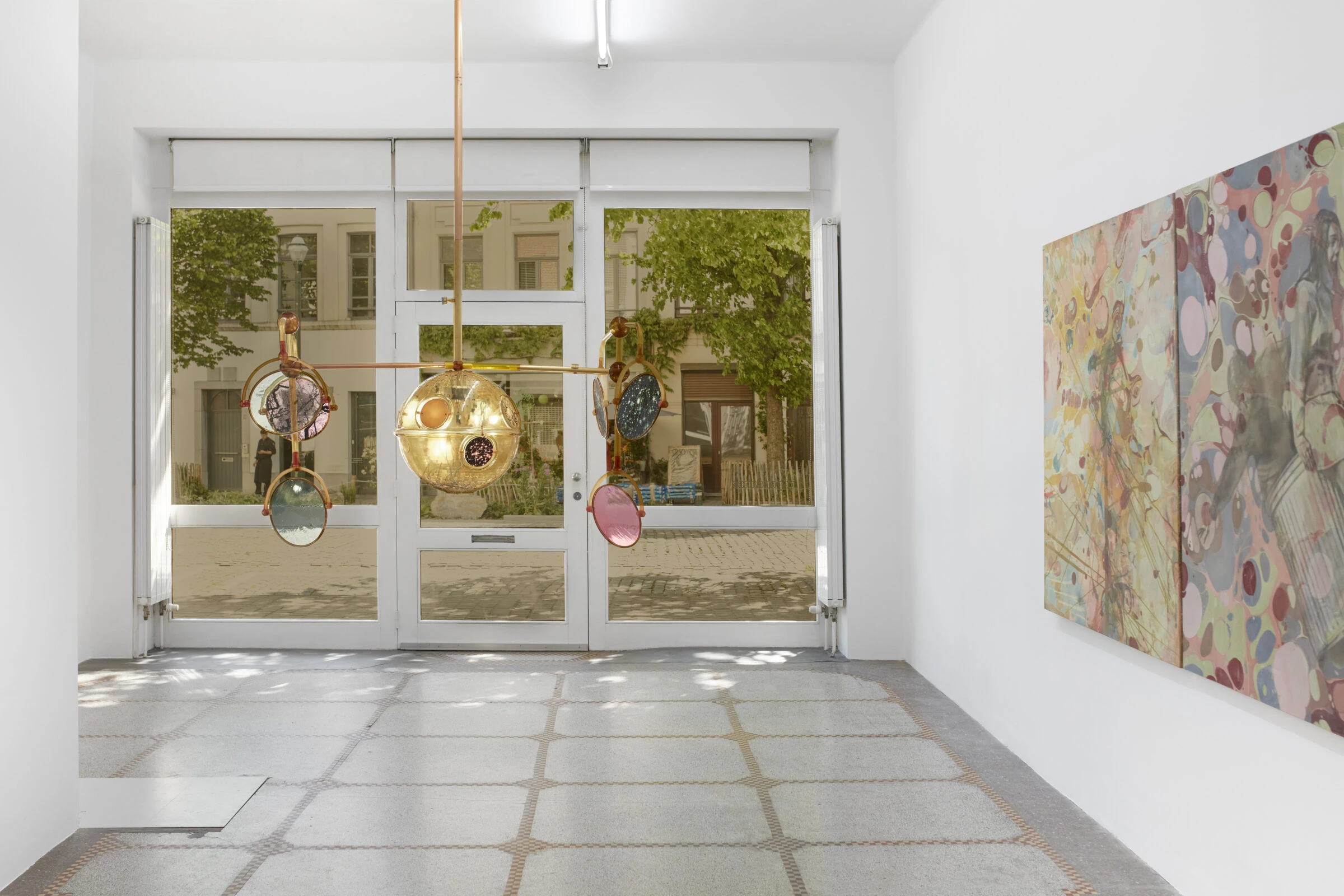
Dépendance’s Closure Marks a Real Loss in Brussels
After 23 years, Brussels gallery dépendance is closing, ending a lean artist-first model that resisted expansion mania and market bloat
A Small Gallery With Real Taste Is Calling It Quits
Dépendance, the Brussels gallery founded by Michael Callies and Stephan Jaax in 2003, is closing after 23 years. Artnet News reported the decision after the gallery informed its mailing list that it was time to say goodbye. The gallery’s final exhibitions, including Alexandra Metcalf’s presentation visible on the gallery’s current exhibitions page, will close on June 27, with administrative follow-up continuing through the end of August. The news lands with a particular sting because dépendance was not just another regional commercial space. It was one of the rare galleries that managed to stay intellectually sharp, visually adventurous, and structurally modest while the rest of the market spent two decades equating seriousness with scale.
That is what makes the closure feel larger than one business shutting its doors. The art market can absorb another mega-gallery outpost, another fair-week pop-up, another strategically timed relocation. What it cannot easily replace is a dealer program built on patience, conviction, and the refusal to inflate itself into a lifestyle brand. Dépendance represented artists including Ed Atkins, Allison Katz, Josef Strau, Oscar Tuazon, and Jana Euler, and it built a reputation by backing difficult work without pretending difficulty had to be softened for collectors. In a market that increasingly rewards logistics, speed, and social saturation, the gallery’s existence was a reminder that a single room in a single city could still matter more than a global footprint.
How Dépendance Refused the Expansion Script
According to Artnet’s account, Callies and Jaax built the gallery on notably unsentimental assumptions. They kept costs low enough that the business could survive even if sales did not come quickly. They worked from Brussels rather than chasing the supposedly mandatory capitals of Berlin, London, or New York. They did art fairs, but not with the feverish relentlessness that came to define the growth era. The gallery usually participated in five or six fairs a year, modest by the standards of its peers, and it remained focused on a concentrated roster instead of turning itself into a volume operation. That discipline now reads less like eccentricity than foresight.
The gallery’s early program was closely linked to the Städelschule orbit, including artists and teachers associated with Martin Kippenberger, Michael Krebber, Haegue Yang, and Thomas Bayrle. That lineage mattered, but the gallery was never merely an alumni salon. What distinguished dépendance was its ability to carry forward a certain rigorous, anti-decorative temperament without turning it into orthodoxy. The program could feel severe, mischievous, and exacting in turn. It offered a place where artists could test ideas that were not engineered for immediate legibility. That is easy to praise in hindsight and much harder to fund in real time, which is part of why the gallery’s longevity matters.
Why Brussels Became the Right Wrong Place
Callies once said that Brussels felt like an island, and that phrase says a lot about the ecology in which dépendance thrived. Brussels has long supported galleries that benefit from being slightly off the main script of art-world self-mythology. The city offers proximity to major European institutions and collectors without the same level of symbolic overexposure found in London or Paris. For a gallery committed to building carefully rather than loudly, that relative remove could be productive. Dépendance used the city’s scale to its advantage. It was able to make space for a program that did not need to present itself as inevitable.
That makes the closure a telling symptom of the present market. The pressure on small and mid-size galleries no longer comes only from rent and fair costs, though both matter. It also comes from the expectation that a gallery must always be scaling, communicating, shipping, posting, and appearing everywhere at once just to remain legible. The old model of deep local presence combined with selective international visibility is harder to sustain when every layer of the business has become more expensive and more performative. Dépendance’s decision to stop rather than morph into something more opportunistic may be sad, but it is also coherent with the values that made the gallery worth caring about in the first place.
There is also an institutional context here that commercial stories often flatten. Brussels has benefited from a wider ecosystem of artist-run initiatives, nonprofit spaces, collectors willing to buy conceptually difficult work, and proximity to public institutions across Belgium, France, Germany, and the Netherlands. A gallery like dépendance could not have existed in a vacuum. It was part of an ecology that made slower, more editorial dealing possible. When one node disappears, the effect is not isolated. Artists lose a context, collectors lose a trusted filter, and the city loses one more place where ambition did not need to arrive dressed as inevitability. That is why closures like this deserve to be read alongside broader questions about how smaller art capitals hold onto risk-bearing infrastructure.
The Project Space, the Final Shows, and the End of a Certain Dealer Ethic
The gallery even spent its last stretch doing what it had always done: making room for artists. In 2024 it opened a project space called VIEW, adding another venue for focused presentations rather than a more obviously commercial extension. Its last exhibitions and practical wind-down are being handled with the same unspectacular clarity that defined the program. There is no attempt to turn closure into a self-congratulatory brand moment. That restraint is refreshing. Too many farewells in the art trade now arrive wrapped in content strategy, as if the final obligation of a gallery were to curate its own ending for maximum shareability.
Dépendance leaves behind a model that younger dealers may find inspiring and discouraging in equal measure. Inspiring because it proved that a gallery could build authority without imitating conglomerate behavior. Discouraging because even that example has now reached its limit. The lesson is not that idealism is naive. It is that idealism without structural protection becomes brutally hard to maintain in a market organized around extraction. When small galleries disappear, the loss is not only to artists and collectors. It is to the range of conversations the commercial sector can support. Fewer serious mid-scale spaces means fewer places where risk can happen before the institution arrives to canonize it.
That point should sound familiar to anyone following recent debates about institutional scale and public mission. We made a related argument in our guide to reading museum expansions: bigger systems are not automatically stronger systems. The same logic applies to the gallery sector. More square footage, more fairs, and more branded visibility do not necessarily produce better conditions for artists. Dépendance mattered precisely because it maintained a coherent program without pretending growth was the only proof of health.
What the Closure Means for Artists and the Market
The artists who showed with dépendance will continue to circulate, and some may land in larger systems that can offer more resources. But something changes when the context changes. Galleries like dépendance did not simply transact works. They framed them, defended them, and held open a space in which difficulty was not a liability to be explained away. That kind of context cannot be replicated by scale alone. It depends on a dealer’s editorial confidence and on a program shaped over years rather than quarters.
There is another consequence worth watching: market memory. Galleries like dépendance help establish the interpretive record around artists before museums and auction houses begin rewriting it in their own terms. When those galleries disappear, fewer people remain in the chain who can explain why certain positions mattered before they became fashionable or monetizable. That is not nostalgic hand-wringing. It is a practical account of how art history gets filtered through commerce.
Brussels will keep producing artists, collectors, and curators, but that does not mean the loss is easily absorbed. Cities gain reputations for seriousness by accumulating spaces with distinct sensibilities over time. They lose that reputation gradually, one closure at a time, as the number of places willing to take difficult work seriously starts to thin out. Dépendance was one of those places. Its absence will be felt most by people who understood the gallery not as a logo but as a way of paying attention.
There is no clean substitute for that kind of attention. Another gallery may take on one artist, another may inherit a collector relationship, and fairs will keep absorbing the traffic that once moved through spaces like this. But the specific editorial pressure that dépendance brought to its program cannot simply be redistributed. It was built through time, trust, and a tolerance for ambiguity that larger, more managerial operations often struggle to sustain.
So the closure should not be read as another tidy example of market churn. It is a reminder that the art world’s most valuable institutions are sometimes its least overcapitalized ones. Dépendance stayed small on purpose, and for more than two decades that choice produced real cultural value. Brussels is poorer without it. The broader market is poorer too, because every time a gallery like this disappears, the field becomes a little more standardized, a little more cautious, and a little less capable of supporting art that does not arrive pre-approved.