Crete Hotel Commissions Site-Specific Art by the Sea
The Mamidakis Foundation Art Prize at Minos Palace Resort in Crete awards its first international winners for a Mediterranean landscape installation
What Happened
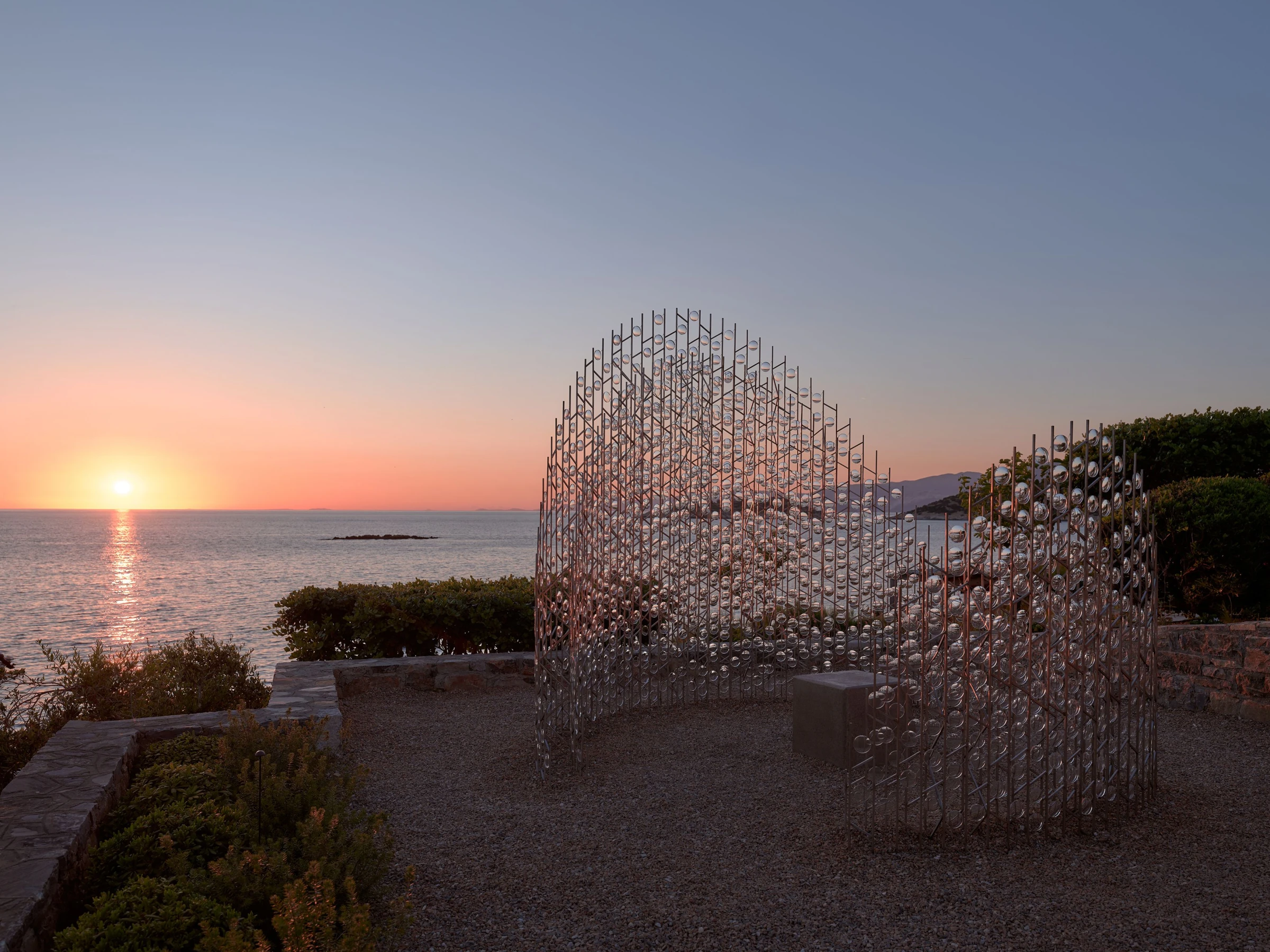
The G. and A. Mamidakis Foundation has awarded its 2026 Art Prize to Canadian artists Caitlind R.C. Brown and Wayne Garrett for their installation Chronotopia, a site-specific work made from hundreds of unused eyeglass lenses that responds to the Mediterranean landscape of the Minos Palace Resort in Crete. The prize, which has been running since 2019, offers artists the opportunity to create a site-specific work for the luxury hotel's sculpture garden, which sits on a headland in the east of Crete near the town of Agios Nikolaos. This year the foundation received more than 450 proposals from 65 countries, and Brown and Garrett are the first international artists to win the prize, which was previously awarded to Greek sculptor Danae Stratou in 2025.
Chronotopia is made from hundreds of unused lenses meant for eyeglasses, arranged in a structure that allows visitors to sit inside and experience the shattered horizon as infinite miniature worlds. A second layer of lenses obscures the viewer from the outside world, creating a private space within the public sculpture garden. The lenses catch the light in different ways throughout the day and from different locations, and the artists even swam out into the bay to see how the installation looked from the seaward side. The work is the latest addition to a collection that now comprises more than 80 pieces, the vast majority created specifically for the sculpture gardens that surround the two hotels operated by the foundation. As The Art Newspaper reports, the collection is curated and managed by the G. and A. Mamidakis Foundation, which was set up by the hotel's owner Gina Mamidaki to continue the legacy of the symposia she hosted at the nearby Minos Beach Art Hotel in the 1980s.
A History of Art and Hospitality
The Mamidakis Foundation's art collection has its origins in the symposia that Gina Mamidaki hosted at the Minos Beach Art Hotel starting in 1988. The first symposium invited five speakers and 32 artists, including Anish Kapoor, Lynda Benglis and Joseph Kosuth, to spend several weeks at the hotel over the summer creating artworks for outdoor display. The idea was simple: artists would create works using simple materials found in the surrounding environment, and the works would remain on permanent display in the sculpture gardens. These early commissions formed the basis of a collection that has grown to more than 80 pieces over nearly four decades, with the vast majority of the works created specifically for the site.
The collection includes significant works by major international artists. Lynda Benglis created a drawing in space out of metal objects welded together at the top of an existing spiral staircase. Magdalena Abakanowicz contributed three wooden structures called The Painful Pyramids (1993), which from a distance appear innocuous but up close reveal rusting barbed wire that creates an unsettling contrast to the sun-loungers around them on the beach. More recent works include Stratis Tavlaridis's Long Waves, made of long pieces of delicate hand-cut paper that ripple in the breeze, and Katerina Nakou's The Resilient Thread, composed from woven textiles. The Mamidakis Foundation has taken a distinctive approach to hotel art, prioritizing site-specific commissions over the more common practice of purchasing existing works for decorative purposes. This approach means that the collection is deeply embedded in its location, with works that respond to the specific conditions of the Cretan landscape, climate and cultural history.
The Challenge of Outdoor Art in the Mediterranean
Conservation of artworks in a Mediterranean coastal environment presents challenges that are very different from those faced by works installed in climate-controlled galleries or urban public spaces. Some pieces are stored inside during winter, others are taken to Athens for occasional touch-ups, and none of the works are protected by barriers. The intense sun, salt air and humidity of the Cretan coast can degrade materials rapidly, and the foundation's approach has been to accept the effects of the environment rather than fighting them. Brown and Garrett carefully weather-tested their concept, putting a model out into the harsh Canadian climate before installation, but a few days after installation were already finding things they had not anticipated. They were surprised by how salt interacted with the lenses and built mitigation strategies, including regular rinsing and wiping to prevent the salt from becoming an abrasive over time.
The location also influences what is possible in the work. Brown and Garrett often create pieces for public spaces such as parks, forests, abandoned buildings and car parks, and they note that a work of this fragility probably would not survive in another location. The relative protection of the hotel sculpture garden, with its controlled access and maintenance staff, allows for a degree of delicacy that would be impossible in a fully public space. But the artists also embrace the impermanence that comes with working outdoors. There is a complexity in working within a functional space where you have the sunbathers and the jet skiers and the folks who are maintaining the garden, Brown observes, but there is also the possibility of communion with the sky, the land and the sea. The UNESCO World Heritage sites of Crete, including the nearby Minoan palace of Knossos, provide a historical context for the foundation's work, connecting the contemporary sculptures to a tradition of art and architecture on the island that stretches back nearly four thousand years.
What Comes Next
The Mamidakis Foundation's model of site-specific commissioning for a luxury hotel raises interesting questions about the relationship between art and hospitality, and about the role of private foundations in supporting contemporary art. The foundation's approach is not simply decorative: the works are commissioned through a competitive prize that attracts hundreds of proposals from around the world, and the resulting installations are serious artistic contributions that engage with the specific conditions of their site. The collection includes works by major international artists that would not be out of place in a museum or public sculpture park, and the foundation's commitment to site-specific commissioning ensures that the works are deeply connected to their location rather than being generic hotel art.
The foundation's future plans include continuing the annual prize and expanding the collection, which already extends across two hotels and their surrounding gardens. The model has proven successful both artistically, attracting high-quality proposals from international artists, and commercially, enhancing the guest experience at the hotels in a way that distinguishes them from other luxury resorts. As the market for art and hospitality continues to converge, with more hotels commissioning contemporary art for their spaces, the Mamidakis Foundation's nearly four-decade experiment in Crete offers a model of how to do it well: with serious artistic intent, site-specific commissioning, and a long-term commitment to the collection and its preservation.
The foundation's approach also raises questions about the relationship between art and commerce that are worth examining. Luxury hotels have long collected art as a form of decoration and status enhancement, but the Mamidakis Foundation's model is qualitatively different. The competitive prize, the site-specific commissioning process, and the foundation's commitment to conservation and scholarship all distinguish the collection from the typical hotel art program. The works are not merely decorative but engage seriously with their environment, responding to the specific conditions of the Cretan landscape and the cultural history of the island. The collection includes works by major international artists, including Anish Kapoor, Lynda Benglis, Joseph Kosuth and Magdalena Abakanowicz, and the foundation's commitment to site-specific commissioning ensures that the works are deeply connected to their location rather than being generic luxury hotel art.
The conservation challenges of maintaining an outdoor art collection in a Mediterranean coastal environment also provide valuable lessons for other institutions and collectors working with site-specific outdoor art. The foundation's approach, which combines seasonal storage, regular maintenance and an acceptance of the effects of the environment on the works, offers a pragmatic alternative to the climate-controlled preservation strategies of indoor museums. The International Centre for the Study of the Preservation and Restoration of Cultural Property has identified outdoor art conservation as a growing challenge as more institutions commission site-specific works for outdoor display. The Mamidakis Foundation's nearly four-decade experience in this area provides a valuable case study for other organizations grappling with similar challenges. The foundation's commitment to site-specific commissioning, combined with its rigorous approach to conservation and its engagement with the local cultural and natural environment, sets a standard that other hotel art programs would do well to emulate. As the art world continues to grapple with questions of site, context and community engagement, the Mamidakis Foundation's experiment in Crete offers a model of how private patronage can produce public cultural value. The foundation's annual prize continues to attract proposals from artists around the world, and the collection grows each year with new commissions that respond to the specific conditions of the Cretan landscape. The result is a body of work that is neither a museum collection nor a commercial gallery but something altogether different: a living, evolving art collection embedded in the daily life of a hotel and the natural environment of the Mediterranean coast.