Courtauld Opens Hepworth-Nicholson Studio Photo Show
The Courtauld is showing rare Paul Laib photographs of Barbara Hepworth and Ben Nicholson's Hampstead studio, reframing it as an engine of modernism.
The Courtauld Is Showing a Studio as a Machine for Looking
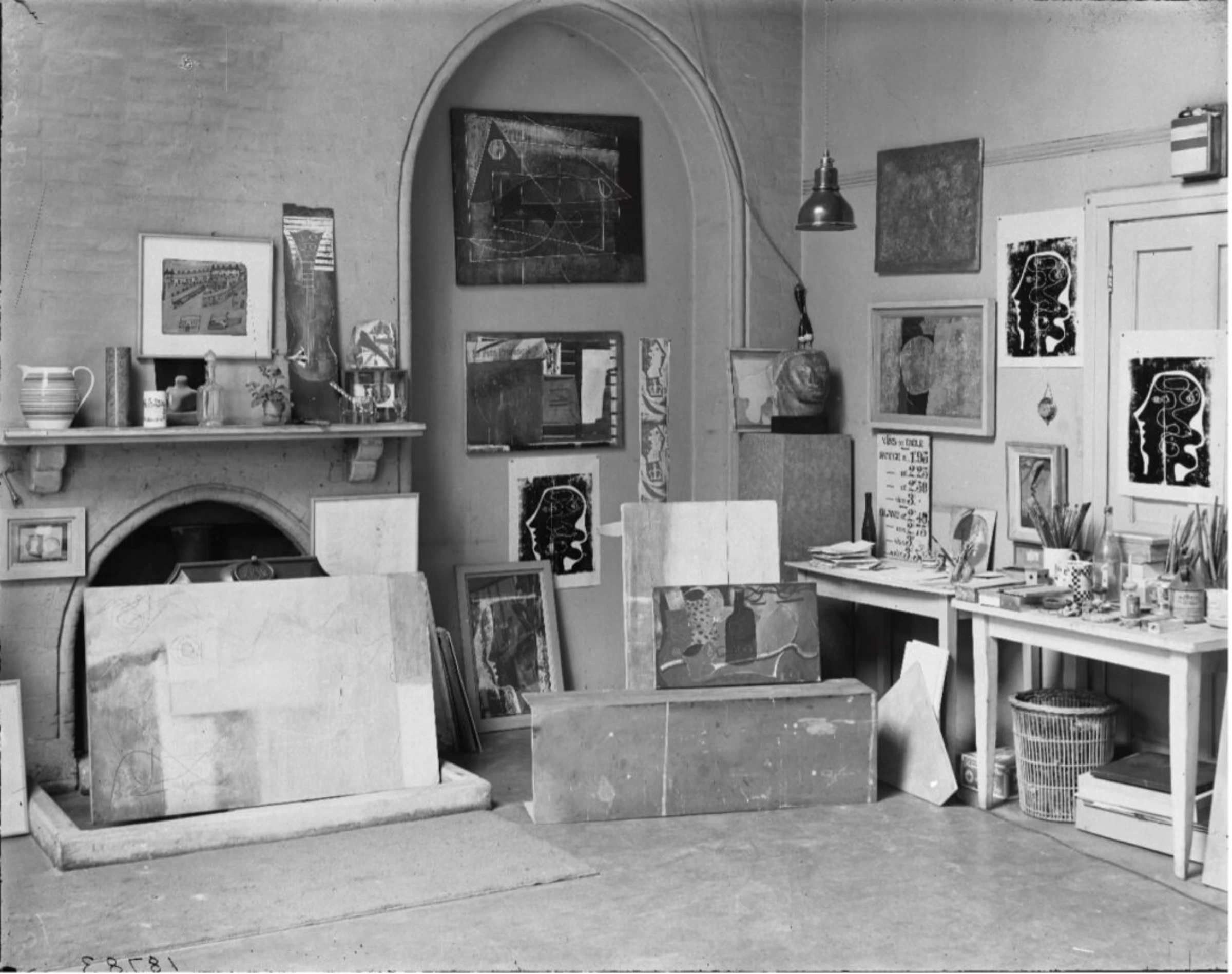
The Courtauld Gallery has opened Hepworth and Nicholson: The Hampstead Studio Photographs, a focused exhibition built around twenty-three black-and-white images made by Paul Laib in 1932 and 1933. The subject is the shared studio of Barbara Hepworth and Ben Nicholson at 7 The Mall in Hampstead, but the real achievement of the show is that it does not treat the studio as a nostalgic relic. As The Art Newspaper explains, the display reveals how the space functioned as a catalytic environment in which artistic production, domestic intimacy, staging and photographic mediation all shaped one another. That may sound like familiar modernist mythology until you see the evidence. The photographs suggest a far messier and more collaborative reality.
The timing is smart. The Courtauld is pairing the Laib material with its larger summer presentation around Hepworth, using a smaller archival show to make a broader point about how modernism was built not only through finished objects but through rehearsal spaces, social arrangements and images designed to circulate. For institutions trying to prove that archival displays can still feel urgent, this is exactly the right scale. The show is neither overblown nor minor. It uses a tight cluster of objects to make the familiar names of Hepworth and Nicholson look less settled and more contingent.
Laib Was Not Merely Documenting the Work
One of the strongest claims in the Courtauld project is that Paul Laib's photographs were not neutral records. They were shaped by Hepworth and Nicholson's own understanding of how a studio image could function as part of artistic self-definition. Co-curator Chloe Nahum tells The Art Newspaper that the artists were effectively directing the shots, drawing on the example of magazines such as Minotaure and the newly influential culture of artist-studio photography. That detail changes the register of the material. These pictures are not simply windows into a lost room. They are acts of self-fashioning in which sculpture, painting, furniture, mirrors, textiles and bodies are composed into a coherent modernist scene.
That is especially visible in the photographs that center Hepworth's hands, or place one artist's work inside the other's visual territory. The studio becomes a site where artistic identities are tested against each other and made public through the lens. Laib, in this telling, is less an autonomous author than a highly responsive collaborator. Yet the images also retain their own formal intelligence. The Art Newspaper notes the velvet blacks, the gradations of tone and the careful handling of spatial depth. So the show avoids the simplistic conclusion that photography was merely instrumental. Instead it shows a triangular relation: artists shaping photographic conditions, the photographer turning those conditions into compelling images, and the images in turn shaping how the artists would be seen.
The Exhibition Complicates the Story of Shared Modernism
Hepworth and Nicholson have long been discussed as intertwined figures, but their pairing often collapses into cliché: the celebrated modernist couple, the fertile Hampstead milieu, the polished story of mutual influence. The Courtauld's photographs complicate that smooth narrative because they expose how uneven and negotiated the visual field really was. In some images, Nicholson's paintings behave like backdrops for Hepworth's sculpture. In others, Hepworth's work asserts itself inside a room otherwise dominated by his framing structures. The photographs do not dissolve the artists into one harmonious unit. They show an environment in which proximity produced friction as well as dialogue.
That is useful because modernist coupledom has too often been narrated through a hierarchy that makes the woman artist's labor seem decorative, relational or derivative. Here the opposite happens. The studio photographs sharpen Hepworth's authority. Even when the room contains both artists' works, her forms repeatedly anchor the image and determine its emotional charge. The exhibition therefore contributes to the broader correction under way in British art history, in which Hepworth is no longer treated as a supporting figure within a male-led avant-garde. The images make clear that she was one of the central forces structuring the studio's visual logic.
Archives Matter Most When They Change How Finished Work Reads
Archival displays can sometimes feel dutiful, especially when museums assume that rarity alone will create interest. The Courtauld avoids that trap by ensuring that every documentary revelation feeds back into how we read the finished work. Once you understand that Hepworth and Nicholson actively staged these photographic encounters, later debates about authorship, abstraction and domestic modernism look different. The archive stops being background material and becomes part of the work's operational history. It tells you not only what was made, but how the artists wanted making itself to appear.
That has implications beyond this exhibition. Museums are increasingly searching their photo archives, correspondence files and installation records for ways to renew canonical material without repeating the same greatest-hits narrative. Our recent coverage of new evidence around Whistler attribution showed another version of that impulse: an archive can destabilize a settled picture. The Courtauld show does something subtler but equally valuable. It enriches rather than overturns. The achievement lies in making the visual evidence feel necessary, not supplementary.
Why the Courtauld Show Matters Now
The timing also works because London's institutions are currently trying to balance scholarship with immediacy. Larger museums have leaned hard on immersive installations, politically topical framing or market-certified names. The Courtauld is doing something quieter and, frankly, harder. It is asking viewers to spend time with black-and-white images of a room, trusting that the density of relations inside those images can still command attention. That confidence is refreshing. It implies a public still capable of close looking and still curious about the machinery behind familiar masterpieces.
The exhibition also speaks indirectly to the current conversation about artistic labor and infrastructure. Studios are again central to how the art world understands sustainability, collaboration and precarity, as seen in our guide to London gallery business models. Hepworth and Nicholson's Hampstead rooms were not precarious in the same way as a contemporary artist's rent burden, but the photographs make visible how much work a studio does beyond housing objects. It is a space of negotiation, image management, support and shared experiment. That broader understanding gives the show contemporary bite.
What Comes Next From This Archive
The Courtauld says around 150 Laib images relate specifically to Hepworth and Nicholson, drawn from a much larger gift of glass-plate negatives. That means the current exhibition is less a definitive statement than an opening move. One hopes the institution continues to mine the archive not only for additional displays but for deeper research into how photographic mediation shaped British modernism. There is plainly more here than a charming glimpse behind the scenes.
The photographs also tell us something about class and resourcefulness inside interwar modernism. Hepworth and Nicholson were often short of money, and that fact matters because it keeps the studio from hardening into a fantasy of pure aesthetic freedom. Decisions about how works were placed, photographed and circulated were entangled with practical need. Images could help secure reputation, attract attention and stabilize an artistic identity in a competitive field. Seen from that angle, the Courtauld show is not just about intimate bohemian life. It is about modernism as labor, presentation and strategic visibility.
There is a further historiographic payoff. British modernism is often narrated through movements, manifestos and major objects, with the studio serving as little more than atmospheric backdrop. Laib's photographs reverse that hierarchy. They show the room itself as a compositional intelligence, a place where aesthetic arguments were staged before they were finalized in public. That perspective could prove especially fertile for future scholarship on Unit One, on exhibition photography and on how reproductive images helped determine what counted as advanced art in Britain during the 1930s. The Courtauld has quietly put an enormous amount of interpretive pressure into a very small exhibition.
It is also worth stressing how effectively the show handles scale. Fourteen vintage prints and nine modern prints are not many objects, and lesser institutions would have padded the display with diffuse contextual material. The Courtauld trusts restraint. That trust allows viewers to register differences in cropping, tonal emphasis and the relation between objects inside the frame. In a museum culture that too often confuses abundance with seriousness, the exhibition feels almost polemical in its economy. It says, correctly, that archival focus can do more intellectual work than a crowded room full of half-processed evidence.
One further strength of the display is that it restores risk to images that could otherwise be filed away as tasteful documentation. These photographs are full of choices about angle, emphasis and authority. They remind us that the modernist studio was not a neutral container but a contested surface on which reputations were built. That is precisely why the show deserves attention beyond Hepworth specialists. It offers a compact lesson in how artists learned to choreograph visibility long before the contemporary art world professionalized every aspect of image management.
For now, the show succeeds because it refuses sentimentality. It does not reduce the studio to bohemian romance or turn the artists into heritage mascots. Instead it presents a shared room as an active laboratory in which objects, bodies and photographs were constantly repositioning one another. That is a sharper and more useful way to think about modernism than the old mythology of solitary genius. The Courtauld has found a way to make a small archival exhibition feel structurally important, which is exactly what good museum editing looks like.