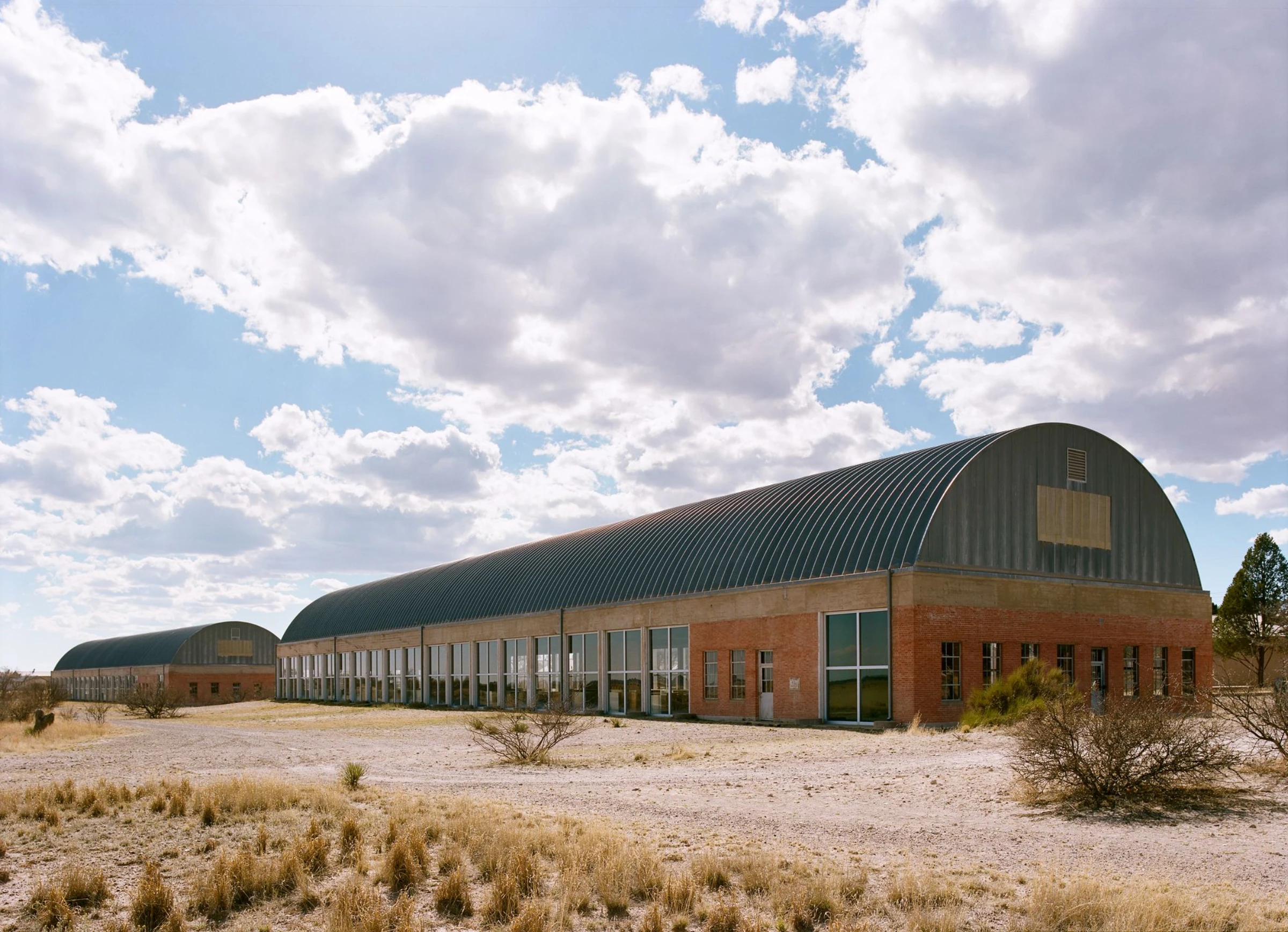
Chinati Foundation Restores Judd Artillery Sheds
Chinati Foundation begins multi-year restoration of Donald Judd Artillery Sheds in Marfa, moving 100 aluminum works for the first time in 40 years
What Happened
This autumn, restoration work will commence on the two former artillery sheds that house Donald Judd's 100 untitled works in mill aluminum (1982-86) at the Chinati Foundation in Marfa, Texas. Having remained precisely where Judd sited them more than four decades ago, each of the mill-aluminum boxes will be moved for the first time so that a team of architects and engineers can address crucial infrastructure concerns in the buildings. The restoration project comes on the heels of the Artillery Sheds' recognition last year on the National Register of Historic Places as part of the Donald Judd Historic District, a designation that underscores the significance of both the buildings and the works they contain.
The Artillery Sheds were built in 1939 by the US Army Corps of Engineers as part of Fort D. A. Russell, a decommissioned army base on the northeastern edge of the Chihuahuan Desert. In the late 1970s, Judd acquired the majority of the former fort, including the sheds, with the vision of creating a museum of permanent, site-specific installations. To display his mill-aluminum works, Judd replaced the sheds' garage doors with long walls of windows and replaced their flat roofs with vaulted roofs of galvanized iron, nearly doubling their height. The result was a space that integrated art, architecture and landscape in a way that had no precedent in museum design. As The Art Newspaper reports, the restoration team faces the challenge of preserving this integration while addressing the wear of four decades in a harsh desert environment.
The Restoration Challenge
Beset by a changing climate, with increasingly intense rainstorms and rising temperatures, the Chinati Foundation has assembled a team of experts to devise a strategy for mitigating wear to the Artillery Sheds and safeguarding them for years to come. The team includes Schaum Architects, Alfred Lippincott who partnered with Judd on the original fabrication and placement of the works in the 1980s, the Getty Conservation Institute, alongside engineers, climate specialists, conservators and landscape designers. The multi-year project will include the installation of energy-efficient glass and passive air-circulation systems to reduce temperatures, the implementation of rainwater harvesting systems to facilitate drainage and sustain newly planted native grasses, the creation of improved pathways for greater accessibility, and repairs to the roofs, gutters and facades.
Climate-control systems that other museums might readily install are out of the question for Chinati. Such interventions, though ideal for ensuring long-term preservation, would fundamentally contradict Judd's intention for the spaces. The restoration team has devised a passive-air system that uses existing openings and breaks caused by concrete expansion joints so that minimal filtered fresh air circulates in the space. The approach, which reflects a changing tide in conservation practice internationally, focuses on moderating extremes rather than chasing a static, museum-standard environment. The team has also adopted an approach comparable to Judd's own working methods to refit the Artillery Sheds' quartered windows with new single-pane glass treated to shed dust and reduce temperatures. To ensure that the new windows are indistinguishable from the originals, the team will do full-scale mock-ups of a few types of glass and live with them for a year to study and experience the glass directly and its relationship to the work. The Getty Conservation Institute has been a key partner in developing these passive conservation strategies, which are increasingly seen as a model for preserving site-specific works in harsh environments.
Judd's Vision and Its Stakes
The Artforum report on the restoration notes that the Chinati Foundation was opened in 1986 as a publicly funded nonprofit and was originally conceived to display the work of Judd, John Chamberlain, and Dan Flavin. Its permanent collection has expanded to include the work of a number of contemporary artists including Carl Andre, Roni Horn, and Claes Oldenburg and Coosje van Bruggen. The downtown buildings were placed on the National Register of Historic Places in 2022, with the Fort D.A. Russell complex being added in 2025 as part of the Donald Judd Historic District. The Artillery Sheds restoration follows the successful restoration of Chinati's first building, the John Chamberlain building in downtown Marfa, which was completed in 2022 and serves, in Murray's words, as a really good example of how to do this well.
The stakes of the restoration extend beyond the Chinati Foundation. Judd's work at Marfa has been enormously influential in the field of site-specific art, and the Artillery Sheds are among the most significant examples of his approach to the integration of art, architecture and landscape. The restoration project raises fundamental questions about how to preserve site-specific works in the face of climate change, and the solutions developed by the Chinati team are likely to inform preservation efforts at other site-specific art installations around the world. The Chinati Foundation has taken a deliberately slow and careful approach, with Murray emphasizing that the team wants to take its time to do the work carefully and correctly. The 39th annual Chinati Weekend in October will be a final opportunity to visit the Artillery Sheds before work begins in November.
What Comes Next
The restoration of the Artillery Sheds is part of a broader effort by the Chinati Foundation to preserve its campus and its collections in the face of environmental challenges. The foundation's 340-acre campus includes 34 buildings with permanent installations by artists including Dan Flavin, Roni Horn, Carl Andre and Robert Irwin, each of which presents its own conservation challenges. The Artillery Sheds project, with its emphasis on passive systems and minimal intervention, offers a model for how to address these challenges without compromising the artistic integrity of the installations. The project also comes at a time of growing recognition for Judd's legacy, with the National Register designation and the recent publication of several scholarly works on his practice.
For visitors, the restoration project will mean that the Artillery Sheds will be closed for an extended period, although the rest of the Chinati Foundation's campus will remain open. The foundation has not announced a timeline for the completion of the work, but Murray's description of the project as once-in-a-generation suggests that it will be a multi-year effort. In the meantime, the Chinati Weekend in October will offer a last chance to see the Artillery Sheds in their current state, and the foundation is planning a series of programs and events to document the restoration process and keep the public informed about its progress. The restoration team has also emphasized the importance of documenting every stage of the process, both for the benefit of future conservators who may need to intervene in the buildings and for the broader field of site-specific art conservation. The Chinati Foundation has commissioned a comprehensive photographic and video record of the Artillery Sheds in their current state, and the restoration project itself will be documented in detail, providing a resource for other institutions facing similar challenges. The documentation will include interviews with members of the restoration team, detailed condition reports for each of the 100 aluminum works, and technical drawings of the buildings and their systems. The project is a reminder that the preservation of site-specific art is not a one-time effort but an ongoing commitment, and that the institutions that steward these works must be prepared to invest the time, resources and expertise necessary to ensure their survival for future generations. The Artillery Sheds restoration follows the successful restoration of Chinati's first building, the John Chamberlain building in downtown Marfa, which was completed in 2022 and serves, in Murray's words, as a really good example of how to do this well.
The restoration project also comes at a time of renewed scholarly interest in Judd's work and legacy. The National Register designation in 2025 recognized the Fort D.A. Russell complex as part of the Donald Judd Historic District, a designation that acknowledged the significance of Judd's contribution to American art and architecture. The designation was the result of years of advocacy by the Chinati Foundation and the Judd Foundation, which jointly manage Judd's legacy in Marfa. The two foundations have worked to preserve not only the buildings and artworks but also the archival records, photographs, and personal papers that document Judd's time in Marfa. The Artillery Sheds restoration is the most significant preservation project undertaken by the Chinati Foundation since its founding, and it reflects the foundation's growing maturity as an institution capable of managing complex, multi-year conservation projects in collaboration with leading experts in the field.
The project has also drawn attention to the broader challenge of preserving site-specific art in the face of climate change. The Chihuahuan Desert, where Marfa is located, has experienced rising temperatures and increasingly intense rainstorms in recent years, trends that are consistent with climate model projections for the region. These changes pose a particular challenge for the Chinati Foundation, whose commitment to preserving the integration of art, architecture and landscape means that conventional museum climate-control systems are not an option. The passive-air approach developed by the restoration team, which uses existing openings and concrete expansion joints to circulate filtered fresh air, represents an innovative response to this challenge, and one that may be applicable to other site-specific art installations in similar environments. The Artforum report on the restoration notes that the approach reflects a changing tide in conservation practice internationally, with a focus on moderating extremes rather than chasing a static, museum-standard environment.