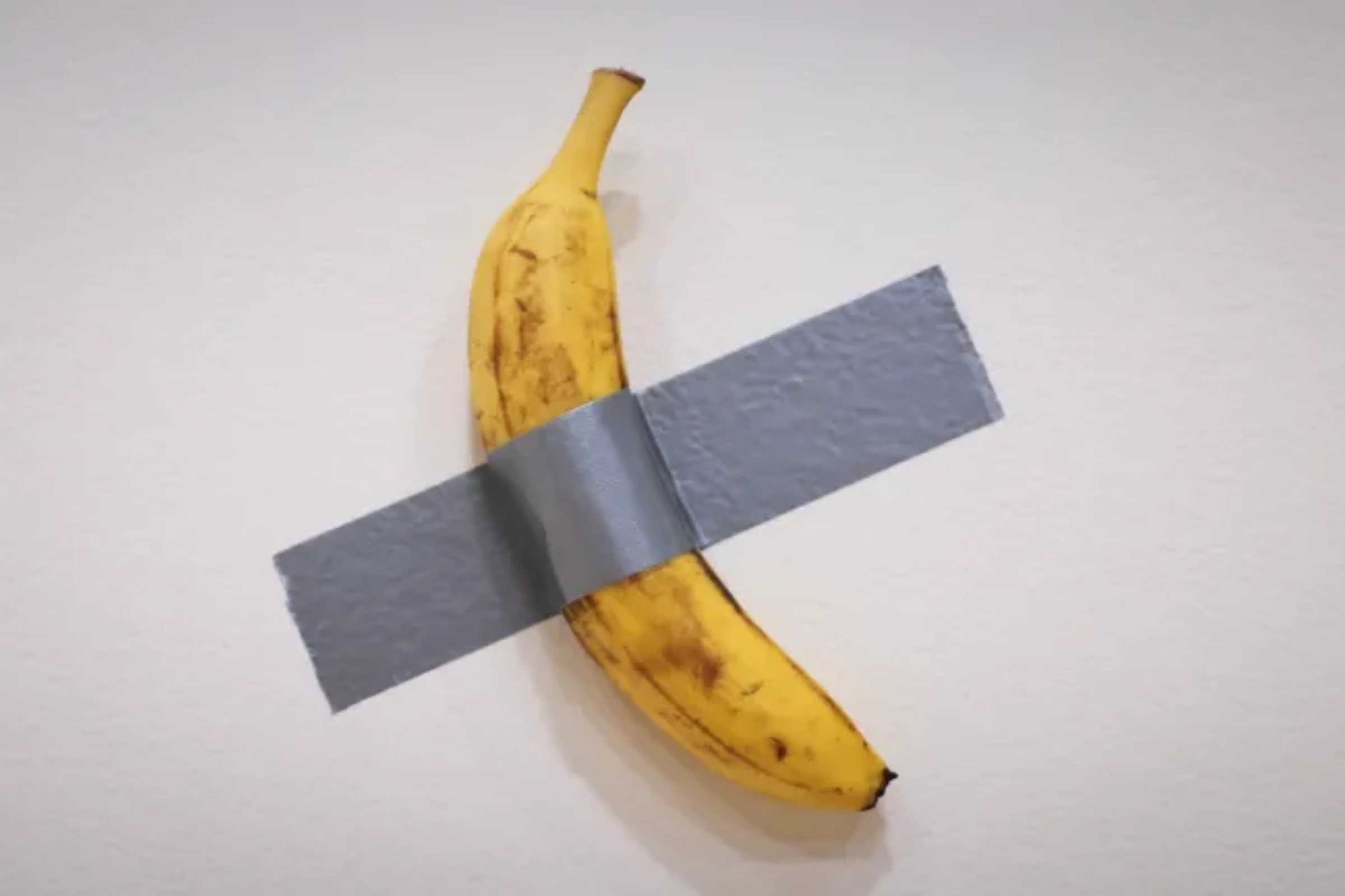
The Eternal Return of the Banana: Cattelan's Comedian
Maurizio Cattelan's infamous duct-taped banana is stolen from the Centre Pompidou-Metz, continuing its history of disruptive behavior.
The art world's most contentious fruit has vanished once again. Maurizio Cattelan's Comedian, the 2019 work consisting of a banana duct-taped to a wall, was stolen from the Centre Pompidou-Metz in France. The theft, which left behind only a mangled strip of duct tape, is the latest chapter in the long and chaotic history of a work that was designed to provoke, but has instead become a recurring target for museum heists and performance art hungry for a punchline.
The Protocol of the Perishable
The theft of the banana is, in the paradoxical world of conceptual art, not a total loss. According to the Pompidou-Metz, the value of Comedian lies not in the physical banana—which is, after all, a piece of fruit that rots—but in the certificate of authenticity and the strict protocol governing its presentation. Cattelan's instructions require the banana to be replaced every three days, meaning the physical object is inherently temporary. The museum stated that "no irreversible damage was observed," which is a polite way of saying that the loss of a piece of produce is an inconvenience, not a tragedy.
However, the theft represents a breach of the institutional sanctuary. The Pompidou-Metz condemned the act, noting that it "undermines the respect due to the works on display." The irony is that Comedian thrives on this lack of respect. From its debut at Art Basel Miami Beach, where it sold for upwards of $120,000, the work has invited disruption. It has been eaten by visitors in 2023 and 2025, and it has been the subject of an endless cycle of outrage and fascination.
This cycle of destruction and replacement transforms the work from a static object into a living event. The museum is no longer just exhibiting a banana; it is exhibiting the public's reaction to the banana. The theft is not an interruption of the art, but the art itself—a continuous loop of provocation, theft, and restoration that mirrors the instability of value in the contemporary market.
The paradox of Comedian is that it only exists in its fullest form when it is being contested. A banana that simply stays on the wall is a boring object; a banana that is stolen or eaten becomes a global news event. In this sense, the theft at Pompidou-Metz is a validation of the work's conceptual strength. The museum, by announcing the theft and then replacing the fruit, is participating in the work's primary function: the demonstration of the absurdity of ownership in the face of the perishable.
The Financial Absurdity of the Concept
The theft also brings back to the forefront the staggering financial disparity between the object and its market value. In 2024, the work sold for $6.2 million at a Sotheby’s auction to crypto-billionaire Justin Sun, who famously ate the banana upon purchase to signal his own mastery over the concept. When a thief steals a banana, they are stealing a few cents' worth of fruit, but they are attacking a multi-million dollar asset. This gap between the material reality of the work and its perceived value is the very point of Cattelan's critique, yet it is also what makes the work a magnet for those looking to puncture the pretension of the high-art market.
The recurring theft and consumption of the work transform Comedian into a living performance. Each time the banana is eaten or stolen, the work is "completed" by the public's reaction. The act of theft becomes part of the work's provenance, adding a layer of folklore to a piece that already mocks the idea of the "masterpiece." The museum's struggle to protect a banana is a perfect metaphor for the absurdity of the contemporary art market, where the most valuable thing in the room is often the thing that is most easily replaced.
This financial theater is particularly potent in the age of the "crypto-asset." The sale to Justin Sun highlights how the work has shifted from a critique of the art market to a trophy for the new digital elite, who view the physical nature of the banana as a joke they are in on. The theft is thus a form of populist rebellion against a value system that prioritizes a certificate of authenticity over the actual physical presence of the work.
The absurdity is further compounded by the insurance and security measures required to protect a perishable fruit. When a museum spends thousands of dollars on security for an object that costs fifty cents at a grocery store, the joke is no longer just on the buyer, but on the institution itself. The security guard's role shifts from protecting a masterpiece to managing a piece of fruit, which is perhaps the most honest commentary on the state of the contemporary museum.
The Institutional Dilemma
The theft creates a tension between the role of the museum as a protector of heritage and the role of the museum as a venue for conceptual provocation. By exhibiting Cattelan, the museum accepts a certain level of risk. The "Endless Sunday" exhibition, curated by Cattelan himself, is designed to be a "living exhibition in perpetual motion," and in that sense, the theft is a natural extension of the show's logic. The banana is gone, the tape remains, and the cycle of replacement continues.
As the art world continues to grapple with the definition of what constitutes a "work of art," Comedian remains the ultimate litmus test. Whether it is stolen, eaten, or simply replaced, the work continues to force a conversation about value, authenticity, and the role of the institution. In the end, the theft at Pompidou-Metz is not a crime so much as it is a recurring performance, a punchline that the art world continues to deliver to itself, one banana at a time.
The persistence of the banana as a cultural meme ensures its longevity. While other conceptual works fade into academic obscurity, Comedian remains relevant because it targets the most basic of human instincts: curiosity and the desire to disrupt. The museum, by continuing to replace the banana, is participating in a grand social experiment, proving that the only way to preserve a conceptual work is to accept its inevitable destruction.
This recurring cycle of loss and restoration mirrors the volatility of the art market itself. Just as the banana is replaced, the market's tastes and valuations are in a constant state of flux. The theft at Pompidou-Metz is a reminder that in the world of high art, the only thing truly permanent is the brand, while the physical object is often just a placeholder for a conceptual trade. The banana, in its perishable nature, is the most honest object in the museum. For those tracking the conceptual movements of the 21st century, Cattelan's work remains the peak of institutional irony.
Finally, the act of stealing the banana can be read as a critique of the very notion of "ownership" in the digital age. In a world where assets are increasingly tokenized and detached from their physical forms, the theft of the physical banana is a crude but effective reminder that materiality still matters. By removing the object, the thief forces the museum to rely entirely on the certificate of authenticity, effectively turning the institution's own logic against it. The theft is not just a crime; it is a critical intervention into the metaphysics of the art market, as discussed in our la previous analysis of corporate museum partnerships.