Carnegie International Tests the Idea of Museum Community
The 59th Carnegie International widens the museum’s civic footprint and gains force by admitting that community inside museums is negotiated, not natural.
The 59th Carnegie International Opens With a More Honest Version of Institutional Warmth
The 59th Carnegie International, titled If the word we, arrives with a proposition that sounds familiar enough to make critics wary: museums should become spaces of listening, collaboration, and community rather than temples of remote expertise. In weaker hands that idea curdles into participatory branding. In Pittsburgh this year, it seems sturdier because the show does not entirely hide the contradictions built into its own ambition. As The Art Newspaper observed, the exhibition is trying to explore sources of connection after the more divisive and sometimes forbidding tone of the 2022 edition. The official Carnegie Museums feature on the project makes the curatorial logic even clearer, emphasizing offsite commissions, community partners, and a wider civic footprint across Pittsburgh. That emphasis could have read as soft focus outreach. Instead it lands as a real structural choice.
The strongest thing about this International may be that it understands a basic institutional fact many exhibitions avoid naming. Museums are not naturally communal. They are expensive, choreographed, labor dependent spaces in which access, interpretation, and comfort are unevenly distributed. The Art Newspaper’s review opens by reminding readers that a general admission ticket represents more than three hours of labor at Pennsylvania’s minimum wage. That detail is not decorative context. It is the pressure system under the whole exhibition. A show about "we" cannot pretend the museum is already a democratic commons. It has to stage connection under compromised conditions. The curators seem to know that, which is why the exhibition’s best moves involve carrying the project beyond the museum walls rather than simply declaring the institution newly porous.
Why the Offsite Structure Matters More Than the Slogan
Liz Park, Ryan Inouye, and Danielle A. Jackson are not the first curators to talk about listening. What gives If the word we more bite is the decision to anchor that rhetoric in collaborations with places that already possess their own publics, rhythms, and forms of expertise. Carnegie Museums’ own material describes commissions and presentations developed with the Children’s Museum of Pittsburgh, the Mattress Factory, Kamin Science Center, and the Thelma Lovette YMCA. Those partnerships are not just clever audience development. They are an admission that a museum seeking relevance cannot keep acting as though all legitimate cultural experience must be processed through its central building first.
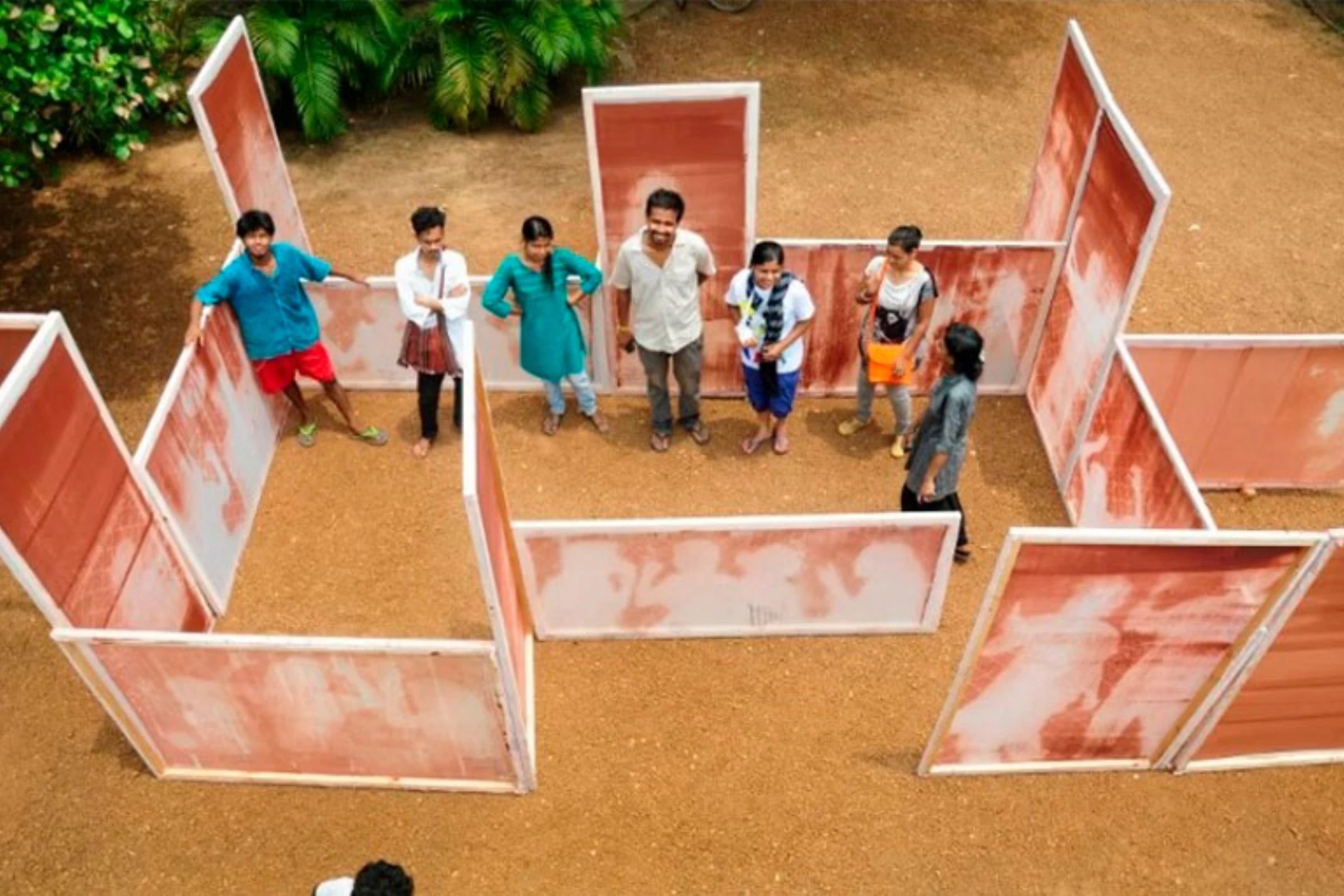
Sanchayan Ghosh’s project at the Children’s Museum is an instructive example. According to the Carnegie feature, his installation grew directly out of the former post office facade, Tagore’s play The Post Office, and workshops with local families whose shadow cast images become part of the work. That is not collaboration as decorative captioning. It is collaboration embedded in form, process, and siting. Likewise, Torkwase Dyson’s planetarium based project at Kamin uses the specific capacities of the Buhl Planetarium to make otherwise invisible underwater extraction infrastructures apprehensible. In both cases, the partner site is not a neutral container. It changes what the art can do. That is a stronger model than the museum simply borrowing the moral prestige of community language while keeping the exhibition physically and conceptually self enclosed.
The same holds for the Mattress Factory presentations by Arturo Kameya and Claudia Martínez Garay, which The Art Newspaper singles out as among the offsite program’s strongest moments. There is a practical intelligence here. The Carnegie International has long carried prestige as North America’s oldest recurring exhibition of international art, but prestige alone can flatten a city into backdrop. By stretching into institutions with distinct audiences and spatial habits, the 2026 edition turns Pittsburgh from host city into active medium. That does not solve every contradiction. It does, however, make the curatorial claim legible in a way too many socially inflected biennials fail to achieve.
The Exhibition’s Tension Is Its Best Subject
What makes the show worth taking seriously is not that it proves museums can become community spaces with sufficient goodwill. It is that the exhibition seems to understand the trade offs involved. The Art Newspaper’s reviewer puts this sharply when describing Georges Adéagbo’s assemblage built from thrifted Pittsburgh objects, sports ephemera, and local references. Museums, the review argues, cannot always serve equally as bastions of high culture and accessible community rooms. That tension is not a flaw in the review. It is the exhibition’s central material. Community and collaboration sound generous, but within museums they always raise the question of what gets simplified, translated, or surrendered in order to widen entry points.
The good news is that If the word we does not appear to answer that tension with anti intellectual flattening. The exhibition still traffics in scale, installation complexity, and transnational conversation. It simply stages those things alongside works and settings that ask how viewers inhabit space together. Shala Miller’s sloped viewing environment, Jasleen Kaur’s light filled carpeted room, and the large collaborative weaving by Silät all suggest an exhibition more interested in duration, bodily presence, and shared attention than in confrontation for its own sake. That may frustrate visitors who want the International to shock harder. It may also be exactly right for a moment when museums are being asked to justify not only what they show, but how they host people.
There is still room to push. The Art Newspaper critic notes that the 2026 edition can feel less visceral than the 2022 Carnegie International, whose harshness sometimes generated more risk. That criticism should not be brushed aside. A community oriented exhibition can become too polite, too comfortable with atmosphere, too reluctant to wound or estrange. The question is whether this International has traded difficulty for hospitality or simply relocated difficulty into institutional self examination. On the evidence so far, it leans toward the second. The exhibition keeps asking whether an institution built on hierarchy can convincingly perform collectivity without lying to itself. That is a harder problem than producing another room of transgressive images.
That question reaches beyond one exhibition cycle. Museums across North America are now trying to prove they can be useful civic actors without surrendering curatorial seriousness or turning every program into a service language exercise. Pittsburgh is not alone in that problem, but the Carnegie International is unusual in making the tension visible instead of pretending it has been solved. That honesty gives the show a sturdier backbone. It also raises the stakes, because once an institution admits its own limits, viewers are entitled to ask how much structural change follows the rhetoric.
What This International Says About Museums in 2026
The 59th Carnegie International is also interesting because it arrives in a wider season of museums trying to renegotiate their public role. Some are expanding physically. Some are rebranding access. Some are entering strategic foreign partnerships. Some are absorbing labor disputes and political pressure while continuing to speak the language of openness. In that context, Pittsburgh’s approach feels less slick than many of its peers. It is not promising that the museum has become pure civic virtue. It is testing whether a major exhibition can distribute attention outward without dissolving into outreach theater. That makes it more convincing than plenty of larger, richer institutions whose public language has become frictionless.
There is also a useful contrast with the usual biennial circuit. Many recurring international exhibitions now rely on a standardized moral vocabulary of care, plurality, dialogue, and repair. Too often the result is a flattening sameness in which every curatorial statement sounds ethically serious and aesthetically interchangeable. The Carnegie International has the advantage of a longer local history and a less migratory identity. It can ask what "international" means in relation to one city, one museum ecology, and a recurring burden of self justification. That helps the 2026 edition avoid some of the generic planetary language that weakens so many global surveys. For readers who have been watching the year’s exhibition cycle, including artworld.today’s coverage of the Whitney Biennial’s opening mood, the Carnegie feels more willing to let local conditions sharpen the thesis.
What to Watch as the Show Settles In
The decisive test will be whether the International’s civic rhetoric survives contact with ordinary visitors rather than opening week discourse. Do offsite partners feel genuinely amplified, or merely annexed into the Carnegie orbit? Do local audiences experience these projects as invitations into contemporary art’s arguments, or as one more round of temporary programming that flatters institutions more than publics? Does the museum meaningfully account for labor, access, and affordability beyond curatorial framing? These are not cynical questions. They are the right ones for any exhibition that uses collectivity as both theme and method.
At its best, If the word we seems to know that community is not produced by slogans, beanbags, or wall text about care. It is produced, if at all, through negotiated forms of attention, friction, translation, and time. That understanding gives the 59th Carnegie International a seriousness that many more loudly political exhibitions lack. It may not be the season’s most brutal show. It may not produce the cleanest canon of masterpieces either. But it is asking a sharper question than most: how can a museum become more social without pretending it has ceased to be a museum? In 2026, that is not a side issue. It is the whole problem.