Billie Holiday Monument Finalists Put Queens Memory on the Line
Six finalists for a Queens Billie Holiday monument show how public art competitions turn memory, representation, and civic process into one fight over form.
Queens Is Not Choosing a Statue, It Is Choosing a Version of Billie Holiday
The six finalist proposals for a Billie Holiday monument in Queens make one thing unusually visible: public memorials are never just about likeness. They are arguments about what part of a life deserves permanence, what kind of image a city can live with, and what tone civic memory should take when the subject is both mythic and painfully historical. As Artnet reports, the New York City Department of Cultural Affairs released six proposals on 19 May and opened a public comment period running through the end of the month. The site sits outside the Jamaica Performing Arts Center, in a borough where Holiday lived and performed in the 1950s. That practical detail matters because this is not a generic celebrity tribute. Queens is trying to claim a relationship to Holiday that is geographically specific and culturally durable.
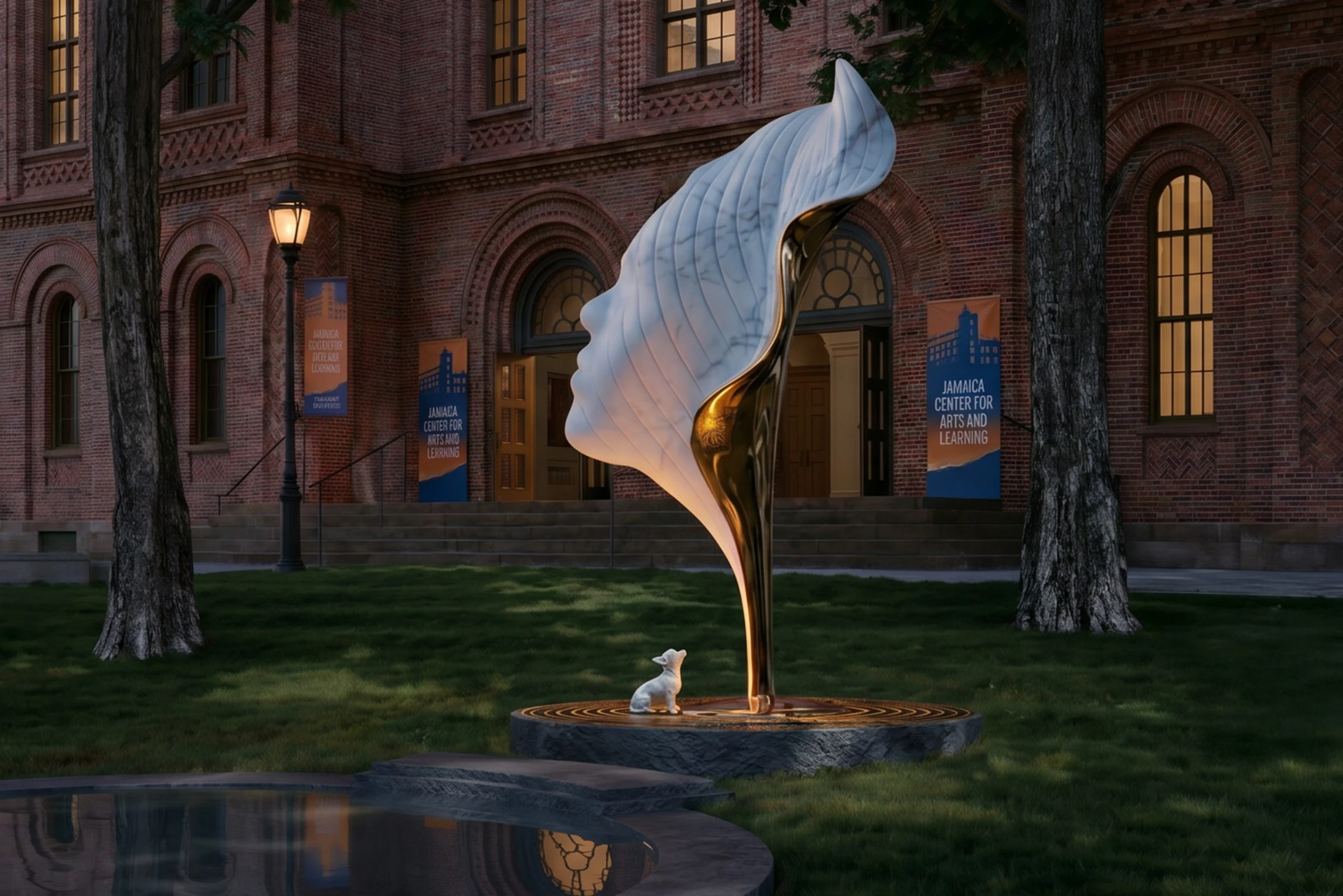
The finalists do not agree on how to picture that claim. Nekisha Durrett offers a monumental marble profile with a gold underside and a small sculpture of Holiday's dog, Pepe, at its base. Nikesha Breeze proposes a more conventional performing figure crowned with gardenias, while Tavares Strachan strips the body away almost entirely and turns Holiday into a vessel-like silhouette, a container for memory instead of an illustrated legend. Thomas J. Price avoids the diva pose and leans into private feeling, translating a photograph of Holiday with a dog into two abstracted bronze forms. La Vaughn Belle and Tanda Francis each take still other routes, treating repose, reflection, and the afterlife of "Strange Fruit" as formal problems. The range is healthy because Holiday's legacy is too layered for one easy civic image.
The Competition Format Reveals What City Cultural Policy Wants From Public Art
The project is funded through New York's Percent for Art program, the long running policy that reserves one percent of eligible city construction budgets for public artworks. That framework sounds administrative, but it shapes the monument before any jury picks a winner. Percent for Art commissions are expected to satisfy many publics at once: arts administrators, elected officials, neighborhood stakeholders, historians, and the wider symbolic economy of the city. In that setting, the release of multiple proposals is more than a transparency gesture. It is part consultation, part risk management, and part pedagogical theater. The city is not only asking which design people prefer. It is teaching viewers how contested commemoration now has to be.
That is a sharp contrast with the old heroic monument model, where authorities selected a subject, hired a sculptor, and delivered an approved likeness to the public as a settled fact. Contemporary memorial culture is far less confident. Cities know that representational decisions can ignite arguments about race, sentimentality, historical simplification, and whose grief or pride gets centered. Holiday brings all of those pressures with her. She was a jazz icon, a Black woman artist navigating exploitation, a performer whose career cannot be separated from structural racism, and the voice most identified with one of the twentieth century's fiercest anti lynching songs. Any monument that makes her feel merely decorative will fail on contact. Any monument that reduces her to trauma will flatten a life that also contained wit, glamour, erotic intelligence, and formal daring.
The finalists therefore double as a diagnosis of what public art commissions now reward. Some proposals favor legibility, betting that civic recognition still depends on a body the public can instantly identify. Others trust abstraction, suggesting that an honest monument may need to leave room for projection, uncertainty, and unfinished memory. Neither side is automatically right. But the split tells you that memorial practice has shifted from producing consensus images to managing plural readings. For a city agency, that is both a cultural ambition and a bureaucratic survival strategy.
Each Proposal Is Really a Theory of How Public Memory Should Look
Look closely and the proposals sort themselves into distinct philosophies of monument making. Breeze and Francis accept that civic sculpture still needs a body, face, and a degree of representational immediacy. Durrett and Belle work closer to metaphor, staging Holiday as profile, pause, and environment instead of only star power. Price moves toward intimate abstraction, while Strachan risks the least literal approach of all by treating absence as a form of presence. That mix should matter to anyone who cares about public art beyond headline politics. Cities often talk as if the debate is simply realism versus abstraction, but the sharper question is how a work asks viewers to remember. Some monuments instruct. Others invite. The strongest ones do both, giving a passerby enough form to enter the work while withholding enough certainty that memory remains active rather than prepackaged.
This is why the supporting materials around a commission matter almost as much as the sculpture itself. The city should publish the finalists clearly, maintain the public feedback archive, and make the panel's reasoning legible once a choice is made. A transparent process would help residents see that public art is not a taste contest but a decision about civic language. New York has already built a useful framework for that conversation through Percent for Art and the city's broader Department of Cultural Affairs programming. This monument could extend that work if the city resists the temptation to reduce public response to a soft engagement metric.
Holiday's Image Has Always Been Politically Charged
Billie Holiday is not an easy subject because her public image was always overdetermined. The flower in her hair, the late night phrasing, the haunted glamour, the autobiographical myth, the state harassment, the songbook, the body in photographs: each element has been circulated so widely that any monument risks repeating a ready made icon rather than rebuilding a relationship to the person. The best proposals seem to understand that. Durrett's profile, with its gold interior and watchful dog, moves away from concert-poster literalism and toward a more oblique intimacy. Strachan's hollow silhouette refuses the temptation to overdescribe. Price searches for authentic joy rather than canonical suffering. These are not evasions. They are acknowledgments that Holiday has been looked at too much and understood too little.
The politics of that looking are inseparable from where the monument lands. Queens has spent years expanding the range of figures it memorializes, especially through commissions that treat public space as a correction to older exclusionary canons. In that context, Holiday's presence outside a performing arts center is not simply honorary. It reasserts Black cultural history inside the everyday choreography of the borough. Visitors, residents, and students will encounter the work not in a museum but in passing, which means the monument must function at the speed of ordinary life while still holding depth for those who stop. That is a hard brief. A weak design turns into background scenery. A strong one changes the emotional weather of a plaza.
There is also a specifically musical problem. Holiday's greatness happened in time, breath, and phrasing. Sculpture freezes. Memorials like this one are therefore always translating one medium into another. Breeze chooses the performance image. Strachan and Price move further from literal song and closer to mood, relation, and residue. The city should resist the assumption that recognizability is the same thing as fidelity. Holiday's voice unsettled listeners because of what it did with delay, fracture, and emotional compression. A monument that captures some of that instability may honor her more truthfully than a polished figurative likeness ever could.
What the Jury Chooses Will Signal How Bold New York Wants Its Memory Politics to Be
The public comment window closes at the end of May, after which the selection panel will choose a final design later this year. The formal decision will belong to the panel, but the broader meaning will travel well beyond this site. If New York selects the safest, most literal option, it will suggest that civic commemoration still defaults to reassurance even when the subject demands more complexity. If it chooses a riskier proposal, especially one that trusts metaphor or emotional indirection, the city will be saying that public memory can ask viewers to work a little harder. That would be a stronger and rarer claim.
There are practical stakes too. Monument competitions often promise community participation, then treat public feedback as decorative. The city should be clear about how comments are weighted, what criteria govern the final choice, and how maintenance, interpretation, and site design will support the sculpture after installation. Public art fails not only through bad concepts but through weak aftercare. A thoughtful monument can still die if the lighting is wrong, the surrounding space is indifferent, or the interpretive material reduces the work to a bland plaque summary.
Holiday deserves more than that. She deserves a monument that understands she was not important because she can symbolize resilience in the abstract. She was important because she altered American sound while carrying the violence of American history in her phrasing without letting it exhaust the totality of her art. Queens now has the chance to make that difficulty public. The strongest of these proposals grasp that a civic tribute should not tidy Billie Holiday up. It should let the city live beside a version of her that remains unresolved, elegant, and impossible to neutralize.