British Museum’s Bayeux Display Becomes a Power Statement
The British Museum's plan to show the Bayeux Tapestry flat turns exhibition design into a bid to control the meaning of a contested masterpiece
The British Museum Wants the Bayeux Tapestry to Read Differently
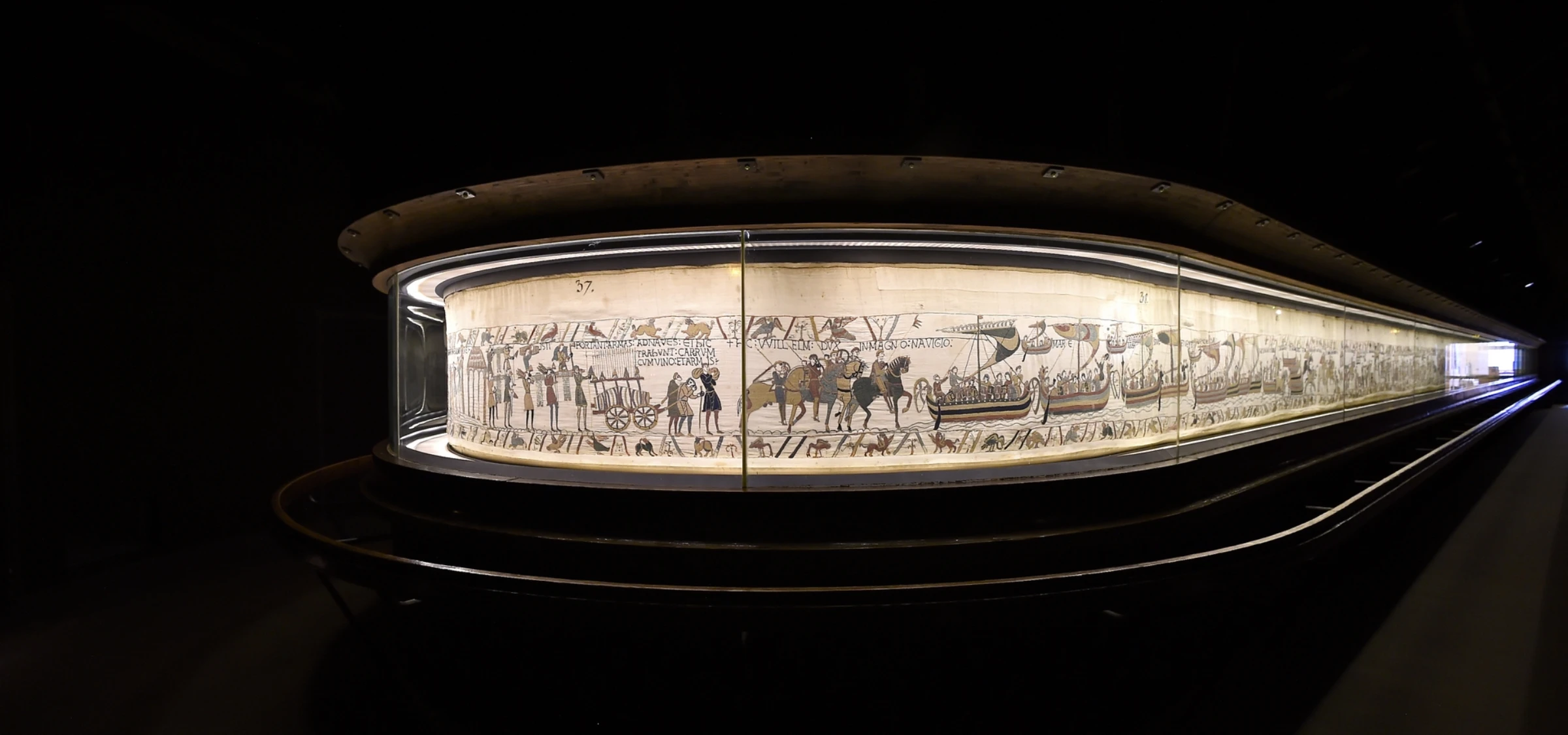
The British Museum has revealed how it plans to display the Bayeux Tapestry when the nearly thousand year old work goes on view in London this September, and the design decision is more consequential than it first sounds. As Artnet reports, the museum will present the 230 foot embroidery laid flat in a bespoke case rather than vertically in the format most contemporary audiences know from Normandy. That single shift changes the work from a familiar monument into a sequence, almost a strip of evidence. It turns spectators from reverent viewers into readers moving across an argument scene by scene.
The official Bayeux Museum page frames the object through its history, survival, and extraordinary narrative density, emphasizing both its fragility and its political scale. The British Museum's plan does not challenge that reading so much as intensify it. A flat display insists on continuity. It asks visitors to take in the full sweep rather than treat the object as a single iconic relic. For an artwork that documents conquest, legitimacy, and contested memory, the museum is effectively choosing a political grammar: sequence over shrine, story over aura.
That matters because this loan was never going to be a neutral exhibition event. The tapestry carries national symbolism for both Britain and France, UNESCO weight, centuries of historiographic argument, and the ordinary museum politics of prestige. Any institution that gets to host it is not simply borrowing an object. It is temporarily borrowing authority. By unveiling a display concept early, the British Museum is telling the public that it intends to shape interpretation, not just provide secure walls.
Why Showing It Flat Is More Than a Conservation Choice
Most coverage will naturally dwell on the novelty of laying the tapestry flat. That is justified. The source report notes that the work was long stored rolled up and, since 1983, has been shown vertically in a vitrine at the Bayeux Museum. To present it horizontally now is to promise a different bodily relation to the object. Visitors will move along it more like they move through a manuscript, a frieze, or even a filmic timeline. The museum's planned digital interpretive elements should reinforce that reading by isolating episodes, motifs, and causal links across the 58 scenes.
But conservation is only part of the equation. The more interesting question is why this display format is so persuasive right now. Museums in the 2020s and 2030s increasingly favor interpretation that looks analytical, panoramic, and systems minded. The Bayeux Tapestry suits that instinct perfectly. It is an image sequence about political decision making, military logistics, oath keeping, and narrative manipulation. Presenting it flat makes it legible as a chain of consequences. That is intellectually rich, but it is also a curatorial act of framing. The museum is nudging the object away from pilgrimage and toward strategic reading.
The support language quoted in the source article makes this explicit in unexpectedly financial terms. Igor Tulchinsky praises the tapestry's chronology, causality, and decisions made under uncertainty. That is a striking vocabulary for a medieval embroidery, and it shows how contemporary patrons and institutions alike want the object to function as more than heritage spectacle. They want it to look relevant to modern forms of analysis. Museums regularly do this with old master painting and archaeology. Here the move will be especially visible because the display architecture itself advances the claim.
Other loans will help the museum widen the frame. Artnet notes that the Bodleian Libraries' Junius manuscript, silver coins from the Chew Valley Hoard, and other documents of Norman rule will accompany the tapestry. That is smart curating. It positions the embroidery not as a lone marvel but as one record within a broader field of visual and political evidence. The danger is that supporting material can also naturalize the host institution's authority. The more coherent the exhibition appears, the easier it is to forget that this is a temporary assembly built around a highly charged loan.
The Loan Also Serves the British Museum's Own Institutional Story
The British Museum is exceptionally practiced at using large scale historical objects to restate its relevance. That does not mean the Bayeux project is cynical. It means the institution understands that blockbuster loans can do strategic work beyond attendance. They allow the museum to perform scholarship, diplomacy, and logistical mastery at once. In a climate where encyclopedic museums face constant questions about repatriation, trust, and imperial inheritance, staging a major international loan around one of Europe's defining historical objects is a way of asserting continued centrality.
Nothing in the available reporting suggests impropriety in the arrangement. The issue is symbolic. The museum gets to present itself as a place where fragile transnational history can be gathered, protected, and interpreted for a global audience. That is the most flattering version of its own mission. It is also a claim that lands differently in an era when museums are asked to justify the terms under which they hold and narrate the past. The Bayeux Tapestry is not a restitution case in the same register as looted antiquities, but the politics of custodianship still hover over it.
The exhibition timing helps too. Tickets will be limited, priced between £25 and £33, and structured in 40 minute visits. That creates scarcity, revenue, and urgency all at once. A museum can call that responsible crowd management and still be participating in the premium event logic that now defines so much major exhibition making. Readers should see the contradiction clearly. The show is being framed as public access to a once in centuries loan, yet the experience will also be tightly rationed and monetized. The British Museum knows the Bayeux name can bear that pressure.
There is another institutional benefit in the exhibition's outdoor and digital components. The planned landscape installation and interpretive media let the museum stretch the event across environments, making the tapestry less of a single object encounter and more of a branded historical experience. Again, this is not illegitimate. It is simply the contemporary blockbuster template applied to an object whose gravity can make the template feel nobler than it really is.
What Visitors Should Watch For When the Show Opens
The strongest version of this exhibition will make the tapestry stranger, not just grander. It should help visitors notice ambiguity, omission, and visual rhetoric rather than presenting the object as transparent documentary truth. Curator Michael Lewis appears to be pointing in that direction when he describes the embroidery as a deliberately ambiguous retelling of events. That is the right emphasis. The Bayeux Tapestry has always been valuable not because it settles the story of 1066, but because it stages power through images while leaving motive and interpretation in motion.
Visitors should therefore pay close attention to how the interpretive materials handle authorship, patronage, and perspective. Do they treat the work as a straightforward Norman account, an Anglo Norman negotiation, a devotional object, a political instrument, or some unstable mixture of all four? Do the surrounding loans deepen uncertainty or close it down? Does the flat presentation open up the work's narrative logic, or does it over engineer the reading into a neat lesson about causality? Those are not academic niceties. They determine whether the show respects the object's complexity.
There is also the question of afterlife. A loan of this scale should leave more behind than high ticket demand and handsome installation photography. It should generate scholarship, digital access, and a thicker public understanding of why the tapestry has remained such a live object of argument. If the British Museum can deliver that, the display will deserve its prestige. If not, the exhibition risks functioning mainly as a triumph of venue power. The Bayeux Tapestry can carry almost any institutional ambition placed around it. The burden is on the host museum to prove that its chosen frame expands meaning instead of merely concentrating attention.
One additional pressure point deserves attention before the show opens: by flattening the tapestry into an extended field of reading, the museum is also flattening centuries of reverential distance. That could be liberating for visitors who have only known the object as a national icon glimpsed through thick institutional framing. It could also expose just how aggressively museums mediate so called direct encounters with history. If the installation makes people aware of that mediation rather than hiding it, then the British Museum will have done something smarter than stage a blockbuster. It will have made the politics of display visible inside the display itself.
For now, one thing is already clear. By deciding to show the tapestry flat, the British Museum has made a curatorial claim before the first ticket goes on sale. It wants the public to encounter the work as unfolding thought, not static emblem. That is an intelligent wager. It is also a reminder that blockbuster design is never just logistics. It is interpretation with architecture doing the talking. artworld.today has already tracked how museum infrastructure debates shape meaning in other settings, including our guide to reading museum expansion announcements. The Bayeux show is a related case, except here the architecture of display is the argument itself.