Antonello da Messina Masterpieces Stolen from Sicily Museum
Four 15th-century works by Antonello da Messina stolen from a Sicilian museum during a religious festival in Italy's boldest art heist
What Happened
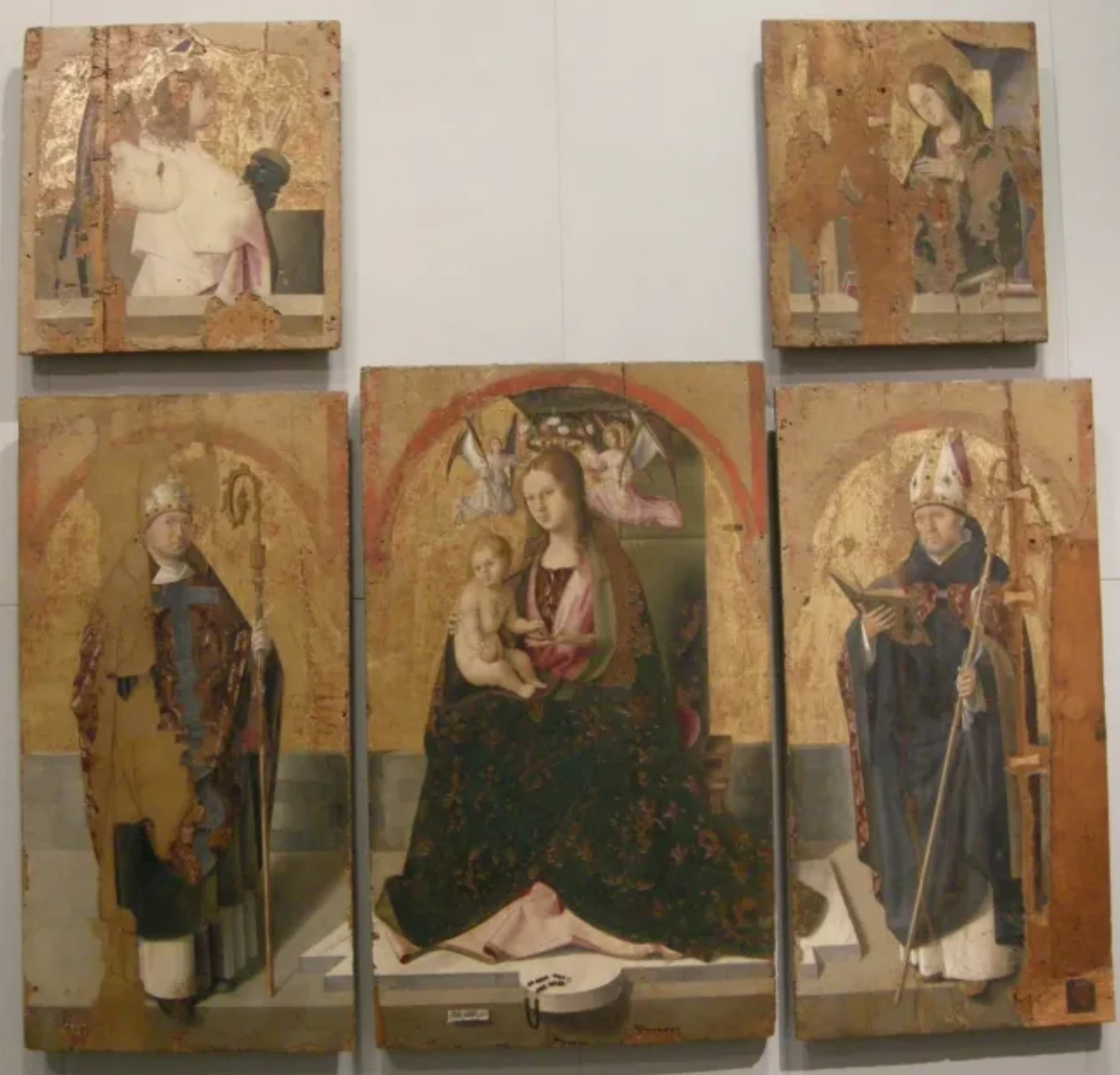
Four works by the 15th-century Renaissance painter Antonello da Messina were stolen from the Museo Regionale di Messina (MuMe) on August 15, during the Feast of the Assumption, one of Sicily's most important religious holidays. The thieves exploited the city's attention on La Vara, a massive religious procession that draws crowds into the streets of Messina each year, to break into the museum and smash glass display cases holding some of the most significant artworks in the Italian Renaissance canon.
The stolen works include three panels from the Polittico di San Gregorio, a five-panel altarpiece that is the only work by Antonello never to have left his hometown. A fourth work, a small double-sided painting depicting the Virgin and Child on one side and Christ on the other, was also taken. That painting had been purchased by the Sicilian regional government from Christie's in 2003, the year it was formally attributed to Antonello. Two additional panels were initially stolen but inexplicably abandoned on a low wall outside the museum, where passersby discovered them.
Experts have estimated the value of the stolen works at between $81 million and $92 million, placing the heist among the most valuable art thefts in European history. Italian police recovered three paintings by Renoir, Cezanne, and Matisse stolen from the Magnani Rocca Foundation near Parma just one day before the Messina theft, making this an extraordinarily turbulent week for Italian cultural heritage protection. The proximity of these two events has drawn sharp attention to the vulnerability of Italy's distributed network of regional museums, many of which house works of global significance with security budgets that would be considered inadequate for a private gallery in a major American city.
The Significance of Antonello da Messina
Antonello da Messina, born around 1430 in Sicily, is widely credited with changing the course of Renaissance art by introducing Flemish oil-painting techniques to Italy. He trained in Naples, where he studied the works of Provencal and Flemish artists, whose influence is visible in his extraordinary attention to detail, subtle glazing, and the soft luminosity that became hallmarks of his style. Even on very small panels, Antonello achieved remarkable precision and depth, qualities that distinguished him from his Italian contemporaries who were still working primarily in tempera. His portraiture, in particular, conveyed a psychological immediacy that was without precedent in 15th-century Italian painting, and his influence can be traced through the work of Giovanni Bellini, Giorgione, and the broader Venetian school that would define the next century of Italian art.
The Polittico di San Gregorio was originally composed of six panels created for the Monastero di San Gregorio in Messina. The monastery was destroyed in the catastrophic 1908 Messina earthquake, a 7.1-magnitude disaster that killed half the city's population and leveled much of the city, including homes, churches, monuments, and countless historical documents. The survival of the Polittico panels through that catastrophe makes their theft now all the more devastating. As Valentina Certo, an art historian at the University of Messina and author of the illustrated children's book The Workshop of Antonello da Messina, told Artforum: "These were works that had survived the earthquake, destruction and five centuries of history. To see them taken from the public in this way makes the loss impossible to measure in purely economic terms."
Antonello's influence on Italian art was profound. His mastery of oil paint, learned from Flemish predecessors, allowed for a depth of color and psychological intensity that Italian painters had not previously achieved. His portraits, in particular, are considered among the most penetrating of the 15th century. In February 2026, the Italian government purchased a rare Antonello masterpiece, his Ecce Homo, at Sotheby's for $14.9 million, underscoring the national cultural priority placed on his work. The fact that the Italian state was willing to spend nearly $15 million on a single Antonello painting just six months before thieves walked away with three panels of his most important altarpiece adds a bitter irony to the loss.
How the Theft Unfolded
According to MuMe director Marisa Mercurio, the museum's security systems were triggered when the thieves smashed the glass display cases protecting the paintings. Surveillance footage shows the burglars inside the museum for less than three minutes, suggesting a highly coordinated operation with prior knowledge of the museum's layout. Despite the alarms, initial reports of the robbery came not from museum staff but from local passersby who saw the fleeing burglars. This detail alone raises serious questions about the effectiveness of the museum's alarm response protocols. If an alarm is triggered but no one responds in time to prevent the theft, the alarm functions more as a notification system than a security measure.
The speed and precision of the heist have raised questions about whether the thieves had inside knowledge of the museum's layout and security protocols. Police sources told the state news agency Ansa that investigators are examining several lines of inquiry, including whether the paintings were stolen on commission for a specific art dealer. The possibility that the theft was carried out to fulfill a private collector's order is being taken seriously, given the difficulty of selling works of such recognized provenance on the open market. Stolen works of this prominence are virtually unsellable through legitimate channels, which means they typically disappear into private collections, sometimes for decades, before resurfacing if they resurface at all.
Prosecutors in Messina have opened a formal investigation. The museum was fitted with multiple surveillance cameras and what was described as a sophisticated alarm system, but the thieves managed to bypass or overwhelm these protections during the brief window of the heist. The fact that the theft occurred during La Vara, when the city's attention and police resources were focused on the religious procession, suggests careful planning and timing that took advantage of the one night when the museum's surroundings would be least monitored.
What Comes Next for Italian Heritage Protection
The theft has sparked outrage and fear about the state of Italian heritage protection. Italian art historian Michele Dantini compared the Messina heist to the infamous 1969 theft of Caravaggio's Nativity with St. Francis and St. Lawrence from a church in Palermo, a crime that remains unsolved and is considered one of the greatest art thefts in history. Dantini wrote in a blog post that Italy's artistic heritage is irresponsibly managed and called for reallocating a portion of defense spending toward upgrading museum security systems and supporting ongoing maintenance and restoration of the country's cultural patrimony.
The comparison to the Caravaggio theft is not merely rhetorical. Both cases involve works of singular importance to their respective cities, stolen under circumstances that exposed weaknesses in security protocols. The Caravaggio was taken from a small church in Palermo with minimal protection. The Antonello works were taken from a regional museum with what was described as a sophisticated alarm system. In both cases, the cultural significance of the works far exceeds their monetary value, though the monetary value in Messina is staggering. The stolen Antonello panels represent three of the five surviving panels of the Polittico di San Gregorio, meaning the altarpiece has been largely destroyed as a coherent work.
Italy's Minister of Culture, Alessandro Giuli, released a statement describing the stolen works as being of extraordinary value for Italian cultural heritage and expressing dismay and regret. The timing of the theft, coming just one day after Italian police recovered three stolen French masterworks near Parma, has intensified scrutiny of museum security protocols across the country. The contrast between the successful recovery in the north and the devastating new theft in the south highlights the uneven state of heritage protection across Italian regions, with better-funded northern institutions generally maintaining stronger security than their southern counterparts.
The stolen works represent an irreplaceable loss for Messina, a city that has rebuilt itself repeatedly from catastrophe. The Polittico di San Gregorio survived the 1908 earthquake, two world wars, and five centuries of history. Its panels were a point of civic pride and a tangible connection to one of Messina's most famous sons. As the investigation continues, the art world will be watching closely to see whether Italian authorities can recover these works as quickly as they did the Renoir, Cezanne, and Matisse stolen from Parma. The precedent is encouraging, but the stakes in Messina are arguably higher, given the singular importance of Antonello da Messina to the history of Renaissance art and the deep cultural identity his work represents for Sicily.
The Messina theft also raises difficult questions about the market for stolen art. Unlike the works recovered from Parma, which were by French Impressionist painters with a well-documented market history, the Antonello panels are sufficiently rare and distinctive that any attempt to sell them through auction houses or dealers would immediately trigger alarm. This has led investigators to consider the possibility that the theft was commissioned by a collector who intends to keep the works privately, perhaps for decades. If that is the case, recovery will depend on intelligence work rather than market surveillance, and the panels may not resurface for years.