Guide to Visiting Land Art Destinations Across the American West
From Heizer's City to Smithson's Spiral Jetty, a practical guide to planning visits to the most significant land art sites in the United States
Why Land Art Demands a Visit
Land art, or earth art, emerged in the late 1960s as artists rejected the confines of gallery walls and sought to create works directly in the landscape. The movement produced some of the most ambitious and physically imposing artworks of the 20th century, carved into deserts, built across valleys, and embedded in remote terrain. These works cannot be fully understood through photographs alone. Their scale, their relationship to light and weather, and their isolation from urban centers are all essential to the experience that the artists intended.
The American West became the primary canvas for this movement, with artists drawn to its vast open spaces, stark geological features, and sparse population. Today, these sites draw thousands of visitors each year, from art enthusiasts to hikers to those simply curious about seeing something built at the edge of what seems possible. Planning a trip requires patience, preparation, and an understanding that these works were never designed for casual tourism. The journey itself, often involving hours of driving through empty landscapes, is part of what the artists intended visitors to experience.
Michael Heizer's City (Nevada)
Heizer's City is perhaps the most ambitious land art project ever undertaken. Begun in 1970 and completed in 2022, the sculpture stretches 1.5 miles through the Nevada desert and took over fifty years to finish. It is one of the largest works of art in the world, inspired by Mesoamerican architecture and built from earth, concrete, and stone. The work's scale is difficult to convey in words or images, which is precisely the point.
Visiting City is an exercise in commitment. The site is located in the remote Garden Valley, roughly three hours north of Las Vegas. Visits are limited to six people per day, cost $150 per person, and last approximately three hours. Reservations open seasonally through the Triple Aught Foundation website and tend to sell out within hours. Visitors must arrange their own transportation on dirt roads that require high-clearance vehicles, and cell service is nonexistent in the area. The reward is an experience of scale, silence, and isolation that no museum can replicate. Bring water, food, and a full tank of fuel, and check road conditions before departure, as rain can make the dirt roads impassable.
For those unable to secure a visit, digital artist Lily Belmira recently created a free video game that recreates the City environment using LIDAR data and satellite imagery. While not a substitute for the physical experience, it offers a sense of the work's scale and geometry that photographs cannot convey. The game is available for free download and runs on most computers, making it the most accessible way to engage with Heizer's monumental work.
Robert Smithson's Spiral Jetty (Utah)
Smithson's Spiral Jetty, built in 1970, is the most famous land art work in the United States and the most accessible of the major earthworks. Located on the northeastern shore of the Great Salt Lake, the 1,500-foot coil of black basalt rocks extends into the rust-colored water, changing appearance with the lake's water level, which has submerged and re-exposed the work multiple times since its construction. The color of the water, influenced by microorganisms and salt concentrations, shifts between deep red, pink, and orange depending on the season and water level.
The Dia Art Foundation maintains the site, which is free to visit and requires no reservation. The drive from Salt Lake City takes approximately two hours on paved roads, with the final stretch on a gravel road that can become impassable after rain. There are no facilities at the site, so visitors should bring water, food, and sunscreen. The best times to visit are spring and fall, when temperatures are moderate and the lake level is typically low enough to expose the jetty. Summer visits are possible but brutally hot, and winter access depends on snow conditions. Check the Dia Art Foundation website for current water levels before making the drive.
Walter De Maria's Lightning Field (New Mexico)
The Lightning Field, installed in 1977, consists of 400 polished stainless steel poles arranged in a grid measuring one mile by one kilometer in the high desert of western New Mexico. The poles, each pointing to the same height above sea level, create a plane that interacts with the sky, the land, and weather in ways that change by the minute. Despite its name, the work is not primarily about lightning strikes, which are rare, but about the experience of light, space, and time in an isolated landscape that most people would never otherwise visit.
Visiting the Lightning Field requires a reservation through the Dia Art Foundation, which opens bookings in February for the season running from May through October. The fee includes overnight accommodation in a rustic cabin at the site, as visitors are expected to spend a full 24 hours experiencing the work in changing light. The cabin accommodates a limited number of guests, and reservations are competitive, often selling out within days. Transportation from the nearest town of Quemado is provided by Dia, and visitors are asked not to photograph the work for publication, preserving the primacy of the direct experience. The overnight stay transforms a gallery visit into something closer to a retreat, with the desert sky and the grid of poles as the only entertainment.
Donald Judd's Marfa (Texas)
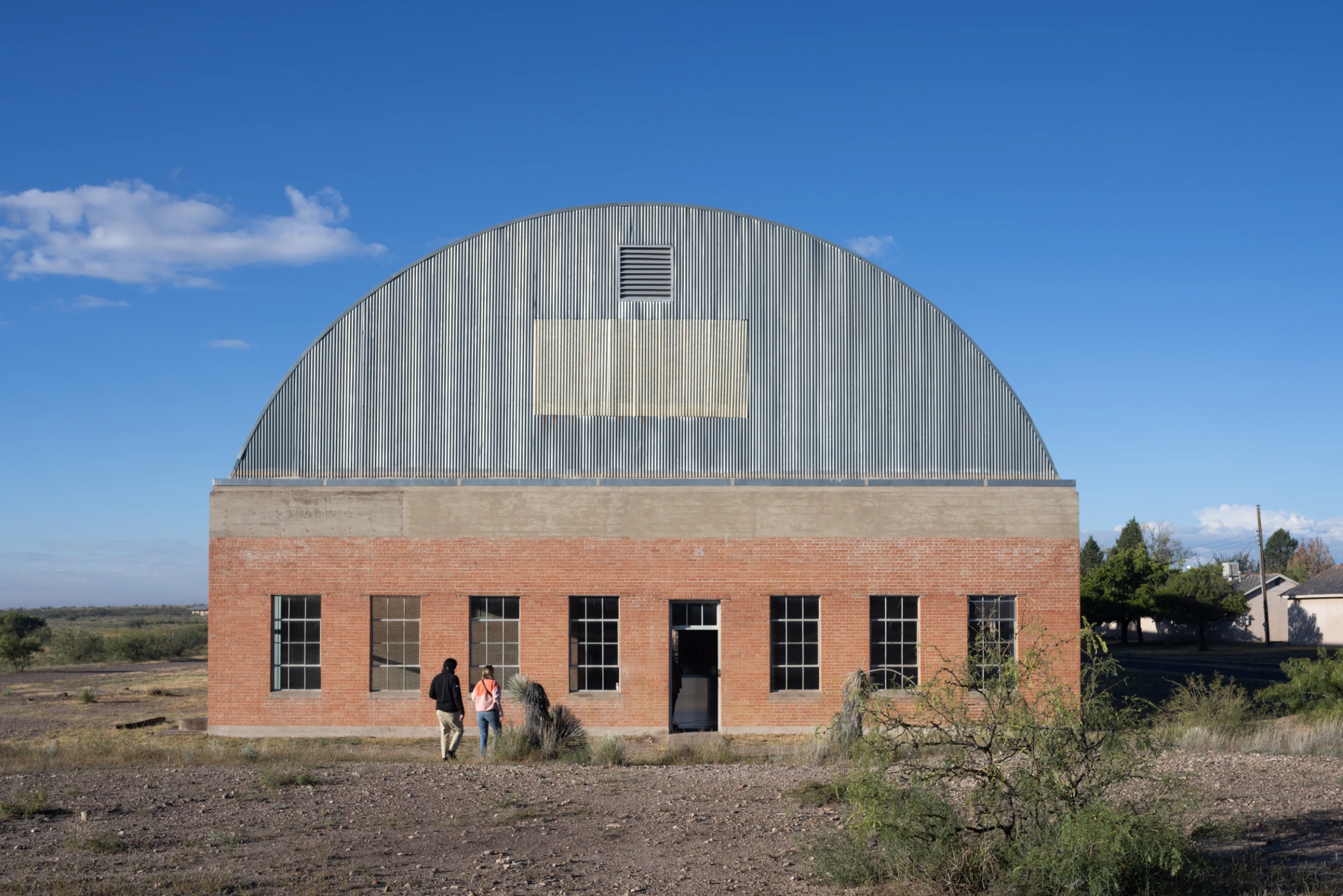
While not a single earthwork, Donald Judd's transformation of Marfa, Texas, into a permanent installation site represents one of the most significant land art projects in North America. The Chinati Foundation, founded by Judd in 1986, houses large-scale installations by Judd and other artists in former military buildings on the edge of town. The foundation's collection includes Judd's 15 untitled works in concrete, arranged across the desert landscape, and 100 untitled works in mill aluminum, housed in two converted artillery sheds that Judd transformed into ideal spaces for his work.
Marfa is the most accessible of the major land art destinations, with galleries, restaurants, and lodging options that have grown around the art infrastructure Judd created. The Chinati Foundation offers guided tours of the collection, including the popular full-day tour that covers the entire collection. Tours should be booked in advance, particularly during peak season from October to April. The Judd Foundation separately maintains Judd's living and working spaces in Marfa, including his library and studios, which offer a more intimate view of the artist's practice. Marfa's remote location in far west Texas, three hours from the nearest airport in El Paso, is part of its appeal, and the town has become a pilgrimage site for art lovers, filmmakers, and those drawn to the desert landscape.
James Turrell's Roden Crater (Arizona)
Turrell's Roden Crater, located outside Flagstaff, Arizona, is the most recent of the major land art sites to offer public access and the most ambitious work of optical art ever attempted. Turrell has spent decades transforming an extinct volcanic crater into a naked-eye observatory, with tunnels and chambers designed to frame celestial events. The project remains incomplete, but Turrell has begun offering limited visits through a reservation system with fees that start at $6,500 per person, making it the most expensive and exclusive of the major land art destinations. For those unable to visit, Turrell's installations at museums worldwide offer a sense of his work with light and space, though none approach the scale of Roden Crater. Information about visits is available through the Roden Crater website.
Planning Your Trip
Several practical considerations apply to visiting any of these sites. First, timing matters. The desert environments where most land art is located are punishing in summer, with temperatures regularly exceeding 100 degrees Fahrenheit. Spring and fall offer the most comfortable conditions, though spring can bring unpredictable weather and fall can see crowds at the more accessible sites. Winter visits are possible at Spiral Jetty and Marfa but require checking road conditions.
Second, reservations are essential for City and the Lightning Field, and recommended for Chinati Foundation tours. Book well in advance, particularly for City, where reservations sell out within hours of release. Spiral Jetty requires no reservation but benefits from checking water levels before driving out, as the jetty is occasionally submerged. Roden Crater visits require booking through the Skystone Foundation and should be arranged months ahead.
Third, prepare for the absence of services. All of these sites are remote, with limited or no cell service, no food or water available on site, and long distances between gas stations. A high-clearance vehicle is recommended for City and useful for Spiral Jetty. Bring more water than you think you need, a full tank of fuel, and a paper map as backup. Tell someone where you are going and when you expect to return, particularly for City and the Lightning Field, where cell service is completely unavailable.
Finally, embrace the journey. Land art was designed to be difficult to reach, and the experience of traveling to these sites is integral to the work itself. The hours spent driving through empty landscapes, the sudden appearance of the artwork on the horizon, and the silence of the desert are all part of what these artists intended. The reward is an encounter with art at a scale and intensity that no gallery or museum can provide, a reminder that some of the most extraordinary works of human creativity exist not behind museum walls but in the landscape itself.