How to Read Public-Art Mega-Event Commissions in 2026
Behind every World Cup art trail sits a real politics of funding, fabrication, visibility, and legacy that readers should learn to decode
Begin with the organizer, not the object
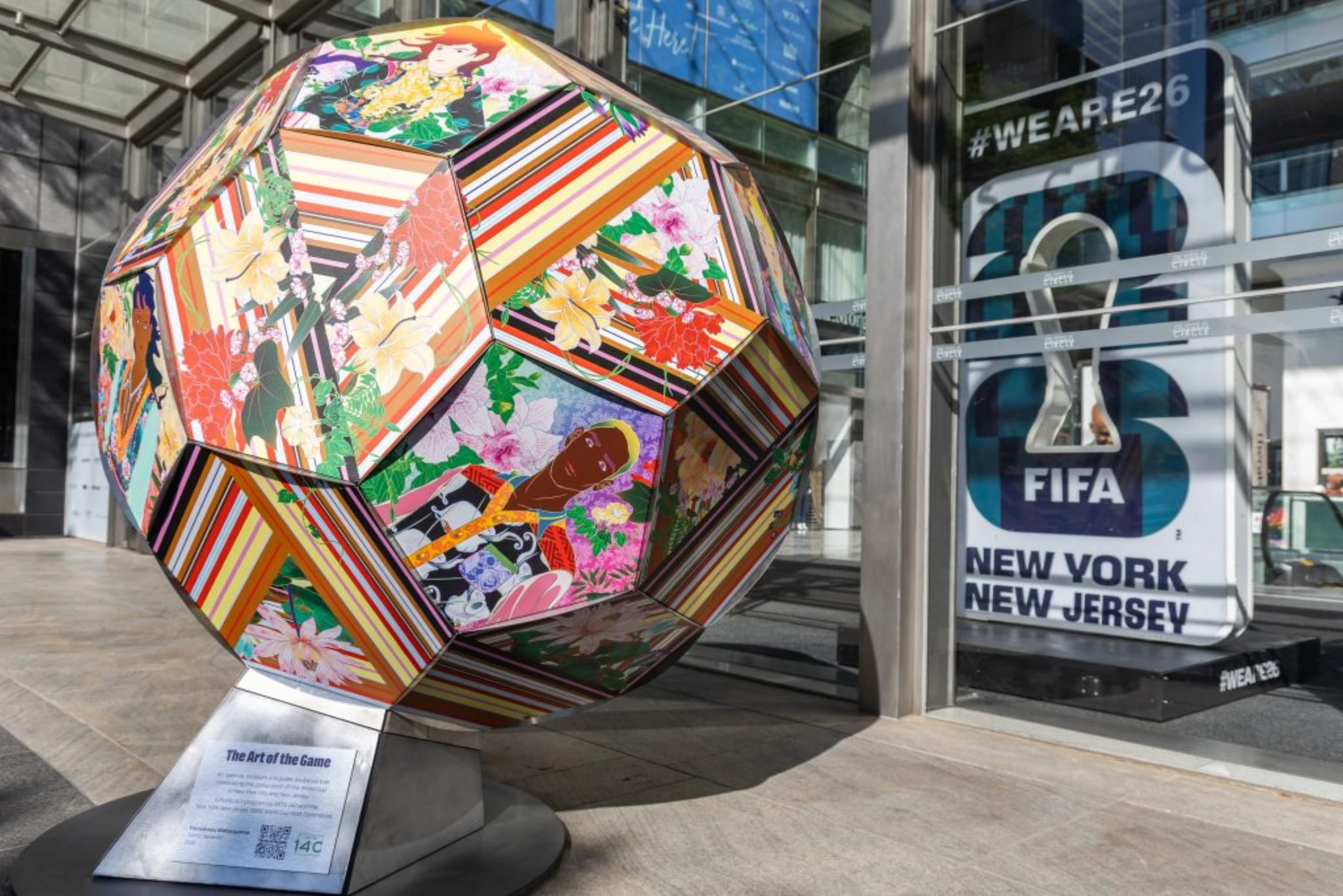
When a city unveils a public-art project tied to a World Cup, Olympics, biennial, or major civic anniversary, the easiest mistake is to judge the work only at the level of appearance. Is the sculpture fun? Is the mural photogenic? Does the installation make the district feel alive? Those questions matter, but they are the last layer, not the first. Start instead with the organizer. In the case of ARTnews’s report on The Art of the Game, the central actor is ARTS 14C, working with the NYNJ World Cup Host Committee and a board-level circle of museum and nonprofit figures. That tells you immediately that the project is not a decorative add-on. It is an organized cultural intervention built through logistics, permissions, donor relationships, and institutional power.
This matters because public art attached to mega-events is always overdetermined. It has to flatter the host city, satisfy partners, remain legible to visitors, and still leave enough room for artists to make something more than civic wallpaper. The organizer determines which of those goals wins when they come into conflict. A nonprofit with long-term local commitments may treat the event as a chance to build durable infrastructure. A tourism board may treat it as branding. A real-estate coalition may treat it as atmosphere for land value. Learn who is convening the project, and you will understand most of the politics before you have looked closely at a single artwork.
The project page for The Art of the Game lists advisers including Max Hollein, Thelma Golden, Anne Pasternak, Glenn Lowry, Lisa Phillips, Scott Rothkopf, and other cultural heavyweights. That roster should change how you read the sculptures. It signals a deliberate attempt to bring museum authority into a civic sports framework. Whether you like that or not, it is far more revealing than the size of the soccer balls.
Read the artist list as a theory of audience
The next step is to examine the roster. Which artists were invited, and what does that imply about the audience the organizers want? In this case the names range from Futura 2000 and Katherine Bernhardt to Hank Willis Thomas, Fred Wilson, Edgar Heap of Birds, Taína H. Cruz, Tomokazu Matsuyama, and Bony Ramirez. That is not a neutral spread. It mixes artists with broad popular recognizability, artists identified with public address, and artists whose work can carry questions of race, memory, nationalism, and symbolic display without collapsing under the weight of a giant sporting event.
A shallow commission uses artists as signature stickers on a predetermined format. A stronger commission asks whether the format can hold different meanings. A soccer ball is already overloaded with national aspiration, commercial sponsorship, childhood play, migration narratives, and television spectacle. The best participating artists will exploit that overload instead of smoothing it away. The weakest will deliver attractive surfaces that disappear into event branding. So when you assess a mega-event public-art project, do not ask only whether the names are impressive. Ask whether the names suggest friction. Friction is a good sign. It means the organizers were willing to risk meanings they could not fully script.
Audience theory matters here too. A project full of insider art references may satisfy curators while boring everyone else. A project calibrated only for easy public delight may become forgettable within a week. Strong civic commissions sit between those extremes. They let the general public in without insulting the public’s intelligence. That balance is rare, which is why the artist list deserves slow reading.
Follow the money and the fabrication chain
Public art becomes much clearer when you track who paid for it and who physically made it. ARTnews notes that the host committee covered costs and that the works were fabricated at Powerhouse Arts and assembled at Mana Contemporary. Those details are not secondary. They are the structure. Funding determines how much freedom an organizer has, what scale is possible, and whether the project can outlast the event. Fabrication tells you where local expertise actually resides.
Most mega-event art marketing encourages viewers to look upward toward celebrity names and away from the labor systems that make the work possible. That is a mistake. Technicians, installers, production managers, nonprofit staff, and fabricators are often the real continuity in a region’s public-art ecosystem. The tournament comes and goes. The labor base remains, if it is supported properly. Projects that strengthen that base deserve more credit than projects that merely create a week of attractive coverage.
Funding design also reveals intention. In The Art of the Game, several sculptures are slated for a Christie’s online sale with proceeds shared among artists, ARTS 14C, and Studio in a School. That arrangement shows the project is part philanthropic platform, part market mechanism, and part civic celebration. Those mixed motives are not a scandal. They are the norm. But naming them helps you evaluate whether the public benefit is real or just decorative language attached to a transaction.
Ask what kind of city the project imagines
Every mega-event art program contains a fantasy about the host city. Some imagine the city as a polished global destination with no rough edges. Others present it as a mosaic of neighborhoods and communities suddenly brought into dialogue. A few admit the city is divided and use art to stage that tension rather than erase it. To read a project well, ask what version of urban life it is trying to make visible.
The Art of the Game places sculptures across New York and New Jersey rather than confining them to stadium-adjacent spectacle. That matters because distributed placement implies a more regional imagination of culture. It suggests that public attention can be routed through plazas, parks, and streets that are usually treated as peripheral to official city branding. This is one reason the project stands out. It resists the lazy assumption that all meaningful cultural visibility must funnel through a single glamorous core.
There is already a useful local benchmark. Our earlier guide on how to read World Cup public art argued that these commissions are best understood as battles over who gets to narrate place during a global media event. The same principle applies here. Placement is politics. If a project sends art only to the most obvious tourist corridor, it is probably building image rather than public memory. If it distributes works into daily civic life, it may be doing something more generous.
Judge the legacy plan before you judge the press photos
The decisive question for any mega-event commission is simple: what remains when the event ends? Organizers often promise legacy because the word sounds responsible. But legacy has to be specified. Will works remain in place? Will schools, local nonprofits, or neighborhood groups continue using the project? Will revenue cycle back into future commissions, arts education, or maintenance? Or will everything vanish once the camera crews leave?
ARTnews reports that ARTS 14C hopes many of the sculptures will remain on view beyond Labor Day. That ambition is more important than the opening-week buzz. Temporary spectacle is cheap in conceptual terms, even when it is expensive to stage. Durable public value is harder. It requires maintenance plans, site agreements, insurance, local buy-in, and enough institutional discipline to resist treating the event as a one-off branding opportunity.
Legacy should also be measured qualitatively. Did the project widen who felt addressed by public art in the region? Did it give artists room to make work that was not flattened into pure boosterism? Did it strengthen local production networks? Did it create a precedent for future commissions that are less cynical and more publicly accountable? Those questions are harder than counting attendance, but they are the only ones that matter after the banners come down.
One more practical rule helps: notice whether the project invites genuine encounter or merely choreographs circulation. Some commissions are designed so that viewers can spend time with them, move around them, and argue about them. Others are optimized to be passed quickly, photographed instantly, and forgotten efficiently. The difference is not trivial. It reveals whether the organizers believe public space is for attention or just for traffic. Mega-events usually favor traffic. Serious public art tries, however briefly, to win back attention.
Use a practical checklist for the next civic-art spectacle
When the next public-art trail arrives wrapped around a mega-event, run a six-part checklist. Who organized it? Who funded it? Who fabricated it? Which artists were invited, and what kinds of meaning do they usually produce? Where are the works placed? What happens after the event ends? If a project has good answers to most of those questions, you are probably looking at a serious cultural intervention. If it dodges them, you are probably looking at branding with better typography.
This is not a cynical way to read public art. It is a respectful one. Mega-events put enormous pressure on culture to perform civic harmony on demand. Good projects resist that pressure by building structures that can hold complexity, labor, and long-term value inside the spectacle. The Art of the Game is interesting because it appears to understand that challenge rather than hide from it. Readers should learn to reward that kind of seriousness. Cities get the public art they are willing to read closely.