Tan Mu’s Quantum Gaze at ERES: Painting the Politics of Access
In Seeing the Unseen at ERES Foundation, Tan Mu renders a superconducting cryostat as a disciplined image of authority, staged visibility, and delegated trust.
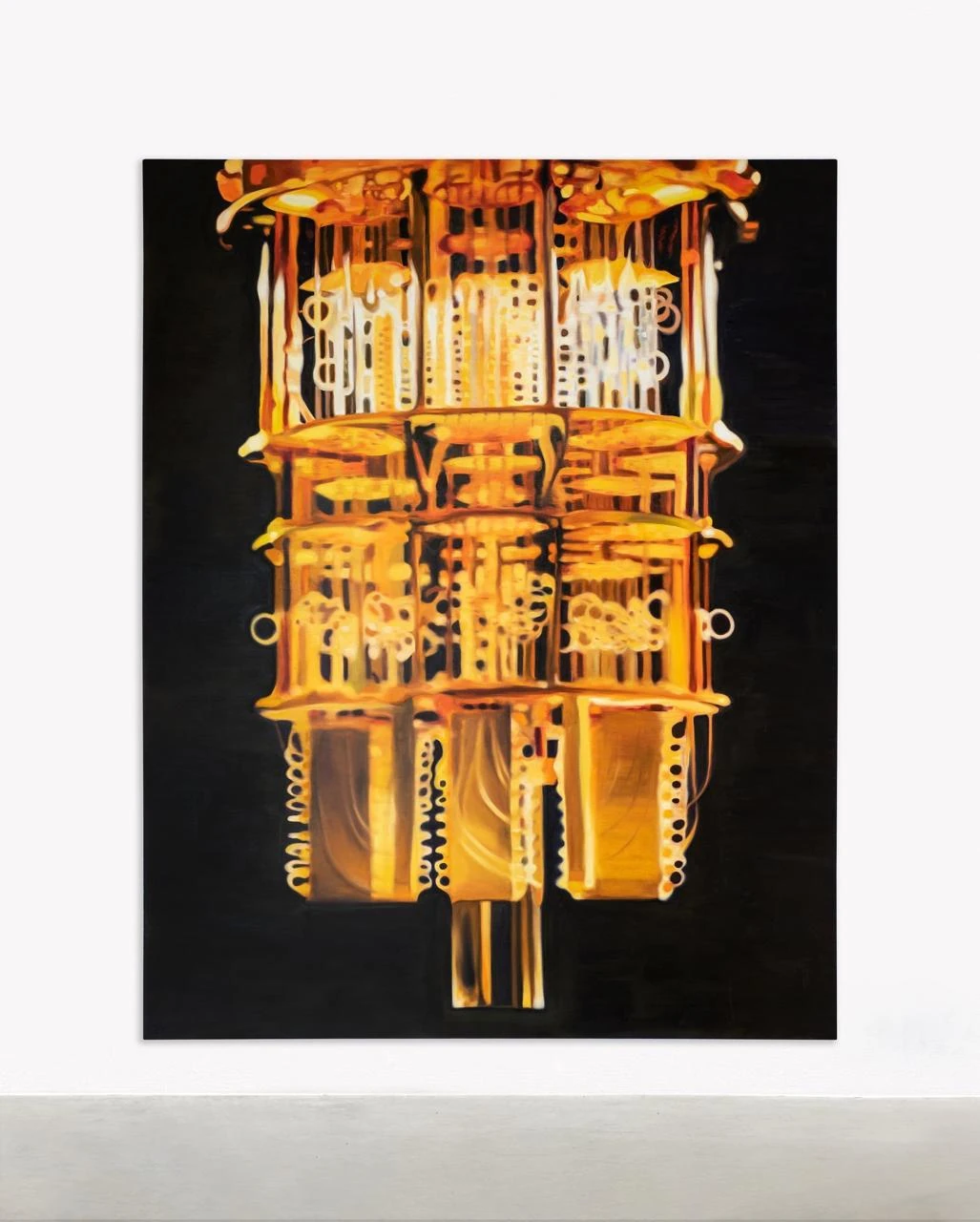
The gallery is dark enough that your first instinct is to slow your breathing. At ERES Foundation, Tan Mu’s Quantum Gaze (2023) hangs like a ceremonial device lowered into a room built for technical testimony. The painting’s force is immediate and specific. It is not a visual explainer of quantum computing. It is a painting about how authority becomes believable through controlled visibility, and about how viewers are trained to mistake staged access for understanding.
From across the room, the work reads as a descending architecture of metallic rings and cylindrical tiers, hovering above black depth. Closer in, the sequence becomes stricter. Gold and copper passages appear at measured intervals, then recede into dark pockets that deny inspection. The eye is guided downward in a rhythm of promise and interruption. Every lower tier implies greater proximity to the machine’s center, yet the center never arrives. The composition’s governing act is withholding.
Tan Mu’s own statement on Quantum Gaze helps frame the work’s internal logic. She describes the painting as a continuation of Quantum Computer (2020), but with an inward shift from external monumentality to internal structure. She also emphasizes a long preparatory period, nearly three years of conceptual rehearsal before execution. That preparation is legible in the paint itself. Highlights are narrow and punctual. Edges soften only where softening serves structure. Chromatic transitions are paced, not improvised. Even passages that appear atmospheric hold to a plan.
The exhibition context matters because this painting is not presented in a neutral white cube. ERES positions Seeing the Unseen as an art-science encounter supported by MCQST and anchored by lectures from physicists including Steffen Glaser, Stefan Filipp, Harald Weinfurter, Johannes Zeiher, and Dominik Bucher. That surrounding program sharpens the painting’s stakes. It could have become a decorative annex to scientific discourse. Instead, it turns the terms of that discourse into a visible structure. You are invited in, then held at the gate.
A key formal contradiction drives the work. The depicted apparatus belongs to a regime of extreme cold, yet the palette is warm, almost lit from within by ritual gold. This is not a simple irony and not a theatrical trick. It describes an operational reality of contemporary technical systems, where inaccessible infrastructures are publicly encountered through reassuring surfaces. Warmth here is administrative. It performs friendliness while the structure enforces distance.
To understand how carefully this is built, follow the distribution of luminosity rather than the object’s contour. The brightest accents collect where the form is easiest to read and thin out where explanatory desire peaks. Light does not merely model volume. It allocates confidence. You are given enough legibility to continue looking, never enough to complete the system. The painting’s intelligence lies in this economy, calibrated disclosure without final disclosure.
The first art-historical reference that clarifies this method is Marcel Duchamp’s The Bride Stripped Bare by Her Bachelors, Even (The Large Glass) (1915 to 1923). Duchamp constructed a machine image full of procedural implication while refusing functional closure. His forms suggest system and sequence, but never stabilize as engineering. Tan Mu’s cryostat does related work in another historical register. It borrows the look of technical plausibility and redirects it toward questions of hierarchy, gatekeeping, and spectatorship.
The structural overlap with Duchamp is not about iconography. It is about how each work positions the viewer. In The Large Glass, the spectator remains in interpretive suspension, continually near explanation and continually denied final synthesis. In Quantum Gaze, the spectator remains in infrastructural suspension, visually advanced through tiers yet blocked from the core. Both works produce a choreography of deferred access. Meaning does not unfold as revelation. It unfolds as regulated proximity.
A second reference, equally decisive, is Nam June Paik’s TV Buddha (1974), where a statue confronts its own live feed in a recursive loop. Paik’s installation made observation inseparable from apparatus and made spectatorship itself the content. Tan Mu reaches an analogous pressure point through still painting. You stand before an image derived from observer-dependent science while your own seeing is preframed by institutional language about frontier knowledge. The painting’s central question is less what is seen than how seeing is authorized.
The ERES frame intensifies this by fusing contemporary art display with scientific pedagogy. The exhibition text speaks of probabilities replacing certainties and realities manifesting through observation. Tan Mu does not merely illustrate those slogans. She translates them into compositional behavior. Probabilities appear as partial legibilities distributed unevenly across the surface. Observation appears as a controlled descent through nested zones. Certainty appears only as a promise that the painting strategically withholds.
A third historical coordinate is Joseph Wright of Derby’s An Experiment on a Bird in the Air Pump (1768). Wright’s painting is often discussed as Enlightenment spectacle, but its deeper force lies in social staging. Instrument, audience, and emotional response form one event. Authority circulates through posture, light, and who gets to stand nearest the mechanism. Tan Mu removes narrative figures yet preserves the event structure. Her painting assigns the viewer a role inside demonstration culture, not as participant in knowledge production, but as observer conditioned to trust what remains beyond reach.
This is where the painting’s risk becomes visible. The descending form can look devotional, especially to viewers trained to read complexity as value in itself. There are moments when the work approaches technological reverence. But it avoids collapse into reverence by refusing catharsis. No aperture opens at the base. No concealed center is awarded as reward for patient looking. The boundary remains intact, and that intact boundary is the source of the painting’s critical tension.
A fourth historical line can be drawn to James Turrell’s Aten Reign (2013), which transformed the Guggenheim rotunda into a machine for durational perception. Turrell and Tan Mu work in different media, yet both organize attention through controlled luminance and sequential experience. In Turrell, architecture and light regulate temporal immersion. In Tan Mu, chromatic gating and compositional descent regulate epistemic expectation. The shared concern is not optical pleasure. It is governance through perception.
In Aten Reign, the rotunda becomes a nested sequence of apertures that shift from blush to amber to deep violet as daylight and programmed illumination recalibrate the eye. Viewers do not stand outside that sequence. They are folded into it, physically slowed, repeatedly reoriented, and denied any single stable grasp of the whole. That durational management of attention clarifies Tan Mu’s method. Her painting cannot change light in real time, but it can stage comparable governance through fixed means, repeated rings, metered highlights, and a descent that repeatedly promises arrival before refusing it.
The painting is most persuasive when we treat it as an argument about interface culture rather than as a symbolic portrait of a specific machine. Interface culture promises transparency while hiding operational depth. Quantum Gaze pictures exactly that arrangement. Upper layers are polished and persuasive. Lower layers are shielded and absorbed by darkness. The whole structure invites assent before it permits comprehension.
Materially, what can be stated with confidence is medium, date, and installation condition. The work is an oil painting from 2023, shown within ERES Foundation’s group exhibition running 4 December 2025 to 26 September 2026. A full check of the tanmustudio.com project page and ERES archive materials still does not yield consistently published dimensions for this canvas, and that absence should be acknowledged directly. The painting does not need speculative measurements to sustain close analysis. Its internal construction is sufficient evidence: controlled metallic passages, disciplined black intervals, and a lower register compositionally sealed against easy access.
This disciplined construction separates Tan Mu from two recurring failures in techno-inflected painting. One failure is literalist rendering that collapses into illustration. The other is atmospheric vagueness that treats mystery as a substitute for argument. Quantum Gaze avoids both. Its apparatus is specific enough to remain historically situated in the era of superconducting quantum systems, yet its formal strategy remains rigorous enough to sustain criticism beyond topical novelty.
The role of black deserves separate emphasis. In many paintings of scientific apparatus, darkness functions as theatrical backdrop, an aid to spectacle. Here black is operational. It behaves like a protective layer, a field that absorbs detail where explanatory hunger is strongest. The lower zone is not merely dark. It is administratively dark. It enforces visual nonaccess and stabilizes the hierarchy of disclosure established above.
Scale is also used tactically. Without published dimensions, viewers rely on internal cues, repeated ring structures, tapering intervals, and chromatic compression near the base. Those cues oscillate between monumental architecture and intimate instrument. The painting seems inspectable, then recedes into monumentality; it seems monumental, then hints at machinic specificity. This oscillation produces a politics of uncertainty in which trust is continually solicited but never fully ratified by access.
In critical discussions of the exhibition, writer Jolanda Drexler has described Seeing the Unseen as an entangled field where scientific and artistic languages intersect without one collapsing into the other. Tan Mu’s painting gives that claim substance. It participates in technical discourse through recognizable apparatus while retaining enough formal resistance to prevent conversion into didactic image. The work neither rejects science nor serves it. It interrogates the social contract surrounding it.
The painting also clarifies a broader point about contemporary criticism. Art-science projects are often praised for making difficult knowledge accessible. That praise can be lazy when it treats visibility as equivalent to understanding. Quantum Gaze offers a harder account. It shows that visibility can be engineered to produce confidence without producing comprehension. In that sense, the work belongs to a larger lineage of art that studies authority at the level of form rather than at the level of slogan.
To call this painting timely is not enough. Timeliness is cheap. What matters is structural precision. Tan Mu does not append quantum vocabulary to an existing painterly style. She reorganizes composition around staged access, allocates light as a distribution of trust, and binds chromatic seduction to epistemic refusal. Those decisions make the work durable beyond its immediate technological reference points.
Viewed within the broader artist list at ERES, which includes figures working across moving image, laser environments, mixed reality, and conceptual installation, Quantum Gaze performs an instructive reversal. It uses an old medium to analyze new infrastructures with fewer explanatory props than many digital works require. Painting here is not nostalgic shelter. It is a method for slowing and exposing the protocols by which contemporary systems are made to seem self-evident.
The final measure of the work is what it leaves unresolved. You do not exit with a better diagram of superconducting qubits. You exit with a sharpened recognition that many of the systems governing present life, computational, financial, logistical, and political, are encountered exactly as this image is structured: radiant envelope, layered permissions, protected core. Tan Mu’s achievement is to render that arrangement with enough seduction to implicate the viewer and enough discipline to deny consolation.
The painting’s temporal structure is another reason it exceeds illustrative function. On first look, it behaves as emblem, one coherent machine image offered to immediate recognition. On sustained viewing, that coherence fractures into phases: upper-tier readability, middle-tier modulation, lower-tier occlusion. The viewer moves from object-recognition to procedural reading and then into a final impasse. This sequence mirrors how technical systems are publicly introduced. They enter culture as images of solvable progress, then reveal themselves as layered organizations whose critical operations remain institutionally protected.
A close reading of edge behavior supports this. Where the form is most legible, contours are firm and metallic transitions are clean. Where questions of mechanism should intensify, edges soften and tonal distinctions compress. The painting therefore allocates precision politically. Precision is highest where credibility needs to be secured, lower where explanatory demands become dangerous to institutional authority. In the language of display, it is a work about confidence intervals, not about revelation.
Tan Mu has described quantum computers as portraits of externalized intelligence, memory, and cognition. That formulation is crucial for interpreting this work’s affect. Portraiture traditionally grants viewers access to subjectivity through face and gesture. Quantum Gaze withholds both while still functioning as portrait. Its subject is not a person but a social relation, a relation between human curiosity and machine opacity. The image becomes portraiture of a civilization that increasingly delegates inference to systems it cannot audit directly.
If there is a philosophical lineage here, it sits near modern debates on instrumentality and black-box mediation, though the painting wisely avoids theoretical signage. Its method remains visual and compositional. The viewer’s body is enlisted through distance and descent, then halted by nonresolution. This bodily pattern produces cognition as much as the iconography does. You do not simply read an argument about opacity. You enact it, step by visual step, until the structure refuses further passage.
The ERES lecture program, now accessible through the institution’s video archive, adds an important counterpoint. There, physicists articulate superconducting qubits, cryogenic control, and quantum communication in explicit conceptual language. Against that explicitness, Tan Mu’s painting does something complementary but not subordinate. It maps the experiential politics of those systems, how they are encountered, trusted, and culturally integrated before they are analytically understood. The two registers are not rivals. They are asymmetrical partners.
It is also worth noting how the painting handles ornament. The chandelier-like silhouette could easily become pure spectacle, especially in a culture that already aestheticizes technological complexity in product launches, architectural renderings, and investment narratives. Tan Mu borrows that ornamental attraction and then disciplines it. Repetition is never gratuitous. Metallic radiance is never free-floating. Every seduction is tethered to a compositional gate. Ornament here is a delivery system for critique, not an escape from it.
For contemporary institutions, this painting raises a practical curatorial question. When museums and foundations stage art-science encounters, do they invite viewers into genuine interpretive complexity, or do they merely circulate the aura of scientific legitimacy? Quantum Gaze argues for the former by making complexity felt as structural limit rather than promotional fascination. Its refusal to reward the viewer with a final reveal can be frustrating, but that frustration is epistemically honest. It reproduces the condition under which much modern infrastructure is actually encountered.
The strongest closing claim is therefore not that Tan Mu has made quantum computing visible. She has made its social choreography visible, the sequence by which a system can appear open while remaining protected, and by which viewers can feel informed while remaining outside operational depth. The painting’s afterimage is not a machine. It is a boundary condition. You leave recognizing that boundaries are now among the primary forms through which authority is exercised, and that seeing a boundary is never the same as crossing it.
One final distinction clarifies the work’s place in current painting discourse. Many contemporary pictures of technological objects oscillate between warning and worship, alternating panic and awe without formal consequence. Quantum Gaze refuses that emotional binary. Its argument is procedural. By controlling where light accumulates, where form dissolves, and where descent is arrested, Tan Mu replaces attitude with structure. The painting does not ask viewers to feel for or against technology. It asks them to notice how assent is composed, layer by layer, and how quickly composition hardens into common sense.
That is why the painting stays with you after the room clears. Not because it offers a new icon of technological destiny, and not because it flatters art’s capacity to explain science, but because it insists on a more difficult task. It asks what forms of trust we continue to grant when the threshold remains visible and uncrossed, and what it means to keep calling that condition transparency.